
Phone calls strip away everything except your voice. No facial expressions. No reassuring nod. Tone, word choice, and how well you listen carry the entire weight of your professionalism on every call.
Despite the rise of chat, email, and self-service portals, phone still ranks as the top channel customers reach for when they need technical help. When consumers were asked how they'd prefer to get support for a computer problem, 28% chose talking to someone by phone, ahead of every other channel measured, according to Qualtrics XM Institute's 2024 global consumer study.
That preference puts real weight on how your team answers, listens, and closes every call. This guide breaks down the core principles behind great telephone etiquette, walks through real call examples stage by stage, and covers how to build training that actually sticks.
Key Takeaways
- Great telephone etiquette blends technical competence with genuine warmth, especially for frustrated callers.
- The Competence, Compassion, Empathy, Listening, and Respect framework keeps call quality consistent for every rep.
- Lasting skill comes from scripts, role-play, and ongoing call reviews, not a one-time seminar.
- 28% of consumers prefer live phone support over chat, self-service, or email for tech issues (Qualtrics XM Institute, 2024).
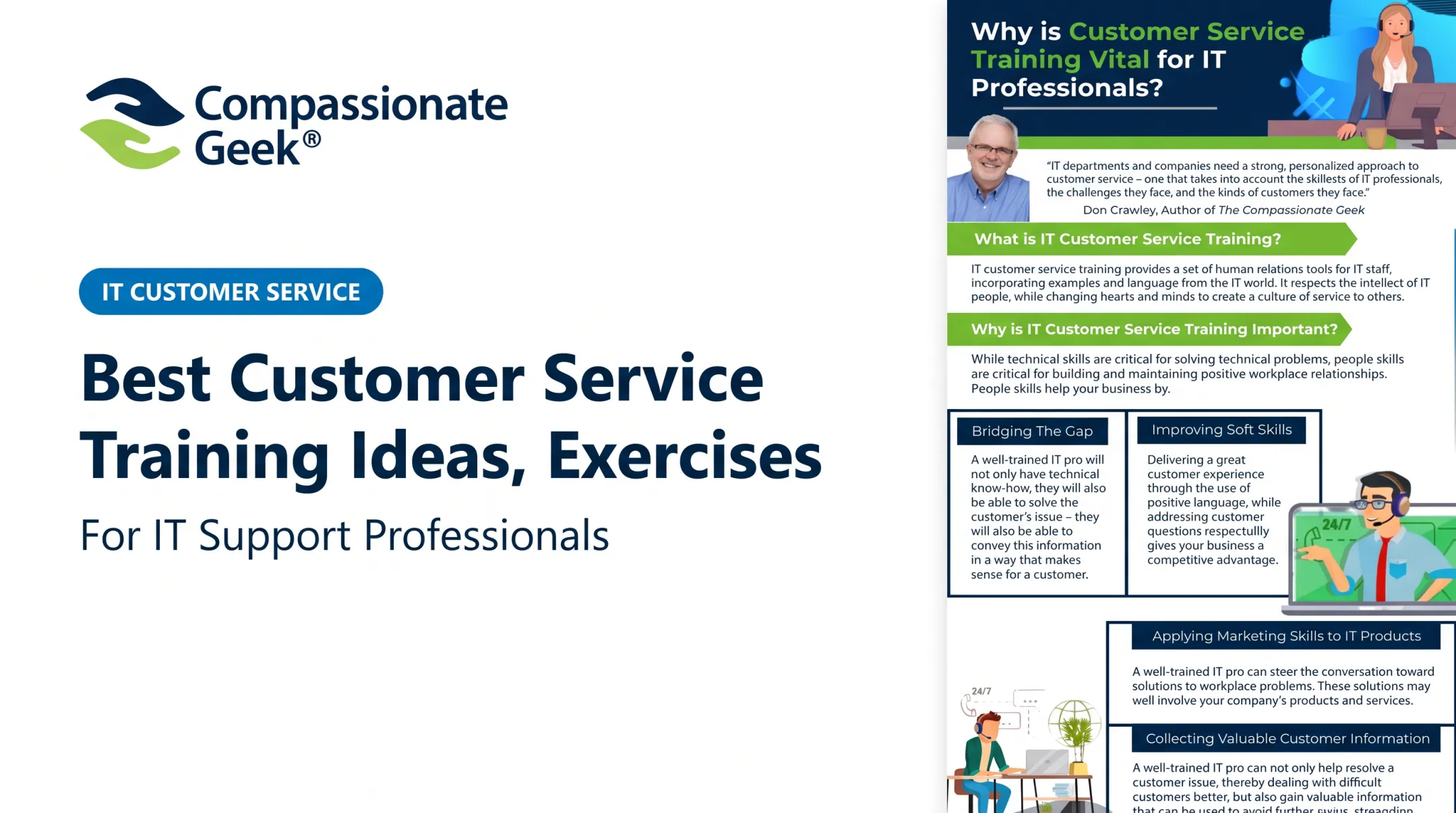
The 5 Core Principles Behind Great Telephone Etiquette
Telephone etiquette combines technical skill with interpersonal skill, because the real job behind every support call is solving a human problem. Compassionate Geek's philosophy centers on crafting creative technical solutions to perplexing human problems, and that mindset shapes five principles that show up in every well-handled call.
Competence
Nothing erodes caller confidence faster than an agent who sounds unprepared. Before you pick up the phone, know your system access, pull up account history, and have a rough explanation ready. Callers can sense hesitation in a fumbled search. Ask deeper questions before jumping to a fix, and test the solution before ending the call so you're not calling back five minutes later.
Compassion
Compassion means caring about what's happening to the person on the other end of the line. Saying "I'm going to stay with this until it's fixed" signals ownership in a way that "I've logged your issue" never will. Compassionate Geek's training calls this shift moving from a transactional exchange to a relational one, where the caller feels understood.
Empathy
Empathy means putting yourself in the caller's place before offering a solution. Someone locked out of their files an hour before a deadline doesn't want to hear about root causes first. Try something like, "I understand how stressful it is being locked out right before a deadline, let's get this fixed." Acknowledge the urgency before you explain the fix.
Listening
Active listening means not interrupting, not multitasking, and summarizing the issue back to the caller before acting. Divided attention carries a real, measurable cost: a 2015 study on divided attention found comprehension accuracy dropped from 97.6% under focused listening to 90.2% when split between two tasks, a statistically significant decline.
Put it into practice:
- Take notes during the call
- Ask questions instead of making statements
- Confirm you understood before touching a single setting
Respect
Respect means honoring the caller's time, their title, and their technical knowledge level, whatever it is. A network engineer and a first-time computer user need very different explanations for the exact same problem. Skip jargon with one and skip condescension with the other. Adjust your language to fit their level while keeping your patience steady for everyone.
Real-World Examples of Good Telephone Etiquette by Call Stage
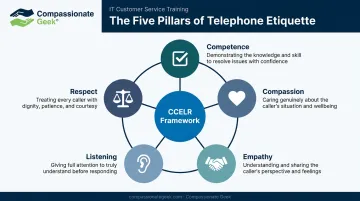
Principles only matter once they show up in the actual words agents use. Here's what good etiquette sounds like at each stage of a support call.
Answering and Greeting the Call
A strong greeting follows a simple structure: positive opening, department name, your name, and an offer to help. For example: "Good morning, IT Help Desk, this is Sarah, how can I help you today?" Answering within two or three rings matters more than people realize. A long wait before the first word already signals disorganization.
Here's something worth trying: smile before you pick up. Research on vocal acoustics found that smiling measurably changes a speaker's pitch and formant frequencies, and listeners could reliably detect a smiling voice from audio alone, without ever seeing a face. Your caller can hear whether you're glad to help.
Active Listening and Managing Hold Time
Hold time handled badly turns a minor issue into a complaint. Good hold etiquette includes:
- Asking permission first: "Can I put you on hold for two minutes while I check that?"
- Checking back at regular intervals, even just to say you're still working on it
- Thanking the caller for their patience the moment you return
Before taking action, paraphrase the issue back: "So your VPN connects but drops every ten minutes once you open email, is that right?" That single sentence confirms understanding and shows the caller they were actually heard.
Handling Difficult or Frustrated Callers
A frustrated caller needs three things, in order: acknowledgment, ownership, and a next step. Try: "I can hear how frustrating this has been, especially with a deadline today. This is on me to fix, and here's what I'm doing right now."
A flat, scripted "I'm sorry" tends to fall flat with frustrated callers. Attentive, specific responses land far better. Match your response to what the caller actually needs, not a canned line.
Closing the Call Professionally
End every call by summarizing the resolution, thanking the caller, and offering a follow-up path: "To confirm, we reset your password and reinstalled the VPN client, so you should be back up and running. If anything else comes up, call this number and reference ticket 4521."
Let the caller hang up first. It's a small habit, but it signals you weren't rushing them off the line.
Common Telephone Etiquette Mistakes That Damage Customer Trust
Even well-meaning agents fall into habits that damage caller trust:
- Visible distraction. Typing loudly on an unrelated task, eating, or carrying on a side conversation while a caller is talking signals disengagement. Callers can hear it, and once they sense they're competing for attention, they stop trusting the answer they get.
- Speaking too fast or leaning on jargon. IT support callers are often non-technical and already anxious about a problem they don't understand. Terms like "DNS propagation" mean nothing to most users, so slow down, explain in plain terms, and offer technical depth only if they ask for it.
- No clear next step. Ending a call without a summary or follow-up plan leaves the caller uncertain whether the issue is fixed. That uncertainty often triggers a repeat call, which costs more time than a clear close would have taken.
All three mistakes share a root cause: they put the agent's convenience ahead of the caller's understanding.
Building a Structured Telephone Etiquette Training Program for Your Team
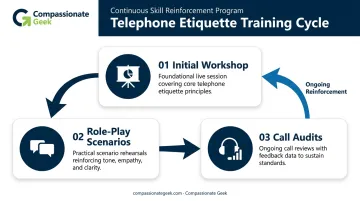
A single seminar won't build lasting habits. Real proficiency comes from an ongoing cycle: an initial workshop, role-play practice, and regular call recording reviews that reinforce what was taught.
Structure the program in three phases:
- Initial workshop - Introduce the five-principle framework and walk through call examples for each stage.
- Role-play scenarios - Practice greetings, hold-time conversations, and de-escalation scripts in low-stakes settings before agents face them live.
- Call audits - Score recorded calls against the same five-principle framework so feedback ties directly back to what was taught.
Specialized, IT-focused training adds a layer most generic customer service courses miss. Compassionate Geek's on-demand course, Customer Service Secrets of Successful IT Professionals, pairs phone etiquette with emotional intelligence and communication skills built for technical teams.
It's delivered globally through an on-demand portal and virtual live-video sessions in English, French, and Spanish, so distributed IT teams and MSPs can train consistently regardless of location. Organizations that want to formalize this commitment can pursue the Compassionate Geek Certified Company program, built around the same five principles.
Training shouldn't stop after the first course, though. Build a coaching feedback loop:
- Score a sample of calls monthly
- Share specific feedback with agents
- Schedule refresher training every six to twelve months
Tools and ticketing systems change, new hires join, and skills erode without reinforcement.
Frequently Asked Questions
What are some examples of good telephone etiquette?
Good telephone etiquette includes greeting callers with your name and company, listening without interrupting, using the caller's name, and asking permission before placing someone on hold. It also means staying calm with upset callers and closing with thanks and a clear next step.
How long should telephone etiquette training take for a new employee?
Initial training can run anywhere from a few hours to a full day, depending on curriculum depth. Real proficiency builds through ongoing coaching and call reviews over the following weeks, not from a single session.
What's the difference between general customer service skills and telephone etiquette specifically?
Telephone etiquette focuses on tone, pacing, and verbal cues, since phone calls remove the body language and facial expressions used in face-to-face service. General customer service skills cover a broader set of behaviors across every channel.
Why is telephone etiquette especially important for IT support teams?
IT callers are often already frustrated by a technical problem before they even dial. Patience, clarity, and empathy become essential to a positive outcome, because a caller who feels rushed will remember that more than the fix itself.
What are the most common telephone etiquette mistakes to avoid?
The top mistakes are visible distraction like multitasking or side conversations, overwhelming callers with unexplained jargon, and ending calls without a clear next step. All three erode caller confidence and increase repeat calls.
How can companies measure the success of their telephone etiquette training?
Track call monitoring scores against your framework, customer satisfaction ratings, and repeat-call or escalation rates over time. A drop in repeat contacts is often the clearest sign training is translating into better calls.