Introduction
A customer calls in, voice already sharp, before you've even said your name. Maybe their internet's been down for the third time this month, or the "quick fix" from yesterday's ticket didn't hold. The next 60 seconds decide everything.
Here's the thing most support reps get wrong: they think the anger is about them. It rarely is.
Most irate customers are angry at the situation, not the person on the phone. Once you internalize that distinction, de-escalation shifts from a defensive skill into a chance to build loyalty.
This guide covers:
- Why customers get angry in the first place
- A five-principle framework built on Compassionate Geek's Competence-Compassion-Empathy-Listening-Respect model
- A practical, step-by-step script you can use on your next call
- The specific phrases that make things worse
Key Takeaways
- Most anger targets the problem, not the person answering the phone
- A five-step script (Acknowledge, Apologize, Ask, Act, Aftercare) creates a repeatable process
- Technical competence is itself a de-escalation tool, not just a fix
- Knowing when to escalate protects both the customer relationship and your team
Why Do Customers Become Irate? Common Triggers
Anger rarely comes out of nowhere; it builds from a handful of predictable frustrations:
- Unmet expectations: The fix didn't work, or took far longer than promised
- Repeated problems: The same issue resurfacing after it was supposedly "solved"
- Long wait times: Sitting on hold with no idea how much longer it will take
- Feeling ignored: Tickets that go quiet for days with no update
- Being bounced between departments: Explaining the same problem to a third person
Wait times matter more than most teams realize. A 2021 Qualtrics-ServiceNow survey of over 1,000 U.S. adults found 54% would hang up after just 5 to 10 minutes on hold. If your customer's already anxious about a technical problem they don't understand, that clock feels even longer.
Why IT Support Sees a Sharper Edge
Technical frustration carries an extra layer that retail or hospitality complaints don't. Many customers feel technologically helpless, and that helplessness often surfaces as anger when it's really embarrassment.
Research summarized in a 2022 review of consumer behavior found that more than a third of people avoid asking for tech help altogether, driven by shame and fear of looking incompetent. When they finally do call, that pent-up anxiety often surfaces as sharpness or hostility toward the rep.
That hostility carries real consequences beyond an uncomfortable call. PwC's global consumer survey found 32% of customers would abandon a brand they loved after just one bad experience. One rough call can undo months of goodwill.
The 5-Principle Framework for Handling Irate Customers
Before any script or tactic works, you need the right mindset underneath it. Don R. Crawley, founder of Compassionate Geek, built his training around a simple idea: IT work isn't about technology. It's about solving human problems that happen to involve technology.
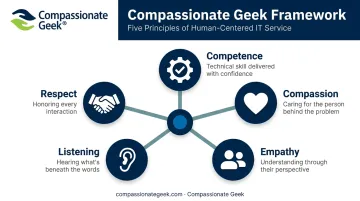
That philosophy produced five core principles that form the foundation of Compassionate Geek's IT customer service training: Competence, Compassion, Empathy, Listening, and Respect.
Competence
Technical skill isn't separate from customer service. It's the floor it stands on. No amount of warmth compensates for a rep who clearly doesn't know what they're doing.
When you sound confident and prepared, customer anxiety drops immediately. A shaky, uncertain technician makes an already-stressed customer feel worse, because now they're worried the problem won't get fixed at all. Competence isn't just about solving the ticket. It's about projecting that you can.
Compassion
Compassion means choosing to care about someone's situation, even when it's inconvenient, even when they're being difficult. It's a deliberate choice you make consciously, regardless of how you feel in the moment.
That choice changes your tone and word selection in real time. Instead of "that's a user error," you might say, "let's figure out what happened together." Same information, completely different emotional impact.
Empathy
Empathy and sympathy get confused constantly, but they're not the same thing. Sympathy feels sorry for someone. Empathy imagines what they're experiencing with them, without needing to have lived through the exact same thing yourself.
Compare these two responses to a customer whose data didn't save after a crash:
- Dismissive: "That happens sometimes. Let's just move on and try again."
- Genuinely empathetic: "Losing three hours of work like that is genuinely frustrating. Let's see what we can recover, and I'll walk you through backing this up going forward."
The second version names the specific pain and offers a path forward. That's empathy doing actual work.
Listening
Most irate customers want one thing before anything else: to feel heard. Not fixed. Heard.
Active listening looks like:
- Letting them finish completely before responding, even if you already know the answer
- Using short verbal acknowledgments ("I see," "got it") without cutting them off
- Paraphrasing back what you heard so they know it landed
Interrupting, even with good intentions, tells the customer you've already stopped listening. That's often what escalates a frustrated call into a genuinely hostile one.
Respect
Respect means treating the customer's time, intelligence, and feelings seriously, even when they're not returning the favor. You don't have to feel respect for someone acting badly to act with respect anyway.
That distinction matters because matching hostility with hostility never de-escalates anything. Staying professional when someone's yelling isn't weakness. It's usually the fastest route out of the yelling.
A Step-by-Step Script for De-escalating the Conversation
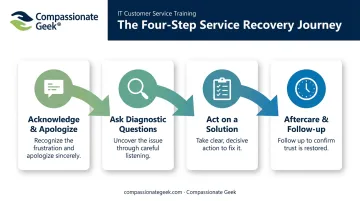
Here's a practical four-step sequence you can run through in real time, no matter how the call opens.
Acknowledge & Apologize — Address the emotion before anything else. "I'm sorry you're dealing with this, and I can hear how frustrating it's been" costs you nothing and buys immediate goodwill. Blame can wait; acknowledgment can't.
Ask Diagnostic Questions — Specific, caring questions do two jobs at once: they calm the customer down and gather the facts you need. "When did you first notice the connection dropping?" feels very different from a rapid-fire interrogation.
Act on a Solution — Vague promises ("I'll look into it") make things worse. Give a clear next step and a real timeframe: "I'm resetting your account access now, it'll take about five minutes, and I'll stay on the line while it processes."
Aftercare / Follow-up — Checking back after the fix, even a quick email the next day, rebuilds trust fast. This step is where angry customers actually turn into loyal ones.
Putting It Together
Rep: "Hi, this is Jordan from IT support. I understand you're having trouble accessing your files again, and I'm sorry, that's the third time this month. Let's get this sorted."
Customer: "This is ridiculous, I have a deadline in an hour."
Rep: "That's a real problem, and I want to get you moving fast. Can you tell me exactly what error message you're seeing right now?"
Customer: "It just says 'access denied.'"
Rep: "Got it. I'm resetting your permissions now, it'll take about three minutes. I'll stay on the line to confirm it worked before you go."
(Later, follow-up email:) "Wanted to check in and confirm everything's still working smoothly after this morning. Let me know if anything else comes up."
Mistakes That Make Angry Customers Angrier
Some responses feel natural in the moment but reliably backfire.
- Making excuses. Blaming the system, a coworker, or "policy" tells the customer, whether you mean it or not, I'm not going to help you. Move straight to options instead.
- Arguing or getting defensive. Trying to "win" the conversation guarantees you lose the relationship. The goal is resolution, not being right.
- Saying "I understand" and stopping there. According to HBR research on apology psychology, visible action matters more to satisfaction than words alone. Pair empathy with a concrete next step, or it reads hollow.
Staying Calm and Protecting Your Own Wellbeing
Handling irate customers all day takes a toll. Protecting your own composure matters as much as resolving the customer's issue.
In the moment:
- Take one deep breath before responding, even if it feels awkward
- Pause a beat rather than reacting instantly
- Build a short debrief habit: even two minutes of reflection helps you spot patterns and prevents burnout
Organizations that invest in structured soft-skills training, such as Compassionate Geek's IT customer service courses, build teams with stronger resilience because reps have already practiced these responses before a real call tests them.
Knowing When to Escalate or End the Interaction
There's a real difference between a frustrated-but-reasonable customer and one who's crossed into abuse, and knowing which one you're dealing with matters.
Loop in a supervisor when:
- The customer becomes verbally abusive or uses threatening language
- Demands are genuinely unreasonable or outside your authority to resolve
- You've hit a real impasse with no path forward on your own
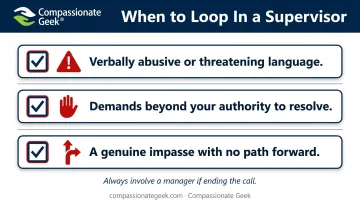
Ending an interaction entirely is a last resort. When it happens, it should always involve a manager, both for documentation and to make sure the customer isn't left without a path to resolution.
Frequently Asked Questions
How do you handle angry and rude customers?
Stay calm, acknowledge their feelings before defending yourself, and focus on solving the actual problem rather than reacting to their tone. Most anger fades once someone feels heard and sees action.
How do you calm a customer down?
Listen actively without interrupting, offer a sincere apology, then give them a clear next step. Uncertainty fuels anxiety, so a specific timeline does more than reassurance alone.
How do you deal with rude customers over the phone as an IT support technician?
Stay polite, avoid taking comments personally, and don't try to argue back. If the behavior escalates beyond ordinary rudeness, escalate the call to a supervisor rather than handling it solo.
What should you never say to an angry customer?
Avoid "calm down," "that's not my problem," or anything that shifts blame to policy or another department. These phrases signal you're not going to help, which only escalates things further.
When is it okay to end a call with an irate customer?
Ending a call is reserved for abuse, threats, or harassment, not ordinary frustration. It should always involve a manager for documentation and follow-up support.
How can IT support teams specifically prepare for irate customers?
Structured soft-skills training, like Compassionate Geek's IT customer service programs, gives technical staff the compassion and communication tools that technical training alone doesn't cover. Preparation beats improvisation every time.