
That's not a technical failure. It's a listening failure.
Don Crawley, founder of Compassionate Geek, built his entire training philosophy around one idea: IT work isn't really about technology. It's about solving human problems that happen to involve technology. Active listening is what separates a technician who closes tickets from one who actually helps people.
This article covers what active listening really means, why it matters specifically in IT and tech support, the strategies that make it work, and how to overcome the barriers that get in the way.
Key Takeaways
- Active listening combines full attention, visible acknowledgment, and a thoughtful response
- In IT support, it cuts repeat tickets and de-escalates frustrated, non-technical users
- Techniques like paraphrasing and open-ended questions are learnable skills, not personality traits
- Compassionate Geek ranks Listening among its five core service principles
What Is Active Listening in Customer Service?
Active listening is a two-way, intentional process. It means giving full concentration to what someone says, understanding their meaning, responding appropriately, and actually remembering the details afterward. It's the difference between a technician who's already typing a solution while the user is still talking and one who's fully present for the conversation.
Researchers Zenger and Folkman studied nearly 3,500 people rated as effective listeners and found something interesting: the best listeners don't just stay quiet. They ask useful questions, make the conversation feel safe, and offer feedback that moves things forward. Listening, in other words, is active — not passive.
Active listening differs from two related concepts:
| Mode | What it means | What it lacks alone |
|---|---|---|
| Passive listening (hearing) | Words register, but there's no verification or processing | No clarification, no paraphrasing, no confirmed understanding |
| Empathic listening | Focuses on the speaker's feelings and perspective | May validate emotion without confirming the technical details |
| Active listening | Combines full attention with clarification and confirmation | Requires both cognitive effort and genuine presence |
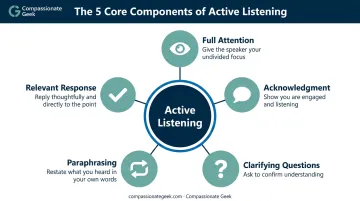
The core components break down like this:
- Full attention: no multitasking, no mental rehearsal of your reply
- Acknowledgment — a verbal cue like "I see" or a simple nod on video
- Clarifying questions ask rather than assume
- Paraphrasing: restating the issue to confirm you got it right
- A relevant response that directly addresses what was said, not what you assumed was said
Why Listening Is a Core IT Customer Service Principle
Compassionate Geek's training frames Listening as one of five interlocking principles: Competence, Compassion, Empathy, Listening, and Respect. Competence is the foundation — you need to know the technology. But without the other four, technical skill alone doesn't resolve much of anything for the human on the other end of the call.
Here's the unique risk in tech support versus, say, retail: IT professionals recognize patterns. A caller mentions "slow computer," and the technician's brain jumps to RAM, or malware, or a dozen other familiar culprits before the user finishes their sentence.
That pattern recognition is useful, until it causes the technician to stop listening for the detail that doesn't fit the pattern. Listening is the mechanism that turns compassion and empathy into something the user actually experiences.
Why Active Listening Is Important in Customer Service
The stakes here aren't abstract. Customers notice when they're not being heard, and it changes how they feel about your organization.
Salesforce's global survey of over 15,000 consumers and business buyers found that 68% of customers expect brands to demonstrate empathy, but only 37% said companies generally deliver it. That gap is exactly where active listening lives — it's the observable behavior that closes it.
Personalization tells a similar story. Deloitte Digital's 2024 research found that personalization leaders were 71% more likely to report improved customer loyalty than their peers. Interestingly, brands believed they personalized 61% of experiences, while customers only recognized 43% as personalized. Feeling understood matters more than intending to be understood.
In IT support specifically, poor listening has direct operational consequences:
- Misdiagnosis from surface-level listening leads straight to repeat tickets and longer resolution times
- Jargon-heavy responses to non-technical users increase frustration instead of resolving it
- De-escalation stalls when a caller feels dismissed rather than heard, turning a five-minute fix into a twenty-minute argument
There's also a ripple effect inside IT teams. Technicians who practice active listening with users tend to communicate more clearly with each other during handoffs, meaning fewer "the ticket notes don't match what the customer told me" moments and smoother escalations overall.
Active Listening Strategies for Customer Service Teams
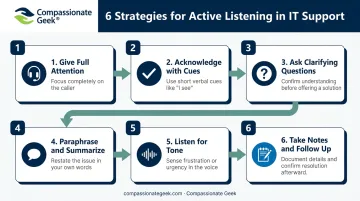
These six strategies are trainable. None require natural charisma, just consistent practice.
Give full attention. Silence notifications, close the second monitor tab, and resist drafting a solution before the user finishes talking. Multitasking during a support call is the single fastest way to miss the detail that matters.
Acknowledge with verbal and non-verbal cues. Simple phrases like "I understand why that's frustrating" go a long way. On video calls, nodding and eye contact do the same work. Avoid saying "I know how you feel," which can come across as dismissive rather than validating.
Ask clarifying, open-ended questions. Use "what," "how," and "why" instead of yes/no questions. When a non-technical user struggles to describe a problem, open questions uncover the real issue instead of stopping at surface symptoms.
Paraphrase and summarize. Restate the problem in the user's own words before proposing a fix. This single habit catches misunderstandings before they turn into a second call.
Listen for tone, not just words. Frustration and confusion often show up in pacing and pitch before they show up in vocabulary. Adjust your tone in response, even if the caller never says "I'm upset."
Take structured notes and follow up. Document what was actually said in the ticket, not just what was diagnosed, so the next technician doesn't force the user to repeat the whole story. A quick follow-up after resolution confirms the fix actually stuck.
Active Listening in Call Centers and IT Help Desks
Phone and chat support strip away facial expressions and body language. Agents have only tone, pacing, and word choice to work with, which raises the stakes on active listening rather than lowering them.
That's not necessarily a disadvantage. Removing visual cues can sharpen attention to voice.
Research on empathic accuracy found that people sometimes read emotion more accurately in voice-only conditions. Attention concentrates fully on vocal information instead of splitting across visual and audio channels.
A quick example: a caller says "my internet is down." A technician who takes that literally starts troubleshooting the router.
A clarifying question changes the diagnosis path:
- Literal approach: Assume a full outage, restart the router, check cables
- Clarifying question: "Are other websites or apps working right now?"
- Likely finding: Only one application is failing to connect, a completely different fix
Skipping that question wastes real diagnostic time.
Ticketing systems matter here too. A MetricNet benchmark reported by ICMI found that worldwide first-contact resolution for service desks averages around 74%, with satisfaction rising roughly in step with FCR.
Case notes that capture what the customer said, not just the technical diagnosis, help the next technician resolve things on the first contact instead of making the user re-explain everything from scratch.
Overcoming Barriers to Active Listening (and Building a Listening Culture)
IT support has a few barriers that retail or hospitality teams don't face as acutely:
- Ticket volume and KPI pressure push technicians toward speed over understanding
- Jargon assumptions cause technicians to explain in language non-technical users can't follow
- Treating callers as tickets rather than people, especially during high-volume shifts
None of these are personality flaws. They're habits, and habits can be retrained through role-playing, coaching, and honest performance feedback — the same way any technical skill improves with repetition.
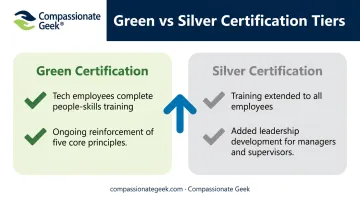
This is exactly the gap Compassionate Geek's training was built to close. The Compassionate Geek Certified Company program gives IT organizations and MSPs a structured path beyond individual courses.
Green certification requires all tech employees to complete people-skills training, with ongoing reinforcement of the five principles. Silver certification extends that training to every employee, adding dedicated leadership development for managers and supervisors. Together, these levels build a lasting listening culture through structured practice and reinforcement.
Frequently Asked Questions
What is the 10-5-3 rule in customer service?
It's an in-person retail formula: acknowledge a customer at 10 feet, greet them verbally at 5 feet, and fully engage at 3 feet. It's less relevant to phone or ticket-based IT support, but it shares the same core idea — make the person feel noticed.
What are the 5 active listening strategies?
Give full attention, acknowledge with verbal and non-verbal cues, ask open-ended clarifying questions, paraphrase to confirm understanding, and pay attention to tone and emotional cues alongside the words themselves.
Why is active listening important in customer service?
It leads to faster, more accurate resolutions, higher satisfaction, and stronger loyalty. Customers who feel genuinely heard are far more likely to return and recommend the service to others.
What is active listening in a call center?
Since visual cues aren't available, it means focusing entirely on tone, word choice, and pacing over the phone or chat to accurately diagnose the issue and respond with the right level of empathy.
How is active listening different from just hearing what a customer says?
Hearing is passive: words register but nothing gets confirmed. Active listening involves intentional engagement: clarifying, paraphrasing, and responding in a way that proves understanding actually happened.
How can IT teams train staff to improve active listening skills?
Role-play exercises, direct coaching, and consistent feedback all help. Structured programs, like Compassionate Geek's courses and Certified Company program, give teams a repeatable framework instead of leaving it to chance.