
Introduction
Jan's screen went blue in the middle of a report her boss needed in twenty minutes. She called IT support in a panic, certain she'd lost hours of work. The technician who answered was sharp: rapid diagnostic questions, a quick remote session, document recovered in under 20 minutes. Textbook fix.
Yet when the call ended, Jan said something the technician never forgot: "I appreciate that it's working now, but that was really stressful."
The problem was solved. The person wasn't.
That gap is exactly what emotional intelligence fills. Don R. Crawley, founder of Compassionate Geek, built his training philosophy around one idea: IT work isn't about managing technology. It's about crafting creative technical solutions to perplexing human problems.
Technical skill gets the system running again. Emotional intelligence determines whether the person on the other end feels heard, respected, and supported while it happens.
This guide covers what EI means in IT support, the five pillars that make it usable on the job, why it matters for trust and retention, and how to actually build it into your team's day-to-day work.
Key Takeaways
- A resolved ticket doesn't guarantee a satisfied customer; the emotional experience matters too.
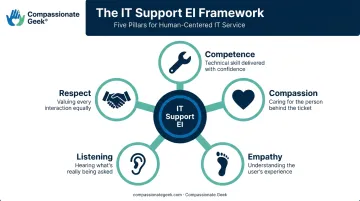
- Five pillars—competence, compassion, empathy, listening, and respect—form a practical EI framework for IT.
- EI is trainable through role-play, coaching, and structured courses, not an inborn trait.
- Track tone and acknowledgment alongside CSAT and FCR to gauge how well your team applies EI.
What Is Emotional Intelligence in Customer Service?
Emotional intelligence, at its simplest, is the ability to recognize, understand, and manage emotions, both your own and the customer's. Psychologists Peter Salovey and John Mayer first defined the concept in 1990, describing it as the capacity to accurately appraise emotion, regulate it, and use it to guide thinking. Daniel Goleman's 1995 book turned the idea into a household term for workplaces everywhere.
In a support interaction, that translates into three concrete moves:
- Reading a customer's mood before diving into troubleshooting
- Controlling your own frustration when a call or ticket goes sideways
- Steering the exchange toward a calmer, more productive outcome
EQ vs. Technical IQ
Plenty of IT professionals can diagnose a network issue in their sleep but freeze up when a user starts venting. That's a training gap, not a character flaw: most technical education focuses entirely on systems and almost never on the person sitting in front of (or calling about) those systems. A technician who can rebuild a server blindfolded may never have been taught how to respond when that same user starts raising their voice.
Why IT Support Runs Hot on Emotion
Tech problems hit differently than a delayed shipment or a billing question. When someone's computer crashes, their ability to do their job is suddenly on the line. That triggers:
- Helplessness: users often can't fix it themselves and feel exposed by that
- Anxiety: deadlines, presentations, or client calls hang in the balance
- Embarrassment: many users assume the problem is somehow their fault
Resolving the technical issue doesn't automatically erase any of that. The good news: EI isn't a fixed trait you either have or don't. It's a skill, and like any skill, it can be built.
The 5 Pillars of Emotional Intelligence Every IT Support Pro Needs
Goleman's original model covers self-awareness, self-regulation, empathy, social skills, and motivation. Compassionate Geek translates that into a simpler, IT-specific framework: five principles built for the realities of a help desk.
Competence
Your technical skill is the foundation everything else sits on. Compassion and empathy can't fix a broken server if you can't actually solve the problem. A network outage still needs a technical fix, not just a caring voice. As Crawley puts it, without solving problems effectively, nothing else matters.
Compassion
You show compassion when you notice a customer is stressed and choose to ease that stress, not just close the ticket as fast as possible. That's what separates simply resolving an issue from actually taking care of the person behind it.
Empathy
Empathy is putting yourself in a non-technical user's shoes. It changes your tone instantly. A simple line like "I understand how disruptive this must be for your work" tells the customer you see their situation, not just their error message.
Listening
Let the customer finish explaining before you jump to diagnosis. Interrupting to troubleshoot early is one of the fastest ways to misdiagnose an issue and trigger a repeat call later.
Respect
Treat every user the same, no matter how much they know about technology. That means skipping jargon dumps, never sighing at a "simple" question, and not talking down to someone who's already embarrassed about not knowing the answer.
Why Emotional Intelligence Matters in IT Customer Service
Customer patience is thin, and it's getting thinner. According to Zendesk's 2025 CX Trends Report, 63% of consumers say they'd switch to a competitor after just one bad experience, up 9 percentage points year over year. IT support isn't exempt from that math.
For internal help desks, strong EI shows up as:
- Fewer escalations, because frustration gets addressed early instead of boiling over
- Higher first-contact resolution, since agents actually understand the full problem before acting
- Greater trust in the IT department overall, which reduces friction on future requests
The MSP Angle
For managed service providers, the stakes are higher. Clients don't renew contracts because a ticket got closed fast. They renew because they feel like a trusted partner is looking out for them.
Communication quality and relationship strength are consistently tied to retention in the managed services world. That's exactly why client-facing EI training has become a differentiator for MSPs competing on more than just price.
How to Develop and Train Emotional Intelligence in Your IT Team
EI doesn't improve through good intentions alone. It improves through repetition, feedback, and structure.
Start with self-reflection. After each interaction, agents can ask themselves:
- Did I recognize the customer's mood before I started troubleshooting?
- Did I change how they felt about our team, for better or worse?
- Did I let them finish explaining before jumping to a fix?
Use scenario-based role-play. Practice the situations that come up constantly:
- A panicked executive facing a deadline
- A repeat caller who's clearly losing patience
- A non-technical user embarrassed about their own mistake
Build coaching into call and ticket reviews. Most quality reviews check technical accuracy and speed, but rarely ask whether the agent acknowledged frustration or kept an appropriate tone. Adding that one lens shifts what your team pays attention to.
Invest in structured training. Self-guided reflection helps, but it doesn't scale across a whole team, which is why formal programs matter.
Compassionate Geek's on-demand IT customer service training is built entirely around the Competence, Compassion, Empathy, Listening, and Respect framework, with individual seat licenses starting at $299 and volume discounts of up to 60% for teams of 500 or more. Organizations can also pursue Compassionate Geek Certified Company status as a way to formalize the commitment.
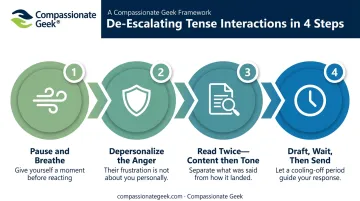
Practice cool-down techniques. Before responding to an angry email or escalated ticket:
- Pause and take a breath before typing a single word
- Remind yourself the anger is about the situation, not about you personally
- Read the message once for content, then again for tone
- Draft your response, then wait a few minutes before sending it
How to Measure the Impact of EI in Customer Service
You can't improve what you don't track. A few practical ways to measure EI in action:
- CSAT with qualitative follow-up — don't just ask if the issue was resolved, ask how the interaction made the customer feel
- Behavior-based scorecards — track specific actions like acknowledging frustration, tone, and confirming understanding before offering a fix
- Proxy metrics — First Contact Resolution, ticket reopen rate, and escalation frequency all move when EI is applied consistently
FCR is a useful benchmark here. HDI reports an average net FCR around 74%, with most service desks targeting 70-80% for voice support.
If your team's FCR sits well below that range, ask whether agents are truly listening before diagnosing—or rushing to a fix and missing the real issue.
Practical EI Tips Across Customer Service Channels
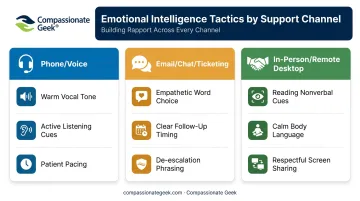
Different channels call for different EI tactics.
Phone and voice support:
- Acknowledge any wait time before diving into the issue
- Keep your tone calm and even, even if the caller's isn't
- Confirm what you heard before proposing a solution
Email, chat, and ticketing systems:
- Skip robotic, copy-paste responses. Personalize every canned reply before sending it
- Translate jargon into context instead of removing it entirely (say "we'll set your computer to find the network automatically" rather than "adjust your DHCP settings")
- Acknowledge tickets immediately, even before you've solved anything
In-person or remote desktop support:
- Use open, attentive body language: lean in, face the person, and put the phone down
- Let the user finish explaining before touching their screen or interrupting
- Narrate what you're about to do so the user isn't left guessing
Frequently Asked Questions
What is emotional intelligence in customer service?
It's the ability to recognize and manage your own emotions and the customer's emotions to create a positive, satisfying interaction, beyond fixing the technical issue.
What are the 5 components of emotional intelligence?
Goleman's model includes self-awareness, self-regulation, empathy, social skills, and motivation. Compassionate Geek's parallel framework covers Competence, Compassion, Empathy, Listening, and Respect for IT specifically.
Why is emotional intelligence especially important in IT customer service?
Tech issues often trigger anxiety, embarrassment, or helplessness in non-technical users. Fixing the problem without addressing those feelings leaves the customer unsatisfied even when the ticket is closed.
Can emotional intelligence be trained, or is it a natural trait?
Some people start with a natural edge, but skills like self-regulation and empathy can be developed through practice, coaching, and structured training programs.
How do you measure emotional intelligence in customer service agents?
Use CSAT paired with qualitative feedback, behavior scorecards tracking tone and acknowledgment, and proxy metrics like First Contact Resolution and escalation rates.
What's the difference between emotional intelligence and customer service skills?
Customer service skills are the tactics, scripts, processes, and call structures. Emotional intelligence is the underlying ability to read and manage emotions that makes those tactics actually work.