"Just apologize and fix it" sounds simple enough. But the results vary wildly depending on the process your team follows, the skills of the person answering the call, and whether that approach is applied consistently across every technician, not just your best one.
This article walks through the exact step-by-step process for handling IT customer complaints, the different types you'll encounter, what preparation makes it work, and how to troubleshoot the toughest scenarios your team will face.
Key Takeaways
- Effective complaint handling follows a repeatable six-step process
- Most escalations stem from how a complaint is handled, not its original severity
- Complaints generally fall into four categories, and the type shapes the right response
- Empowering frontline staff to resolve issues on first contact improves both speed and loyalty
- Active listening and empathy are trainable skills, not fixed personality traits
How to Handle Customer Complaints Effectively: A Step-by-Step Process
Every strong complaint-handling framework, including the ISO 10002 standard for complaint management, follows a similar arc: acknowledge, investigate, resolve, and close the loop. Compassionate Geek's own training builds on this idea with its Six Steps in a Successful Tech Support Session framework — starting with listening without interrupting and ending with problem-solving that keeps the customer informed throughout.
Here's how that six-step framework translates into five practical stages you can use today.
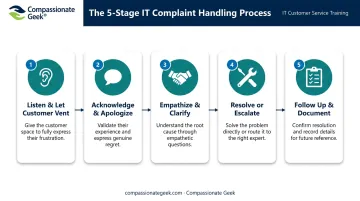
Step 1: Listen and Let the Customer Fully Vent
Interrupting a frustrated customer, even with the right answer, backfires. It signals that you've stopped listening and started assuming, which makes people repeat themselves louder or angrier.
Instead:
- Let them finish the entire story before responding
- Resist the urge to diagnose out loud while they're still talking
- Reflect back what you heard: "So the ticket has been open for three days without an update"
That reflection alone often lowers the temperature of the conversation before you've fixed anything.
Step 2: Acknowledge and Sincerely Apologize
Acknowledgment has to come before resolution. A simple line like "I'm sorry, that shouldn't have happened" does the job without admitting legal fault or blaming a specific person.
Apologizing here shows you recognize the customer's experience fell short of what they expected, without admitting fault. That recognition is what customers are actually listening for.
Step 3: Empathize and Ask Clarifying Questions
Once the customer feels heard, empathy moves the conversation forward. Phrases like "I understand why that's frustrating" de-escalate tension before you shift into problem-solving mode.
From there, ask calm, specific questions to pin down the technical or situational facts:
- When did the issue start?
- What were you doing when it happened?
- Has this happened before?
This is where Compassionate Geek's empathy principle differs from compassion: empathy means understanding how the customer sees the situation, even if you don't fully agree with their read on it.
Step 4: Take Ownership and Resolve (or Escalate With Clear Reason)
Whoever hears the complaint first should try to fix it on the spot. Making a customer repeat their story to a second or third person is one of the fastest ways to lose them.
This approach delivers measurable results, not just goodwill. According to MetricNet's desktop-support benchmarking data, first contact resolution rates average around 84%, with top-performing teams resolving over 90% on the first interaction. That performance correlates strongly with technician training hours and customer satisfaction scores.
When escalation is genuinely necessary, whether for complexity, authority limits, or abusive behavior, make it feel seamless:
- Tell the customer specifically why you're escalating
- Give a realistic timeframe for the next contact
- Hand off full context so they never have to start over
Step 5: Follow Up and Document the Complaint
Checking back after the fix confirms the customer is actually satisfied, not just quiet. It also shows the relationship matters beyond the immediate transaction.
Documentation matters just as much. Logging every complaint, even resolved ones, in a shared ticketing system or CRM lets your team spot patterns before they become recurring problems. Compassionate Geek's training frames this as a shift from reactive firefighting to proactive prevention, one of the more valuable habits an IT leader can build.
Types of Customer Complaints You'll Encounter
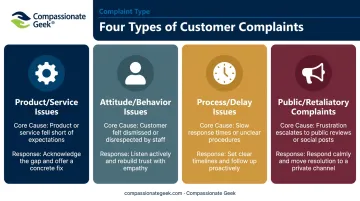
Not every complaint calls for the same response. Matching your approach to the actual complaint type prevents responses that feel tone-deaf or mismatched to what the customer actually needs.
Product or Service Complaints Something technical didn't work as promised. A system outage, a recurring bug, a failed installation. These need a clear technical explanation plus a concrete fix timeline.
Attitude or Behavior Complaints The customer felt a staff member was rude, dismissive, or unhelpful. No technical fix solves this. It requires a genuine apology and, often, a conversation with the employee involved.
Process or Delay Complaints Long wait times, missed SLAs, or slow ticket resolution frustrate customers even when the eventual fix is correct.
In the UK, Ofcom's 2024 customer service research found that complete resolution on first contact ranged from 44% to 50% across mobile, broadband, and landline providers. That means roughly half of all issues required a second touch, right where delay complaints originate.
Public or Retaliatory Complaints Raised on social media or public review sites instead of privately. These need a faster, more visible, reputation-conscious response.
Research from Twitter and Applied Marketing Science found that telecom customers would pay $17 more per month for a reply within four minutes, versus just $3.52 more after a 20-minute wait. Speed matters even more when the complaint is public.
What You Need Before You Can Handle Complaints Effectively
Preparation, not personality, determines whether a complaint interaction builds trust or destroys it. That preparation splits into two areas: the skills your people bring, and the systems your organization gives them.
Skills and Mindset Requirements
Every IT or support staff member needs a working set of interpersonal skills, not just technical know-how:
- Active listening — taking notes, letting people finish, asking clarifying questions
- Empathy — genuinely seeing the situation from the customer's perspective
- Patience — staying calm even when the complaint feels unreasonable
- Clear, jargon-free communication — explaining technical issues in plain language
Compassionate Geek builds its entire curriculum around five principles: Competence, Compassion, Empathy, Listening, and Respect. Competence means resolving problems in a single contact whenever possible. Respect means treating every user with dignity, regardless of how much they know about technology, because even highly capable people get bewildered by tech problems.
Systems and Authority Requirements
Skills alone aren't enough if staff can't act on them. Frontline reps need:
- Clearly defined authority to approve remedies without waiting on a manager for every decision
- A ticketing or CRM system to log and track complaints in real time
- A shared framework and vocabulary so every technician handles complaints the same way, not just the naturally gifted ones
That last point is why structured training matters. TeamLogic IT East Memphis president Drayton Mayers requires every employee to complete Compassionate Geek's IT customer service training. He credits it directly with new business wins, since prospective clients are often already frustrated with competitors who lack that same combination of technical skill and compassionate service.
Common Mistakes and Troubleshooting Difficult Complaint Scenarios
Most failed complaint interactions aren't caused by the original technical problem. They're caused by how the conversation gets handled afterward.Most failed complaint interactions trace back to how the conversation is handled, not the original technical problem.
Common Mistakes When Handling Complaints
- Getting defensive or arguing with the customer instead of listening first
- Making excuses, blaming another department, a vendor, or "the system"
- Skipping follow-up, leaving the customer feeling like an afterthought
- Using one script for every complaint type regardless of root cause
The stakes are real across regulated service industries worldwide. Australia's Telecommunications Industry Ombudsman reported that complaints returning unresolved after the first referral to a provider rose 36.9% year over year, signaling failed first-contact handling rather than tougher underlying problems.
Troubleshooting Difficult Complaint Scenarios
| Scenario | Likely Cause | What to Adjust |
|---|---|---|
| Customer is extremely angry, raising their voice | They feel unheard, or this is a repeat unresolved issue | Move to a private channel, use calming phrases, focus purely on acknowledgment before attempting any fix |
| Complaint is valid, but policy or compliance blocks the exact resolution requested | Customer expectations exceed what's legally or contractually possible | Be transparent about the constraint while still empathizing and offering the best available alternative |
| Same complaint keeps recurring across multiple customers | A systemic process, product, or training gap | Use documented complaint data to find the root cause and route it to process or training improvement |
Compassionate Geek's training frames escalation as a judgment call guided by its five core principles: competence, compassion, empathy, listening, and respect. Escalate when a situation exceeds your authority, your expertise, or your ability to keep the interaction safe.
Conclusion
Effective complaint handling is a repeatable skill built on listening, acknowledgment, ownership, and follow-up. Most failed interactions trace back to skipping the acknowledgment and empathy steps, not to the technical problem itself.
Teams that train for this consistently, rather than leaving it to individual instinct, turn frustrated customers into long-term advocates. For IT teams and MSPs competing on service as much as technical skill, that consistency is a genuine competitive advantage. Compassionate Geek's IT customer service training helps convert these principles into daily habits that your whole team can rely on.
Frequently Asked Questions
What is the best way to handle a customer complaint?
Combine active listening, a sincere apology, empathetic questioning, quick ownership of the fix, and a follow-up to confirm satisfaction. Skipping any one of these steps is usually where things go wrong.
What are the four types of complaints?
Product or service issues, attitude or behavior issues, process or delay issues, and public or retaliatory complaints. Each requires a different response approach.
How do you handle an angry or aggressive customer complaint?
Stay calm, move to a private setting if possible, and acknowledge their frustration before doing anything else. Avoid arguing or defending yourself before you've addressed how they feel.
What are the 5 steps to resolving a customer complaint?
Listen, acknowledge and apologize, empathize and clarify, resolve or escalate, then follow up and document. This sequence works across nearly every complaint type.
Why is it important to thank a customer for complaining?
A complaint often represents many other silent customers with the same unspoken problem. Thanking them acknowledges that they've given your business a chance to fix something before it costs you more customers.
How can IT teams reduce the number of customer complaints over time?
Document complaint trends to spot recurring patterns, then invest in training that addresses root causes instead of just symptoms. Compassionate Geek's Certified Company program helps organizations build this into their culture long-term.