
Many IT organizations still treat customer service training as an afterthought bolted onto technical certification. That gap shows up fast: agents who can fix a server but freeze up during an angry client call. Understanding how training video formats are shifting helps IT leaders close that soft-skills gap, cut training costs, and make smarter investments before competitors do.
This matters because customer patience for bad service has already worn thin, and the training methods that worked in 2020 aren't built for how support teams operate now: distributed, multilingual, and under constant policy churn.
Key Takeaways
- AI-assisted production and role-play scenarios are replacing static training videos
- Microlearning under five minutes is now the default format for busy support teams
- Empathy and emotional intelligence are now formally trained, tested skills
- Certification-backed learning paths give MSPs a client-verifiable credential
- Blending technical and human-centered training boosts retention and resolution rates
Key Trends Shaping Customer Service Training Videos in 2026
In 2026, the real shift centers on three things: how training content gets produced, how it's consumed in smaller pieces, and how skill eventually gets certified.
AI-Generated and AI-Assisted Training Videos
IT policies change constantly. Password reset procedures shift, a new ticketing system rolls out, a compliance requirement gets added mid-quarter. Traditional filmed training can't keep pace, especially when reshoots mean booking a studio and a presenter all over again.
AI avatars, automated scripting tools, and synthetic voiceovers are solving that specific problem. Teams now update a script, regenerate the video, and push it live, often within days instead of weeks. This addresses one of the biggest complaints from support managers: training content that's already outdated by the time it's approved.
What this looks like in practice:
- Automated scripting tools draft training narration from existing knowledge-base articles
- Synthetic voiceovers let teams localize content into multiple languages without re-recording
- AI avatars present procedural updates without scheduling a human presenter
Compassionate Geek's own course library, delivered in English, French (Canadian), and Spanish (Mexican), reflects this same multilingual demand, even where production methods vary. The direction is clear: fast, affordable content refresh is no longer optional for IT support training.
Microlearning and Bite-Sized Modular Videos
Long-form training sessions don't fit how support agents actually work. Shift-based schedules, mobile access, and constant interruptions mean a 45-minute video often gets abandoned at the 12-minute mark.
Microlearning solves this by isolating one behavior per clip. According to ATD's 2025 research on talent-development practices, two-thirds of talent-development professionals now use microlearning, up 28 percentage points from 2017. Microlearning has moved from a niche tactic to mainstream L&D practice.
This structure shows up in skill-specific IT training too. Compassionate Geek's IT Customer Service Training course, built from The Compassionate Geek and The 5 Principles of IT Customer Service Success, is organized into eight distinct sections rather than one continuous lecture. Each section targets a specific competency, which mirrors the modular, single-skill approach microlearning depends on.
For distributed or remote support teams, this modularity matters. New hires in different time zones can complete one module during a slow shift instead of blocking out an hour they don't have.
Scenario-Based Role-Play and Realistic Simulation Videos
Abstract policy explanations rarely stick with agents. Dramatized "wrong way vs. right way" scenarios work better because they show agents the actual dialogue, tone, and outcome side by side.
Don Crawley's own YouTube training video, "Customer Service Heroes and Villains: Customer Service Training 101," is a good example of this format applied specifically to IT support. It contrasts poor interactions against strong ones so viewers see the difference play out in real time, not just described in a bullet list.
This format is growing because it gives agents a risk-free way to rehearse before facing a live, frustrated customer:
- Agents see consequences of poor phrasing without damaging a real client relationship
- Side-by-side contrast makes the "right way" concrete instead of theoretical
- Teams can rehearse escalation scenarios that rarely come up in daily coaching
This lines up with a broader pattern in call-center training, where simulation-based practice tends to outperform traditional role-play in both accuracy and speed of call handling. Watching alone isn't enough; the format works best when agents pair it with active practice.
Emotional Intelligence, Empathy, and Compassionate Communication Training
Technical competence used to be the whole game in IT support. That's changed. A customer whose problem gets fixed but who feels dismissed during the process still walks away unhappy.
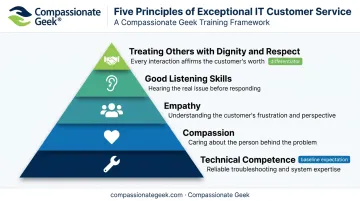
Don R. Crawley's five-principle framework, built specifically for IT professionals, treats interpersonal skill as equally structured as technical skill:
- Technical Competence – the baseline expectation, not the differentiator
- Compassion – genuine concern for the person behind the ticket
- Empathy – understanding what the customer is experiencing, not just their symptom
- Good Listening Skills – hearing the actual problem, not the assumed one
- Treating Others with Dignity and Respect – regardless of how frustrated they are
This trend matters more in IT than almost anywhere else. According to HDI's 2025 State of Tech Support survey, 55% of IT support organizations struggled to find candidates with adequate soft skills, compared with just 39% citing insufficient technical skills. Technical certification has rarely posed the real challenge. Interpersonal skills training is where most organizations fall short.
Certification-Backed and Structured On-Demand Learning Paths
A single training video with no tracking doesn't prove anything to a client or an auditor. Structured learning paths with quizzes, completion data, and formal certification carry that proof instead.
Compassionate Geek's Certified Company program, offering Green and Silver levels since its 2019 launch, reflects this shift toward formalized, credentialed training rather than one-off video viewing. For MSPs pitching enterprise clients, being able to say "our team holds this certification" carries weight that "we watched some videos" never will.
Group purchases (2+ seats) also come with a Group Management Console, letting team leads track enrollment and progress across a group rather than guessing who actually finished the course. That kind of visibility is quickly becoming table stakes for group training programs.
What's Driving These Training Video Trends
Several forces are pushing these formats forward at the same time, not in isolation.
- Technology advances: AI avatar tools, automated editing, and generative scripting have slashed the cost and skill barrier that once required a full production crew.
- Rising customer expectations: PwC's 2025 Customer Experience Survey found that 52% of consumers stopped buying from a company after a single bad service experience.
- Cost and efficiency pressures: Reusable, on-demand video avoids recurring instructor, travel, and venue costs, offering a scalable option for growing support teams.
- Workforce and skills-gap pressures: IT organizations report a wider gap in soft skills than in technical skills among candidates, a persistent hiring challenge.
- Competitive dynamics: Organizations increasingly treat customer service as a revenue and retention driver rather than a cost center to minimize.
How These Trends Are Impacting the Customer Service Industry
These shifts extend beyond how training gets delivered, reshaping how organizations measure performance and staff their entire support function.
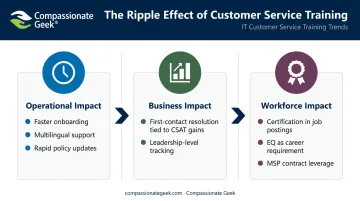
Operational Impact
Modular, on-demand video libraries shorten onboarding timelines noticeably. Instead of scheduling a multi-day in-person session, new hires work through skill-specific modules on their own schedule.
- Distributed and hybrid teams get consistent training regardless of location
- Multilingual course versions support global or bilingual support desks
- AI-assisted production means policy updates reach training content in days, not weeks
Business Impact
Those operational gains carry through to the bottom line: training is now tied directly to measurable outcomes, not filed away as an HR checkbox. ICMI's benchmark research found that roughly every 1 percentage-point improvement in first-contact resolution corresponds with a similar improvement in customer satisfaction, and agent training hours remain the biggest lever for improving FCR.
That connection is why completion rates, quiz scores, and CSAT correlation are increasingly reviewed at the leadership level, not just filed away in an LMS report nobody reads.
Workforce Impact
Meeting those metrics increasingly depends on the people delivering support, not just the systems behind them. Technical professionals are now expected to carry a hybrid skill set. Deep technical knowledge alone doesn't satisfy hiring managers or clients anymore.
- Formal certification is showing up in job postings and promotion criteria for IT support roles
- Emotional intelligence training is being treated as a career-development requirement, not an optional extra
- MSPs increasingly reference staff certifications when pitching enterprise contracts
Future Signals for Customer Service Training Videos
The formats above are early indicators of where training video technology is headed next. Over the next one to three years, watch for:
- Personalized AI presenters that adjust training content based on a learner's role, language, or specific skill gaps
- VR and AR simulations for high-stakes scenarios like de-escalation or healthcare-adjacent support, where mistakes carry real consequences
- Tighter integration between training data and live coaching, where completion records and quiz scores feed directly into real-time quality-assurance scoring on actual support tickets
None of this replaces the fundamentals. It just makes them faster to teach and easier to prove.
Conclusion
AI production, microlearning, scenario realism, emotional intelligence, and certification represent a single shift, not five separate trends: customer service training that builds faster and is harder to fake.
Organizations that adapt early, especially those pairing technical training with human-centered skills like Compassionate Geek's five core principles of competence, compassion, empathy, listening, and respect, gain an edge in retention and client trust. The support teams still relying on outdated, unmeasured training will feel that gap widen.
Video production quality matters less than strategic foresight. The organizations winning in 2026 picked the right formats for the right skills, then measured whether it actually worked, not the ones with the flashiest videos.
Frequently Asked Questions
How do you train staff to deliver 5-star customer service?
Combine scenario-based video training with clear, written service standards, then reinforce through certification or ongoing coaching. One-off training rarely sticks without repeated practice and measurable follow-through.
What are the 5 P's of customer service?
Definitions vary by source. One common version, from Yonyx, cites People, Process, Product, Presentation, and Price, though other frameworks swap in Purpose or Priorities. Video training reinforces whichever version an organization adopts.
What are the 4 C's of customer care?
Zendesk defines these as Compassion, Convenience, Customization, and Consistency, though this isn't a universal industry standard. Training videos work well for illustrating each C through concrete, realistic examples.
What are the 3 F's of customer service?
Often called Feel, Felt, Found, this is an empathy and objection-handling framework. Acknowledge how the customer feels, note that others have felt the same way, then share what was found to help. It's commonly taught through role-play video scenarios.
What is the ideal length for a customer service training video in 2026?
Under five minutes per module is the general recommendation, aligned with the broader shift toward microlearning. Shorter, single-skill videos fit better into shift-based and mobile-first schedules than long-form sessions.
Are AI-generated customer service training videos effective?
They're effective for scalable, frequently updated content like policy changes or procedural updates. For empathy, tone, and complex scenario training, pairing AI-generated content with human-authored role-play material still produces stronger results.