
This happens constantly in IT. Technical skill and great customer service are not the same thing, and most IT training treats them like they are. Certifications teach you how to fix the server. They don't teach you how to talk to the person whose deadline just blew up because of it.
That gap matters more than most IT pros realize. It shapes retention, reputation, and who gets promoted into client-facing or leadership roles. This guide breaks down what IT customer service actually means, the core principles behind it, and the practical skills you can start using on your very next ticket.
Key Takeaways
- Technical competence builds trust, but communication determines satisfaction
- Five principles drive great IT support: competence, compassion, empathy, listening, respect
- Small habits, like acknowledging frustration first, prevent most escalations
- Soft skills need practice and feedback, just like technical skills do
What Is Customer Service for IT Pros?
IT customer service is the practice of helping people, whether coworkers or external clients, solve technology problems in a way that leaves them feeling heard and confident in the outcome. It's not the same as "closing the ticket." A closed ticket with a confused, irritated user isn't a success. It's a support failure disguised as a resolution.
This is the foundation of the Compassionate Geek philosophy: IT jobs aren't primarily about technology. They're about crafting creative technical solutions to perplexing human problems in the workplace.
That reframe changes everything about how you approach an interaction. You stop thinking "How do I fix this system?" and start thinking "How do I help this person, who happens to have a system problem?"
Reactive Support vs. Relationship-Driven Support
There's a real difference between these two approaches:
- Reactive/transactional support: Fix the issue, close the ticket, move to the next queue item
- Relationship-driven support: Understand the context, communicate clearly throughout, and follow up to confirm the fix actually worked
The second approach takes a few extra minutes. It pays off in fewer repeat tickets and far less friction.
Here's why the stakes are higher in IT than in most service industries: a botched interaction doesn't just cost a customer relationship. It can mean lost productivity, compliance exposure, or a furious executive who missed a deadline.
Uptime Institute's 2024 outage analysis found that 54% of organizations' most serious recent outage cost more than $100,000 (Uptime Institute, 2024). When the technical fix and the human experience are both high-stakes, you can't afford to nail one and ignore the other.
This isn't just theory. A 2017 help-desk study found that 42.53% of respondents ranked professionalism as the single most important trait in an ideal support agent, ahead of pure speed (Pogarcic, 2017). How you show up during the interaction shapes how people judge the entire department.
The Five Core Principles of Great IT Customer Service
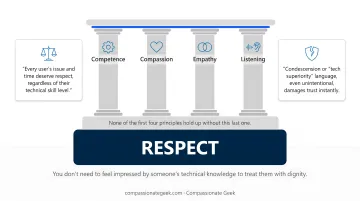
Compassionate Geek organizes great IT support around five principles: Competence, Compassion, Empathy, Listening, and Respect. Each one solves a different failure mode. Skip any of them, and the interaction suffers.
Competence
Technical competence is non-negotiable. No amount of warmth compensates for not knowing how to solve the problem.
Users trust technicians who demonstrate real capability, and that trust erodes fast when a fix requires three follow-up calls. Staying current with tools and systems, and digging past the obvious answer, is the price of entry for everything else on this list.
Compassion
A frustrated user usually isn't attacking you personally. Their frustration comes from lost time, looming deadlines, or stress they're carrying into the interaction. Recognizing that source, instead of reacting defensively, de-escalates the situation before it starts. Compassion means responding to the person's state, not just their words.
Empathy
Empathy goes a step further than compassion. It means genuinely trying to see the issue from the user's perspective, not just feeling sorry for them. A "minor" software bug might feel enormous to someone with a client presentation in ten minutes. Empathy is what lets you calibrate your response to their reality, not yours.
Listening
Calibrating your response starts with hearing the user out fully. Active listening means letting them finish describing the issue before jumping to diagnosis. Paraphrasing back what you heard ("So the export function fails specifically when you select multiple date ranges, is that right?") confirms understanding and often surfaces details you'd have missed by rushing to troubleshoot.
Respect
None of the first four principles hold up without this last one. Every user's issue and time deserve respect, regardless of their technical skill level. Condescension or "tech superiority" language, even unintentional, damages trust instantly. You don't need to feel impressed by someone's technical knowledge to treat them with dignity.
Essential Practical Skills Every IT Pro Should Master
Principles only matter if you can put them into practice mid-interaction. Here's how these ideas turn into concrete habits.
Plain-language translation: Instead of saying "Your DNS cache has stale records causing resolution failures," try: "Your computer is using outdated information to find that website. I'm going to clear that out so it looks up the current version." Same fix, far less confusion.
Acknowledge frustration first: When someone's upset, resist the urge to dive straight into fix mode. Try: "I can hear how urgent this is for you. Let's get you taken care of." That single sentence often does more to calm someone down than any technical explanation could.
Written tone matters: Email, chat, and ticket notes strip out vocal tone and body language, so word choice carries all the weight. A terse "Try restarting and let me know" can read as dismissive, even if that wasn't the intent. Small additions like "please" and "thanks for your patience" go a long way in text.
Honest time estimates: "I'll get to it soon" builds distrust the moment "soon" stretches past expectations. Say instead: "I'm still working on this. I'll have an update for you by 3 PM." Specific, honest estimates reduce follow-up complaints even when the news isn't great.
Voice and body language: On the phone or in person, how you say something often matters as much as what you say. A flat, rushed tone communicates disinterest even when your words are technically helpful. Slow down, and let your tone match the reassurance you're trying to give.
Together, these habits reflect the five principles at the heart of great IT customer service: competence, compassion, empathy, listening, and respect.
Best Practices for Delivering Consistently Great IT Support
Individual skills matter, but consistency comes from habits built into your workflow.
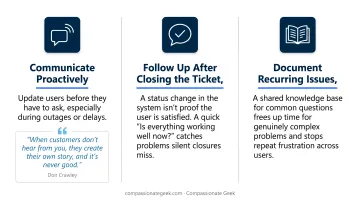
- Communicate proactively. Update users before they have to ask, especially during outages or delays. As Don Crawley says, "When customers don't hear from you, they create their own story, and it's never good."
- Follow up after closing the ticket. A status change in the system isn't proof the user is satisfied. A quick "Is everything working well now?" catches problems silent closures miss.
- Document recurring issues. A shared knowledge base for common questions frees up time for genuinely complex problems and stops repeat frustration across users.
Measuring and Improving Your Customer Service Skills Over Time
Soft skills need the same practice and measurement as technical skills. Yet most IT pros only get feedback on resolution speed, never on communication quality.
Start by asking for feedback directly, from users and from managers, specifically about how you communicate, not just whether the fix worked.
IT teams commonly track metrics like first contact resolution (FCR), with HDI citing 70% to 80% as a solid target range in its 2023 IT support metrics report. You can build an informal personal version: track how often your first response actually resolves the issue versus requiring a second interaction.
For a more structured path, Compassionate Geek offers:
- Online courses covering communication, emotional intelligence, and active listening for IT pros
- The book The Compassionate Geek, which lays out the five-principle framework in depth
- The Compassionate Geek Certified Company program, which validates that an organization has built customer-focused habits into its culture
This investment pays off beyond fewer complaints. IT pros known for strong communication get trusted with client-facing work and leadership roles more often than those known only for technical output.
Common Customer Service Challenges IT Pros Face
Even skilled technicians run into recurring friction points.
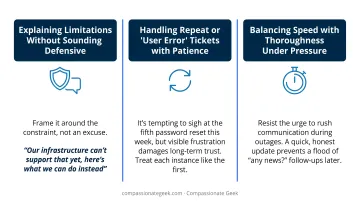
- Explaining limitations without sounding defensive. Frame it around the constraint, not an excuse. "Our infrastructure can't support that yet, here's what we can do instead" lands better than a vague apology.
- Handling repeat or "user error" tickets with patience. It's tempting to sigh at the fifth password reset this week, but visible frustration damages long-term trust. Treat each instance like the first.
- Balancing speed with thoroughness under pressure. Resist the urge to rush communication during outages. A quick, honest update prevents a flood of "any news?" follow-ups later.
Frequently Asked Questions
What is customer service for IT?
IT customer service means helping users resolve technology issues while communicating clearly, respectfully, and empathetically. The goal is an interaction that builds trust, not just a closed ticket.
What is 24/7 technical support?
It means IT assistance is available around the clock, usually through live agents, on-call rotations, or self-service tools. Actual coverage varies by organization, so confirm which channels operate after hours.
What skills do IT professionals need for good customer service?
Beyond technical competence, IT pros need active listening, clear communication, empathy, patience, and the ability to translate technical concepts into plain language.
How is IT customer service different from general customer service?
IT support often deals with higher-stakes, more technical problems, and the "customer" may be an internal employee rather than a paying client. Success requires combining deep technical knowledge with strong interpersonal skill.
Can technical skills alone make someone good at IT customer service?
No. Technical skill is necessary but not sufficient. A technically correct fix delivered poorly can still leave users frustrated and distrustful of IT.
How can IT professionals improve their soft skills over time?
Practice active listening, ask for feedback after interactions, and consider structured training built specifically for IT customer service, such as Compassionate Geek's certification courses focused on these skills.