
 in 2026](https://file-host.link/website/compassionategeek-b0tibp/assets/blog-images/fd9d381f-d1de-442f-9c3d-bde25875dbdd/1785863808285528_2346fb3882254144b72a0364e83dc6ec/360.webp)
Introduction
Your help desk can now diagnose a failing server in seconds. Your chatbot can reset a password before the customer finishes typing their question. Yet none of that automation builds loyalty on its own.
A 2024 Gartner survey of 5,728 customers found that 64% would rather companies skip AI in customer service altogether. Their top complaint: losing access to a real person.
Customers today swim in bots, self-service portals, and canned responses. Automation fatigue is real, and it's making genuine, human-led service one of the last true differentiators.
This post breaks down 10 golden rules of exceptional customer service for 2026, built for IT and support teams who need practical guidance they can use on the next ticket.
Key Takeaways
- Human interaction is now a competitive advantage for IT support teams
- Stressed IT customers judge tone as much as technical accuracy
- Speed without accuracy, or empathy without follow-through, both erode trust fast
- Blending AI triage with human judgment boosts efficiency and customer sentiment
- Structured, ongoing training is what makes these rules stick
Why Customer Service Rules Matter More in 2026
Automation has changed what customers expect from the humans they eventually reach. When a chatbot fails to resolve an issue, it hands the case to a person. That person now faces a customer who's frustrated twice over: once with the original problem, once with the bot.
Gartner's research backs this up. In one survey, 64% of customers said they'd prefer no AI involvement at all, and 53% said they'd consider switching companies if they learned AI was being used in service delivery. The number one concern wasn't job loss or bad answers. It was difficulty reaching a person.
This hits IT support and MSPs particularly hard. Customers calling about a server outage or a locked account are rarely calm. They're behind on deadlines, blocked from doing their jobs, and looking for someone who can fix things without adding friction.
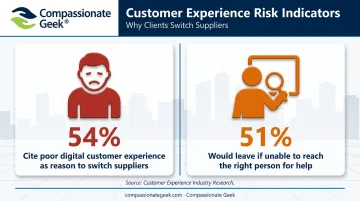
Poor service creates real revenue risk. McKinsey's B2B Pulse survey of nearly 4,000 B2B decision-makers found that among buyers already likely to switch suppliers, 54% cited poor digital customer experiences.
Another 51% said they'd look elsewhere if they couldn't reach the right person for help. When tech stacks look increasingly similar across vendors, service quality becomes the tiebreaker.
The 10 Golden Rules of Exceptional Customer Service
These rules apply broadly, but they're framed here with technical support scenarios in mind, since IT customers face a unique mix of urgency, complexity, and stress that other industries don't always share.
Rule 1: Listen First, Diagnose Second
The instinct to jump straight to troubleshooting is strong, especially for technically skilled staff. Resist it.
Interrupting a customer mid-explanation often means missing the one detail that would've pointed to the real problem. Letting someone finish their full description, even when you think you already know the fix, builds trust and usually surfaces information you'd have otherwise missed.
A tech who listens for 90 seconds before touching a keyboard almost always resolves faster than one who starts typing after 10 seconds.
Rule 2: Lead with Empathy, Not Just Expertise
Technical skill fixes the system. It doesn't fix how the customer feels about the experience.
A frustrated customer needs acknowledgment before they need a solution. Something as simple as "That sounds incredibly frustrating, let's get this sorted" changes the emotional tone of the entire interaction. Skip that step, and even a perfect fix can feel cold and transactional.
Rule 3: Communicate in Plain Language, Not Jargon
Technical accuracy means nothing if the customer can't understand what you're telling them.
- Jargon-heavy: "Your DNS resolution is failing due to a misconfigured PTR record."
- Plain language: "Your computer can't find the right address for that website, we're fixing the setting that controls that."
Translating technical language for non-technical clients isn't dumbing it down. It's respecting their time and reducing their anxiety.
Rule 4: Respond with Speed—But Don't Sacrifice Accuracy
Fast acknowledgment matters. But a rushed, wrong fix does more damage than a slower, accurate one.
There's no single universal benchmark for how fast IT support "should" respond, since expectations vary by industry and contract. What's consistent is the balance required: acknowledge quickly, even if the fix takes longer, and never sacrifice accuracy just to close a ticket faster. A wrong answer delivered quickly costs more time than a right answer delivered a little slower.
Rule 5: Take Ownership of the Problem End-to-End
"That's not my department" is one of the fastest ways to lose a customer's confidence.
A single-owner ticket model, where one person stays accountable from intake to resolution even if other teams get involved, consistently produces higher satisfaction than handing customers between departments. Ownership doesn't mean doing everything yourself. It means the customer never has to repeat their story to a new person.
Rule 6: Set Realistic Expectations and Follow Through
Under-promise, over-deliver. It's simple, and it works.
Telling a customer "we'll have this fixed in 20 minutes" when it realistically takes two hours sets you up to fail. Saying "this typically takes about two hours, I'll update you at the one-hour mark" builds trust even before the fix is complete, because you're managing expectations honestly.
Rule 7: Personalize Every Interaction
Customers are people, not ticket numbers. Using their name, referencing prior interactions, and remembering context from previous tickets signals that they matter beyond the current issue.
This matters even more in long-term B2B IT relationships, where the same client may work with your team for years. A support tech who says "last time we spoke about your VPN setup, is this related?" builds a relationship that a generic script never will.
Rule 8: Blend AI Efficiency with Human Compassion
AI handling routine triage while humans step in for complex or emotionally charged issues is already the standard model heading into 2026.
A 2025 peer-reviewed study in the Quarterly Journal of Economics tracked 5,172 software support agents using AI-assisted response suggestions. Resolved chats per hour rose 15.2%, and customer sentiment improved measurably. Requests to escalate to a manager fell by almost 25%.
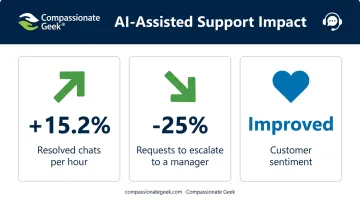
The catch: resolution rate and NPS didn't move much. AI made agents faster and calmer interactions more common, but it didn't replace the human judgment needed for genuinely hard problems.
Rule 9: Turn Mistakes into Trust-Building Moments
Nobody expects perfection. They do expect honesty when things go wrong.
A sincere, quick apology followed by fast resolution often builds more loyalty than a flawless track record ever would. If a deployment causes an outage, saying "we made a mistake, here's what happened, and here's how we're fixing it" earns more trust than deflecting or minimizing the impact.
Rule 10: Continuously Learn and Improve
The rules above aren't a checklist you master once. They're habits that decay without reinforcement.
Post-resolution surveys and feedback loops give you real signal on what's working. Pair that with ongoing training and upskilling, because a team that stops learning eventually stops improving, no matter how good its original training was.
The Five Principles That Power Every Golden Rule
Every rule above traces back to a simpler framework, one Don R. Crawley built his entire Compassionate Geek philosophy around: Competence, Compassion, Empathy, Listening, and Respect.
Competence is the expected baseline. Every IT professional is assumed to know their systems already. What separates good service from exceptional service is what happens after that baseline is met.
Compassion and Empathy come from remembering there's a human being on the other end of every ticket. Crawley puts it plainly:
"Our jobs in IT are not about technology. Our jobs are about crafting creative technical solutions to perplexing human problems in the workplace."
That single sentence reframes the entire job, from fixing machines to solving human stress.
Listening and Respect directly underpin Rules 1, 3, and 7. You can't personalize an interaction or explain something in plain language if you haven't actually listened first. And respecting a customer's intelligence, even when they're not technical, changes how they experience every interaction with your team.
Combine these five principles with the 10 rules, and you get something durable: consistency that comes from how you treat people, regardless of scripts or mood.
Building a Customer-Service-First Culture in Your Team
Occasional coaching doesn't stick. IT teams need structured, IT-specific soft-skills training that reinforces these principles repeatedly, not a single workshop that gets forgotten by the next quarter.
The Compassionate Geek Certified Company program offers Green and Silver certification levels, giving organizations a formal path to build a customer-focused culture. Instead of vague aspirations to "be nicer to customers," teams get a concrete target to work toward.
Practical steps that reinforce this culture:
- Run regular role-play scenarios based on real ticket situations
- Hold peer feedback sessions where techs review each other's customer interactions
- Track soft-skill growth alongside technical KPIs, not as an afterthought
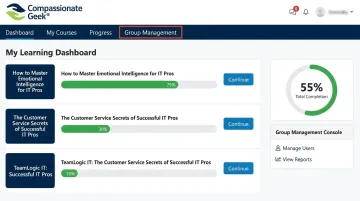
For teams building this from scratch, the self-paced IT Customer Service Training course runs $299 per seat, with volume discounts up to 60% off for groups of 500 or more. Any purchase of two or more seats also includes a free Group Management Console.
Measuring Whether Your Customer Service Is Truly Exceptional
Rules and culture only matter if you can prove they're working. Track these core metrics:
- CSAT (Customer Satisfaction Score): direct feedback after each resolved ticket
- NPS (Net Promoter Score): likelihood customers would recommend your team
- First-contact resolution rate: percentage of issues solved without escalation
- Customer retention rate: percentage of clients who stay long-term
According to TSIA (the Technology Services Industry Association), CSAT is a strong predictor of contract renewal in the tech industry. That connection shows satisfaction scores aren't just vanity metrics: they directly affect whether clients stick around.
Numbers only tell part of the story, though. These signs often reveal more about your service quality than any survey score:
- Unsolicited compliments from customers after interactions
- Referrals from existing clients without prompting
- Repeat business and contract renewals
If customers are recommending you without being asked, your team is doing something the metrics haven't fully captured yet.
Frequently Asked Questions
What are the five golden rules of customer service?
The Compassionate Geek framework identifies five core principles: Competence, Compassion, Empathy, Listening, and Respect. Together, they form the modern foundation underlying most golden rules of service, especially in technical support settings.
What is the 10-5-3 rule in customer service?
It's a proactive engagement sequence from retail: acknowledge a customer at 10 feet, smile at 5 feet, and greet them verbally at 3 feet. The underlying principle, noticing and engaging before customers have to ask, still applies in digital and IT support contexts.
Why is customer service especially important for IT teams and MSPs?
IT customers are often already stressed or blocked from their work when they reach out. Compassionate, competent service in that moment is a major driver of client retention and referrals for MSPs.
How is AI changing customer service in 2026?
The dominant model is hybrid: AI handles routine triage and repetitive tasks, while humans focus on complex, emotionally charged, or relationship-driven interactions. Gartner reports 95% of service leaders plan to retain human agents rather than replace them.
What skills are most essential for delivering exceptional customer service?
Active listening, empathy, clear communication in plain language, and solid technical competence form the core skill set. None of these work well in isolation; they reinforce each other.
How can I train my team to consistently deliver great service?
Structured training programs, regular role-play exercises, and certification paths like the Compassionate Geek Certified Company program help formalize skill development instead of leaving it to inconsistent, ad hoc coaching.