That confusion costs companies more than a mislabeled org chart. Get it wrong, and you'll hire a technical troubleshooter for a relationship-management job, buy a CRM when you needed an ITSM platform, or judge your IT team on customer satisfaction scores that were never designed for their kind of work.
This article breaks down what actually separates a help desk from customer service, where the two overlap, and why the people staffing either function need the exact same human skills to do their jobs well.
Key Takeaways
- Help desks support employees; customer service supports paying customers with billing, product, and relationship needs.
- The two functions differ in audience, goals, tools, and metrics — SLA/MTTR versus CSAT/NPS.
- Most growing organizations need both functions, staffed and measured separately.
- Both jobs live or die on the same foundation: competence, compassion, empathy, listening, and respect.
Help Desk vs Customer Service: Quick Comparison
Before going deep into either function, here's how they stack up side by side.
| Dimension | Help Desk | Customer Service |
|---|---|---|
| Who they serve | Internal employees needing IT support | External customers and prospects |
| Primary goal | Restore service and resolve technical issues fast | Build trust and retain the relationship |
| Common metrics | SLA compliance, MTTR, ticket backlog | CSAT, NPS, first response time |
| Frameworks | ITIL, tiered support (Tier 1-3), escalation paths | CRM-based lifecycle management, omnichannel engagement |
| Core skill emphasis | Technical troubleshooting plus patience and clarity | Relationship-building, active listening, emotional intelligence |
Notice what stays the same: both rows involve a ticket and a person waiting for resolution. The difference lies in who that person is and what "success" looks like to them.
What is a Help Desk?
A help desk is the centralized point of contact employees use when technology gets in the way of their work. Think password resets, VPN failures, hardware requests, or access provisioning for a new hire. It's operational by design, built to restore productivity rather than build rapport.
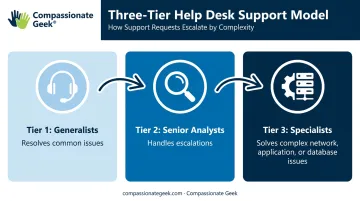
Most help desks are reactive by nature. Someone hits a wall, opens a ticket, and the clock starts. That's why help desks typically run on tiered support:
- Tier 1: Generalists who resolve common, high-volume issues on first contact
- Tier 2: Senior analysts handling escalations that need deeper investigation
- Tier 3: Specialists (network, application, database) who tackle the hardest problems
HDI (the Help Desk Institute) notes that the exact number of tiers and how work gets divided varies by organization. There's no single universal model, just a common pattern most IT shops adapt to their own size and complexity.
Why Resolution Speed Actually Matters
Downtime isn't a minor inconvenience. According to ITIC's 2024 Hourly Cost of Downtime Report, one hour of downtime exceeded $300,000 for more than 90% of midsize and large enterprises surveyed, with 41% of enterprises placing hourly costs between $1 million and $5 million or more.
This figure reflects organization-wide outages rather than isolated ticket delays. But it explains why help desks live and die by SLAs (service-level agreements defining expected response and resolution times) and MTTR (mean time to resolve, calculated as total resolution time divided by number of incidents). Every unresolved minute pushes an organization closer to that level of exposure.
Common Help Desk Use Cases
- New employee onboarding: provisioning laptops, software licenses, and network access before day one
- Recurring technical fixes: VPN drops, printer errors, application crashes
- Self-service deflection: knowledge bases and portals that let employees solve simple issues without opening a ticket at all
What is Customer Service?
Customer service manages the relationship between a company and the people who pay it. That relationship stretches across the full lifecycle: pre-sale questions, onboarding, billing disputes, complaints, renewals. Unlike a help desk, it's not purely reactive; good customer service teams reach out before a problem becomes a reason to leave.
That proactive approach spans multiple channels (email, chat, phone, social media) and leans on CRM or omnichannel platforms to keep a full history of every interaction a customer has had. Miss that context, and a customer feels like they're starting over every time they contact you. That's a fast way to lose them.
Why Sentiment, Not Uptime, Is the Scorecard
Success here comes down to CSAT (percentage of satisfied responses on a given interaction) and NPS (percentage of promoters minus percentage of detractors, based on a 0-10 likelihood-to-recommend score), not server uptime.
Those numbers matter because experience quality drives retention. Zendesk's 2025 CX Trends Report found that organizations it classifies as "CX Trendsetters" see 22% higher customer retention rates than their peers. That's a comparative finding, not a guarantee, but the direction is clear: how customers feel after an interaction shapes whether they stick around.
Common Customer Service Use Cases
Those retention gains show up in everyday interactions such as:
- Post-purchase support: order tracking, returns, refunds
- Account management: plan changes, billing disputes, upgrades
- Proactive outreach: onboarding check-ins and renewal reminders that catch churn risk early, before a customer ever files a complaint
Which One Does Your Organization Need?
Strip away the jargon and this comes down to three questions:
- Who is being supported: employees or paying customers?
- What does success look like: restored uptime or a satisfied customer?
- What does the daily work involve: troubleshooting a system or managing a relationship?
Your primary pain point points to the answer:
- Internal IT incidents piling up: you need a help desk model built around ticket triage and escalation.
- Customers churning after a bad experience: you need a customer service model built around sentiment and lifecycle tracking.
Here's the part many companies get wrong: most mid-sized and larger organizations need both, staffed and tooled separately.
A single team trying to juggle IT incidents and customer billing disputes with one platform usually does neither job particularly well. The skills, the metrics, and the urgency triggers are just too different to force into one workflow.
Beyond the Tools: Why Both Functions Need the Same Human-Centered Skills
Here's the thing nobody puts on the org chart: the audience and the metrics might differ, but the actual moment of interaction is the same. One person asks for help, another person provides it, whether that's an IT ticket or a billing complaint.
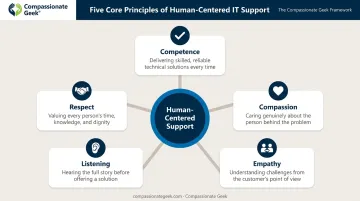
At Compassionate Geek, we've spent years teaching this through five core principles: Competence, Compassion, Empathy, Listening, and Respect. They're not abstract values. They're the difference between a technically correct resolution and one that actually leaves someone feeling helped.
- Competence without compassion feels cold: the fix works, but the person walks away feeling like a nuisance.
- Compassion without competence is just sympathy with no solution attached.
- Empathy means picturing yourself in the other person's seat, not just processing their problem.
- Listening (really listening, not waiting to talk) catches the detail that prevents a repeat ticket.
- Respect doesn't require feeling it. It requires acting on it, every time, regardless of how frustrated someone is.
An IT technician who fixes the VPN but talks down to a stressed employee fails the human half of the job. So does a customer rep who closes a ticket without ever acknowledging why the customer was upset in the first place.
This isn't a soft add-on to technical training. It shows results. HDI's Support Center Practices and Salary Report found that among organizations reporting increased customer satisfaction, 66% pointed to analyst competency or training as a contributing factor.
That's self-reported, not a controlled experiment. But it lines up with what we see repeatedly: teams that train on communication alongside technical skills report fewer repeat complaints and higher satisfaction scores.
That's the exact gap our IT Customer Service Training course was built to close, whether your team sits on a help desk, a customer service line, or both.
Organizations rolling it out across multiple teams can also look into the Compassionate Geek Certified Company program, which recognizes companies committed to building this skill set organization-wide.
The right structure for your support function depends on who you're serving and how the work flows. The right people-skills foundation isn't optional for either one.
Frequently Asked Questions
What is the difference between customer service and help desk?
A help desk primarily supports internal employees with IT-related issues, while customer service supports external customers with product, billing, and account needs. They serve different audiences and are measured with different tools and metrics.
What is the difference between help desk and service desk?
A help desk is tends to be reactive, focused on fixing individual incidents. A service desk has a broader, more proactive scope aligned with ITIL and overall IT service management, covering requests beyond just break-fix issues.
What is considered a help desk?
A help desk is any centralized function that logs, tracks, and resolves technical issues or requests. Most operate in tiers, with defined escalation paths and response processes for each level.
Can one team handle both help desk and customer service functions?
It's possible for very small teams, but it typically creates friction as an organization grows. Each function needs different tools, metrics, and skill emphasis to work well at scale.
What skills do both help desk and customer service professionals need to succeed?
Both roles depend on active listening, empathy, and clear communication in addition to technical or product knowledge. These are learnable skills, not fixed personality traits, and can be developed through targeted training.
Do small businesses need separate help desk and customer service teams?
Small businesses often start with one combined team, which works fine at low volume. As ticket complexity and customer count grow, plan to separate the two functions before overlap hurts both.