
Introduction
A brilliant fix means nothing if the customer walks away feeling dismissed. Technical skill alone no longer buys loyalty. In a global survey of 15,000 consumers, 32% said they'd leave a brand they loved after just one bad experience, according to PwC's Future of Customer Experience report.
Many IT organizations pour budget into ticketing systems, chatbots, and dashboards, yet overlook the human skills and culture that keep customers around. Building genuine trust takes attentive listening and follow-through, qualities no dashboard can replicate.
This guide breaks down proven strategies for improving customer service, from foundational people skills to the systems, culture, and metrics that sustain them. It's written with IT and technical support teams specifically in mind.
Key Takeaways
- Great service pairs technical competence with compassion, empathy, listening, and respect
- Fast resolution and consistent omnichannel support matter, but human connection wins loyalty
- CSAT, NPS, and First Contact Resolution give you the data to prove improvement is real
- A culture that treats employees well produces better customer outcomes
Why Customer Service Improvement Matters
The financial risk of bad service is not theoretical. That 32% abandonment rate from PwC applies even to brands customers already love, meaning loyalty offers less protection than most companies assume.
There's a performance link too. Peer-reviewed research from Morgan and Rego found that average customer satisfaction scores help predict future business performance, including sales growth. Separately, Forrester's 2024 CX Index reported that customer-obsessed organizations saw 41% faster revenue growth and 51% better retention than their peers.
That growth advantage traces back to individual moments — the ones many companies lump together under one vague label.
Service vs. Experience: What's the Difference?
These terms get used interchangeably, but they're not the same thing:
- Customer service is the individual interactions — a support call, a chat session, a ticket resolution
- Customer experience is the customer's overall perception, built across every touchpoint and interaction over time
Service quality heavily shapes that broader experience. A single rude or unhelpful support call can undo months of goodwill built through a smooth product experience.
Build the Foundational Human Skills Every Team Needs
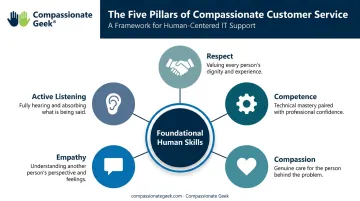
Lasting improvement starts with developing specific interpersonal skills in every team member, not just running another technical training session. Don Crawley, founder of Compassionate Geek, built his entire training philosophy around five pillars that now anchor his company's IT customer service curriculum.
Competence
Deep product and technical knowledge builds customer confidence and speeds up resolution. When a technician clearly knows the system, customers relax almost immediately.
The absence of that knowledge is a top-tier frustration. Microsoft's global survey of 5,000 consumers found that 29% cited a representative's lack of knowledge or ability to resolve their issue as a leading source of frustration, per Microsoft's State of Global Customer Service report. Competence isn't optional. It's the entry ticket.
Compassion
Compassion goes beyond a scripted response. It means genuinely caring about what the customer is going through, not reciting an approved line about understanding their frustration.
This matters most in technical support, where customers often feel helpless or embarrassed about not understanding their own equipment. A technician who recognizes that vulnerability and responds with real kindness, in their own words rather than a script, builds trust a canned phrase never will.
Empathy
Acknowledging frustration before jumping into solutions calms a tense call fast. Skip that step, and even a correct fix can feel cold.
Customers expect this. Salesforce's research across 12,000 consumers and business buyers found that 68% expect brands to demonstrate empathy, but only 37% said companies generally deliver it. That gap is an opportunity: teams that close it stand out immediately.
Active Listening
Active listening isn't passive. It's a set of techniques:
- Summarize to confirm: ask permission to restate the issue, then paraphrase it back
- Ask open-ended clarifying questions before proposing any fix
- Listen without interrupting or forming judgments mid-explanation
- Listen for context: focus on what the customer is trying to accomplish, not just the symptom they reported
These habits uncover the real problem faster and cut down on repeat contacts, since misdiagnosed issues are the top reason tickets bounce back.
Respect
Every customer deserves respect, regardless of their technical literacy. So does every colleague. Talking down to a confused user or dismissing a coworker's input erodes trust and creates friction that eventually reaches the customer anyway.
Compassionate Geek's training programs build their entire curriculum around these five principles: Competence, Compassion, Empathy, Listening, and Respect, presented as a practical framework organizations can actually adopt, not just admire.
Strengthen Systems, Culture, and Team Support
Skills alone don't sustain improvement. You need systems that reinforce them.
Start with the data you already have. Analyze current service metrics and customer feedback (CRM history, support tickets, online reviews) before setting any improvement goals. Guessing at problems wastes training budget on the wrong fixes.
Set SMART Service Standards
Vague goals like "answer faster" don't work. Specific, measurable, achievable, relevant, and time-bound (SMART) standards do. For example, answering 80% of calls within 20 seconds is a common benchmark, though the right target depends on your staffing, channel mix, and ticket complexity. HDI/MetricNet research on IT service desks puts the global average speed of answer around 98 seconds, with wide variation by organization.
Offer Consistent Omnichannel Support
Customers hate repeating themselves. Salesforce found that 76% expect consistent interactions across departments, yet 54% felt sales, service, and marketing didn't share information. That disconnect shows up as a customer explaining the same issue three times across phone, chat, and email.
A shared context system, where every channel sees the same ticket history, closes that gap.
Invest in Training and Break Down Silos
One-time onboarding training doesn't stick, and neither does consistency when departments work in isolation. Formal, recurring programs solve the training half: Compassionate Geek's Certified Company program helps organizations embed a consistent, customer-focused culture through Green and Silver certification levels, rather than leaving service quality to individual personalities.
Cross-team collaboration solves the other half. Nothing frustrates a customer faster than being passed from department to department, so build these into your process:
- Shared ticket visibility so any rep can see the full history
- Joint escalation paths that route issues to the right team fast
- Regular handoff reviews that catch dropped tickets before they become complaints
Measure What Matters: Tracking Your Progress
You can't improve what you don't measure, so start with the three metrics that matter most:
| Metric | What It Measures | Healthy Signal |
|---|---|---|
| CSAT | Satisfaction with a specific interaction | Compare against your own history and industry peers, not a fixed number |
| NPS | Likelihood to recommend | Above 0 is good, above 20 is favorable, above 50 is excellent |
| CES | How much effort the customer spent resolving their issue | Lower effort scores generally correlate with loyalty |
First Contact Resolution and Response Time
First Contact Resolution (FCR) deserves particular attention in IT support. HDI reports an average net FCR around 74% across service desks worldwide, though the range spans from 41% to 94% depending on the support model. Track response time targets separately by channel — phone, email, and chat all carry different reasonable expectations.
Close the Feedback Loop
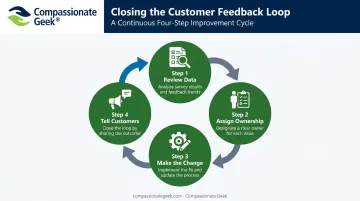
Collecting survey data means nothing if it sits in a spreadsheet. Closing the loop means:
- Reviewing complaint and survey data on a regular cadence
- Assigning ownership for acting on recurring themes
- Making the change, such as updating a process, script, or training module
- Telling customers what changed because of their feedback
American Express did exactly this after customer feedback on replacement-card procedures. First-call resolution rose more than 20%, and NPS among affected customers reached parity with the rest of their base.
Common Customer Service Mistakes That Undermine Improvement Efforts
Even well-intentioned improvement plans fail for predictable reasons.
Over-relying on automation without a human escalation path. Self-service tools are useful for routine tasks, but customers want a person when things get complicated. Gartner found that 64% of customers would prefer companies not use AI in customer service at all, and 53% would consider switching providers over it. Difficulty reaching a live person was their top concern, according to Gartner's 2024 customer service survey.
Siloed departments with inconsistent messaging. Even flawless individual interactions erode trust if the next department contradicts the last one or asks the customer to start over.
Neglecting employee experience. Gallup's meta-analysis found a median 10-point difference in customer loyalty between business units with top-quartile versus bottom-quartile employee engagement, plus notably higher profitability. Poorly supported, undertrained staff often carry that neglect straight into how they treat customers. This is why Compassionate Geek treats internal team culture and customer service as a single, connected challenge.
Frequently Asked Questions
What are three ways to improve customer service?
Focus on personalization, active listening paired with empathy, and consistent multi-channel support so customers never repeat themselves. These three deliver measurable impact fastest, especially for technical support teams handling frustrated users.
What are the 5 core principles of good customer service?
Competence, Compassion, Empathy, Listening, and Respect. Compassionate Geek built its entire training framework around these five pillars, giving each one equal weight alongside technical skill.
How can technology improve customer service without losing the human touch?
Use AI and chatbots for routine, repetitive tasks like password resets or status checks. Route complex or emotionally charged issues to trained human agents quickly, with no dead ends in the self-service flow.
What customer service skills matter most for IT and technical support teams specifically?
IT customers often feel frustrated or out of their depth. Empathy, jargon-free communication, and patience matter just as much as technical accuracy in these interactions.
How do you measure whether customer service has actually improved?
Track CSAT, NPS, and First Contact Resolution trends over time rather than single snapshots. Consistent upward movement across all three, alongside declining repeat contacts, confirms real improvement.
How often should customer service training be updated?
Treat it as ongoing, not a one-time onboarding event. Refresh training around new products, recurring complaint themes, and shifting customer expectations at least a few times a year.