
Customer service skills are the behaviors, knowledge, and communication abilities that let support professionals understand a need, solve the underlying problem, and leave the customer better off than they found them. That applies before, during, and after the interaction, whether it happens over the phone, in a chat window, or standing at someone's desk.
This article breaks down the types of customer service skills that matter most in IT, shows what they look like in real support conversations, explains how to build them deliberately, and covers how to describe them credibly on a resume or in an interview.
Key Takeaways
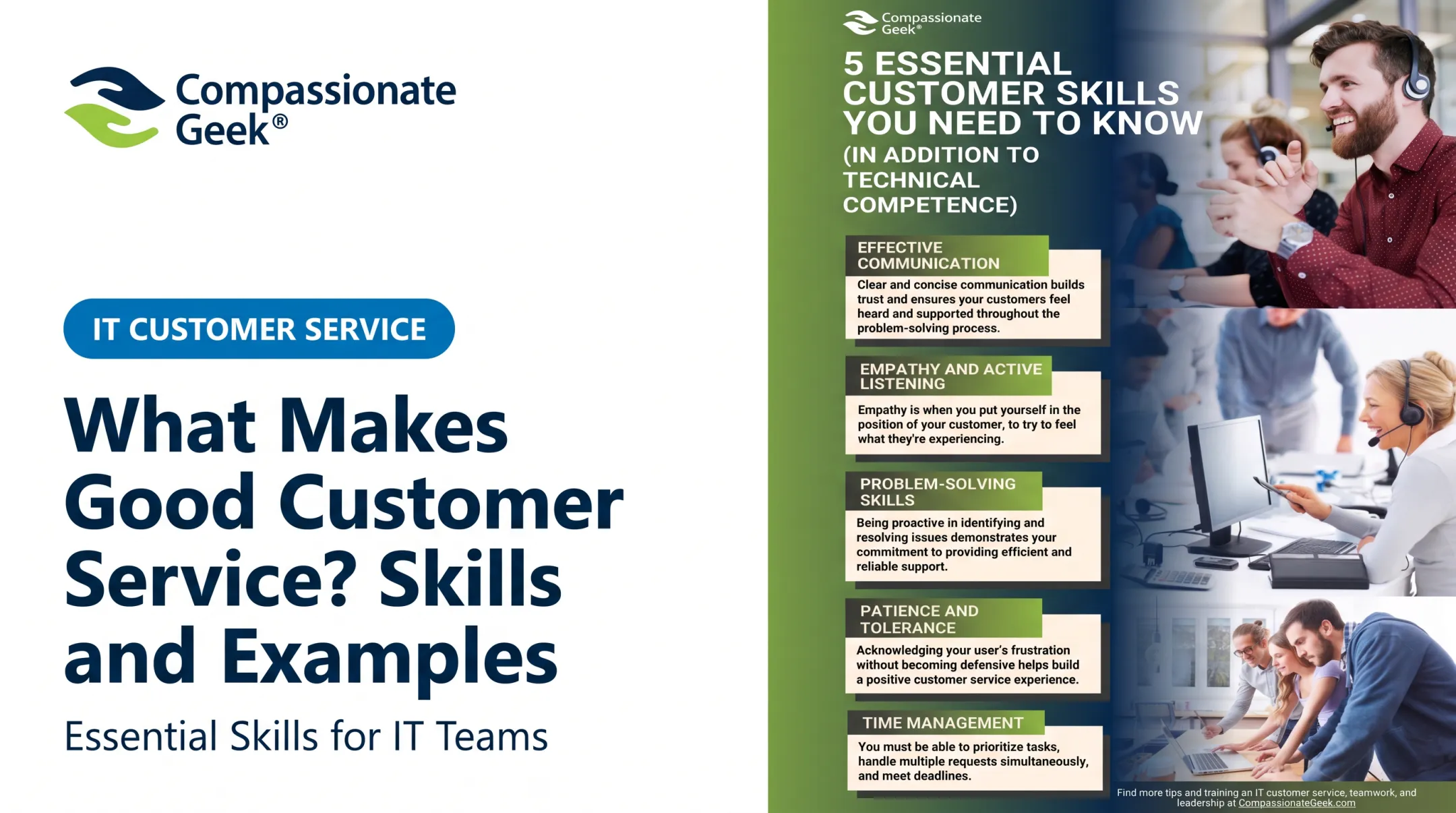
- Customer service skills blend soft skills (empathy, listening) with technical skills (troubleshooting, tool proficiency). Neither works well alone.
- The strongest support interactions pair genuine human understanding with a clearly explained, competent solution.
- Skills improve through realistic practice, coaching, and honest feedback, not one-time training sessions.
- Resume claims land better when tied to a specific action, tool, or outcome instead of a vague adjective.
What Are Customer Service Skills? Types and Why They Matter
Customer service skills let a support professional understand what a customer needs, communicate clearly, resolve the issue, manage expectations, and follow through — regardless of whether the conversation happens over phone, email, chat, or in person.
In IT, the stakes are specific. A user calling about a "system down" issue may be losing billable hours, missing a deadline, or facing a client who's already annoyed.
They often lack the technical terms to describe what's wrong, and they're anxious about whether anyone is even working on it. The technician has to solve two problems at once: the technical fault and the human stress surrounding it.
Soft Skills and Technical Skills Aren't Separate Silos
In practice, soft skills and technical skills overlap on every ticket:
- Soft skills: empathy, active listening, patience, emotional intelligence, clear communication
- Technical skills: product knowledge, troubleshooting, ticketing or CRM use, documentation, escalation
Here's how they work together in a single interaction: a technician listens to a user's description, identifies the likely cause, explains the fix in plain language, documents what happened, and confirms the user can get back to work. Skip any one of those steps and the interaction feels incomplete, even if the technical fix was correct.

Gartner's 2025 analysis of IT service desks notes that technology-centered metrics can miss the human factors that actually shape satisfaction and successful technology adoption — meaning a resolved ticket doesn't always equal a satisfied user (Gartner).
That gap is why the human side matters as much as the fix. Compassionate Geek frames it through five principles: competence, compassion, empathy, listening, and respect. None of them replace technical skill. They decide whether that skill lands with the person on the other end of the call.
Essential Customer Service Skills: Types, Examples, and Behaviors
These skills work best as observable behaviors, not personality traits. Here's how each one shows up in an actual IT support conversation.
Active Listening and Clarification
A user says, "the system is down." That single sentence could mean a dozen different things. Active listening means paraphrasing what you heard, asking focused follow-up questions, and checking assumptions before you act.
A skilled technician would ask:
- Which device or application is affected?
- When did it start, and did anything change beforehand?
- What symptoms are showing up exactly?
- Who else is affected, and what work is blocked?
Paraphrasing and summarizing next steps prevents misdiagnosis. It also makes the customer feel heard, which matters just as much as the fix itself.
Empathy, Patience, and Emotional Intelligence
You can acknowledge frustration without promising something you can't deliver. Separate the customer's emotion from the technical investigation so both get handled properly.
For an outage: "I can see why this is frustrating, especially mid-morning. Let's figure out what's happening."
For a recurring issue: "I understand this keeps coming back, and that's not acceptable. I want to find the actual root cause this time, not just patch it again."
Calm, respectful language reduces tension without overpromising a fix timeline you haven't confirmed.
Clear Communication and Translating Technical Information
Compare these two responses to the same problem:
Vague: "Looks like a disk I/O error causing file corruption on the volume."
Clear: "I've found the cause — the file is corrupted, and I'll need to restore it from backup. That could take up to 90 minutes, and I'll update you at the 45-minute mark."
The second version tells the customer what happened, what happens next, and when to expect an update, with zero jargon. That structure (cause, action, timeline) works for almost any technical explanation.
Problem-Solving, Resourcefulness, and Sound Escalation
A structured approach looks like this:
- Define the issue based on what the customer described and what you've verified.
- Identify the likely root cause, not just the visible symptom.
- Test a plausible fix and confirm the outcome with the user.
- Explain alternatives if the first attempt doesn't work.
- Escalate when the issue exceeds your access, authority, or expertise.
Sometimes the best service is a well-documented escalation with clear ownership, a realistic timeline, and a planned follow-up. A rushed, incomplete handoff creates more frustration than an honest "this needs a specialist, and here's what happens next."
Technical Competence, Product Knowledge, and Tool Proficiency
Competence includes the systems you support, plus common failure points, security requirements, escalation paths, and the customer's history with similar issues. It also means knowing when not to guess.
A technician who verifies before acting, documents accurately, and keeps their knowledge current as tools and policies change is demonstrating competence just as much as one who fixes something fast.
Adaptability, Attention to Detail, Teamwork, and Follow-Through
Not every customer communicates the same way. Some want a quick chat message; others want a phone call and a walkthrough. Representatives adjust their style while keeping service standards consistent.
That consistency includes:
- Checking account details and recording complete notes
- Looping in other teams when needed
- Confirming resolution and following up on open items
Skills in action: An employee is locked out of a business application before a client meeting. The technician listens without interrupting, reassures the employee that this is fixable, and verifies their identity per security policy.
They resolve the access issue (or escalate if it's beyond a password reset), explain how to avoid the lockout next time, and log the full interaction. That's five skills in sequence: listening, empathy, security awareness, problem-solving, and documentation.

How to Improve Customer Service Skills
Improving these skills works better as a deliberate cycle than a one-off training day.
Start With a Skills Assessment
Review customer feedback, quality-assurance notes, ticket audits, repeat contacts, and escalation patterns to identify one or two priority behaviors, not everything at once.
HDI's guidance on ticket-quality reviews recommends checking description completeness, correct categorization and urgency, accurate solutions, and proper escalation (HDI). Its commonly cited sample of four tickets per analyst per month is a rule of thumb, not a fixed standard; use whatever sample size fits your team.
Practice Through Role-Play and Realistic IT Scenarios
Rehearse the situations that actually cause friction:
- Full outages affecting multiple users
- Customers who are already upset before you answer
- Vague or incomplete problem descriptions
- Security-sensitive requests (password resets, access changes)
- Failed fixes that need a second attempt
- Delayed responses that require an honest update
Role-play can target one behavior at a time: clarifying questions, an empathy statement, a plain-language explanation, or an escalation handoff. Don't try to fix everything in one session.
Improve Technical Knowledge and Communication Together
Structured product learning, knowledge-base review, and ticketing-system training matter, but they're incomplete without communication practice. Have technicians explain a fix to someone nontechnical, not just recite the procedure.
HDI's 2025 survey found that 54% of organizations reported increased training complexity over the past three years (HDI). Static, one-time training doesn't keep pace with changing tools and policies.
Use Feedback, Coaching, and Deliberate Reflection
Ask a manager, peer, or customer for feedback on one behavior — listening, clarity, tone, or follow-through — rather than a general review. After a completed interaction, ask:
- What did the customer actually need?
- What did I assume, and was it correct?
- What did I explain clearly, and what confused them?
- What should happen differently next time?
Managers get better results coaching from specific, observable examples than from generic criticism like "be more empathetic."
Make Improvement Continuous
Short, recurring learning activities (scenario refreshers, peer knowledge sharing, post-incident reviews) reinforce skills more effectively than a single annual training. Compassionate Geek's on-demand courses, including How to Be a Better Listener and its emotional intelligence and conflict resolution training, are built for this kind of ongoing, virtual reinforcement rather than a one-time workshop.
Measure both customer experience and operational results together, so efficiency gains don't come at the cost of accuracy or empathy.

How to Describe Customer Service Skills on a Resume or in an Interview
Listing "friendly" or "helpful" on a resume tells an employer nothing verifiable. Describing the behavior and result behind the skill does.
A Formula for Evidence-Based Statements
Action taken + customer or technical situation + skill demonstrated + verified result or responsibility.
Examples to adapt:
- "Documented and resolved an average of 15 support tickets weekly, translating technical root causes into plain-language updates for nontechnical staff."
- "Coordinated escalations between tier-1 support and network engineering, maintaining clear ownership and follow-up on unresolved requests."
- "Rewrote knowledge-base articles for a common login issue, reducing repeat questions from the same department."
Tailoring to the Job Description
Match the skills the posting actually lists. Common ones in IT support roles include:
- Active listening
- Troubleshooting
- CRM or ticketing tools
- Conflict resolution
- Product knowledge
- Written communication
Don't copy keywords you can't back up with a real example. Interviewers ask follow-up questions.
For Interviews: Use Situation-Action-Result
Prepare short, specific stories using this structure:
- Situation: the user's problem and its business impact
- Action: what you did—listening, diagnosing, explaining, or escalating
- Result: what you verified afterward, and what the customer could do next
Prepare at least one example each for empathy, problem-solving under pressure, adaptability, and accountability for a mistake. A real, slightly imperfect story is more convincing than a polished one that sounds rehearsed.

Conclusion
Excellent IT customer service is competent technical support delivered with compassion, patience, and clear communication. The path to building it is straightforward: identify one or two priority skills, practice them in realistic scenarios, get specific feedback, keep your technical knowledge current, and review real evidence of what's improving.
Don R. Crawley's philosophy behind Compassionate Geek captures the core idea: IT professionals solve human problems through technology, not the other way around.
For IT professionals, managers, and MSPs building these skills across a team, Compassionate Geek's customer service and professional development training offers a structured, IT-specific starting point. That includes the Compassionate Geek Certified Company program.
Frequently Asked Questions
What are the top 3 skills of a customer service agent?
Active listening, empathy, and clear problem-solving communication top the list. In IT specifically, technical competence is just as essential. Customers need an accurate fix, not just a kind tone.
How do I describe my customer service skills?
Pair each skill with a specific behavior, situation, tool, or verified outcome instead of listing adjectives like "friendly." For example, describe how you resolved a ticket type, not just that you're "good with people."
What is the difference between soft skills and hard skills in customer service?
Soft skills are interpersonal abilities like empathy, listening, and communication. Hard skills are technical abilities like product knowledge, troubleshooting, and ticketing tools. IT support requires both working together.
How can I improve my customer service skills at work?
Get specific feedback on one behavior at a time, practice through role-play scenarios, keep technical knowledge current, and review your own interactions afterward to spot what to change next time.
Why are customer service skills important in IT support?
IT issues often cause real stress and business disruption, not just inconvenience. Technical fixes alone don't resolve that stress. Clear, respectful communication is what rebuilds the customer's confidence.