
The personality traits of your ticket management staff shape everything: how fast issues get resolved, how satisfied customers feel afterward, and what kind of culture your team builds day to day. It's not just the software doing the work.
This article breaks down the personality traits that separate good ticket handlers from great ones, grounded in Don R. Crawley's Compassionate Geek philosophy. As Crawley puts it, IT professionals "are not just solving technical problems, but human problems."
Key Takeaways
- Ticket management success blends technical skill with empathy and patience
- Empathy, active listening, patience, communication, composure, and adaptability drive outcomes
- These traits directly improve CSAT, first-contact resolution, and reopen rates
- Hiring and structured training build these traits, not just identify them
Why Personality Matters as Much as Process in Ticket Management
Ticket management is the full cycle of logging, prioritizing, resolving, and closing support requests. Most industry conversations about improving this process focus on tools: automation rules, AI-assisted triage, self-service portals.
All useful. None of it replaces the human agent who actually determines whether those systems deliver value.
Here's the data point that backs this up. A 2016 HDI analysis of 803 support organizations found customer satisfaction averaged 5% higher at organizations where employees reported being satisfied or very satisfied in their own roles. Happy employees, in other words, tend to produce happier customers.
That connection isn't proof of direct causation, but it lines up with what most experienced IT managers already sense. A burned-out, disengaged agent handles tickets differently than one who's engaged and equipped with the right interpersonal tools.
The traits below are what fill that gap.
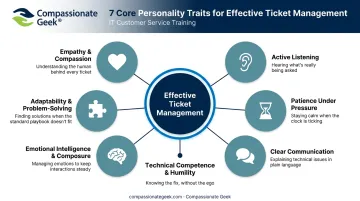
Top Personality Traits for Effective Ticket Management
This list draws from established customer service research and the "Competence, Compassion, Empathy, Listening, Respect" framework used in Compassionate Geek training. Each trait works alongside, not instead of, technical skill.
Empathy and Compassion
Empathy means understanding a user's frustration, not just diagnosing their broken printer or crashed application. Compassion is what happens when an agent acts on that understanding instead of just noting it.
Empathetic agents tend to reduce escalations because users feel heard before they feel dismissed. A Genesys survey of 5,000 consumers across six countries found only 52% felt treated with empathy when contacting customer support. Roughly half walk away feeling unheard, regardless of whether their technical issue got fixed.
In practice, this looks simple: acknowledging that a crashed laptop before a client presentation is genuinely stressful, before launching into troubleshooting steps.
Active Listening
Active listening means fully absorbing what a user says, and doesn't say, before jumping to a scripted fix. It's the difference between hearing "my email isn't working" and understanding that the user actually means their calendar invites aren't syncing.
Misdiagnosis drives ticket reopens, making this trait essential to first-call resolution. Among technical-support organizations using QA scorecards, 94% assess communication skills like probing, listening, and paraphrasing as part of quality reviews.
A practical example: paraphrasing the issue back ("So you're saying the sync stopped after yesterday's update, is that right?") before logging the ticket. It catches misunderstandings early, before they become a second ticket.
Patience Under Pressure
Patience is the ability to stay steady through repetitive, high-volume, or emotionally charged interactions without letting frustration leak into tone or word choice.
Patience protects both service quality and the agent. Help desk burnout runs high during ticket surges, when the same three questions repeat fifty times in a shift.
A patient agent calmly walks a non-technical user through basic steps, like restarting a router, without sighing audibly or rushing the explanation. Small thing. Huge impact on how that interaction gets remembered.
Clear and Respectful Communication
This trait means translating technical problems into plain language while keeping the tone professional and respectful. It's not dumbing things down; it's meeting the user where they are.
Jargon-free updates reduce follow-up tickets because users actually understand what happened and what to expect next. Compare these two:
- Internal note: "DNS TTL misconfigured on secondary NS, propagation delay resolved."
- User-facing update: "We found the cause of the intermittent connection issue and fixed it. You may notice full resolution within the hour."
Same fix. Very different experience for the person waiting on an answer.
Technical Competence Paired with Humility
Competence means staying current on the tools and systems an agent supports. Humility means knowing when to escalate rather than guessing.
Overconfidence without competence produces bad fixes. Competence without humility produces agents who won't ask for help even when they're stuck, which stalls tickets indefinitely.
A grounded example: an agent hits an unfamiliar error, documents exactly what's been tried so far, and loops in a specialist instead of spending two hours guessing. That approach closes tickets faster than guesswork ever could.
Emotional Intelligence and Composure
Emotional intelligence is the ability to read tone and urgency in a ticket or call, then adjust the response accordingly. A one-line ticket in all caps reads differently than a polite, detailed request.
HDI's 2024 survey of more than 100 support professionals identified emotional intelligence, alongside leadership and problem-solving, as a critical skill for superior service delivery.
Recognizing frustration early, in the wording of a ticket, before it escalates into a phone call, lets an agent proactively soften their tone and set clearer expectations. That single adjustment often prevents a two-star review.
Adaptability and Creative Problem-Solving
Adaptability is the willingness to move past the standard script when a ticket doesn't fit the usual pattern. Not every issue lives neatly in the knowledge base.
Edge cases test this trait most, the ones automation and SOPs can't fully anticipate. An adaptable agent might combine two unrelated workaround steps, one from a printer issue and one from a network fix, to solve a problem nobody has documented yet.
Rigid agents get stuck here. Adaptable ones find a path forward.
How These Traits Impact Key Ticket Management Metrics
Soft skills aren't just nice to have. They move numbers that IT managers already track, from customer satisfaction scores to agent turnover. Three traits show the clearest impact:
| Trait | Metric Impacted | Key Data |
|---|---|---|
| Empathy & active listening | CSAT | CSAT averaged 5% higher at organizations with satisfied employees (per HDI); communication skills rank as the most commonly assessed QA metric industry-wide |
| Patience & clear communication | First-contact resolution & reopen rates | Average net FCR near 74% (range 41%–94%); MetricNet identifies FCR as a major driver of CSAT |
| Composure & adaptability | Agent retention | 65% of surveyed US IT decision-makers reported rising, unsustainable stress and burnout among help desk staff |
These numbers compound over time. Burned-out agents make more mistakes, quit faster, and drag down service quality for everyone left behind. Composure doesn't just ease individual interactions; it also helps stabilize the whole team long-term.
How to Build These Traits Across Your Team
These traits are learnable skills, not fixed personality types. You can hire for them and strengthen them through training.
Hiring for the Right Traits
- Ask behavioral questions before evaluating pure technical skill, such as "Tell me about a time you had to calm down a frustrated user"
- Look for candidates who describe listening first, not jumping to solutions in their answers
- Probe for how candidates handled a mistake, since humility under pressure reveals more than a resume ever will
Training the Traits Formally
Structured training turns vague intentions into repeatable behavior. Compassionate Geek's self-paced course, The Secrets of Customer Service for Successful IT Professionals, builds directly around the Competence, Compassion, Empathy, Listening, and Respect framework, covering:
- Empathy and active listening as a paired skill set
- Patience and tolerance techniques for defusing frustration without becoming defensive
- Email, chat, and call communication best practices
- Emotional intelligence techniques for regulating your own reactions
Beyond the curriculum itself, rolling training out to a team also means managing licenses efficiently. Group licenses include a free management console for tracking enrollment, useful for IT managers deploying this across a whole help desk team.
Reinforcing Culture Long-Term
- Run regular coaching sessions using real ticket transcripts as teaching moments
- Recognize soft-skill wins in team meetings, not just fastest-resolution awards
- Build feedback loops where users can flag both technical and interpersonal experiences
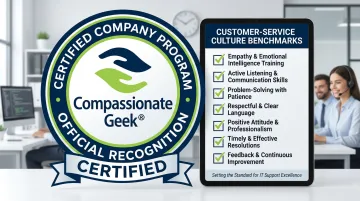
For organizations wanting to formalize this, the Compassionate Geek Certified Company program benchmarks and certifies a team's customer-service culture, giving managers an external standard to build toward.
Conclusion
Ticketing software, automation, and AI triage are only as effective as the people running them. A perfectly configured system still fails if the agent behind it can't communicate clearly or stay composed under pressure.
Treat traits like empathy, patience, and adaptability as trainable skills you can develop over time. Invest in them the same way you'd invest in a new ticketing platform, with intention and follow-through.
If you're ready to build a more human-centered ticket management team, explore Compassionate Geek's training programs and certification to see where your team stands today.
Frequently Asked Questions
What skills do you need to be a ticket manager?
Effective ticket management requires technical troubleshooting ability paired with soft skills like empathy, active listening, and clear communication. Neither alone is enough; the best agents blend both consistently.
Why is ticket management important?
Ticket management directly affects customer satisfaction, operational efficiency, and user trust in your support function. Poor ticket handling creates repeat contacts, frustrated users, and reputational damage over time.
How do you manage tickets?
The ticket lifecycle includes creation, assignment, resolution, and closure, typically tracked through a help desk platform. The process matters, but the people skills applied at each stage matter just as much.
Can personality traits like empathy and patience be trained?
Yes. Structured coaching and training programs, such as Compassionate Geek's courses built on its five core principles (competence, compassion, empathy, listening, and respect), help agents develop these traits systematically rather than relying on them as innate qualities.
What's the difference between technical skills and soft skills in ticket management?
Technical skills cover system knowledge and troubleshooting ability. Soft skills cover communication, empathy, and patience. Strong ticket management requires both working together, not one substituting for the other.
How do personality traits affect customer satisfaction in IT support?
Traits like empathy and clear communication directly shape CSAT scores by reducing escalations and repeat contacts. Users who feel heard and informed are far less likely to reopen a ticket or leave a negative review.