
Introduction
By 2026, most Tier-1 IT tickets won't need a human at all. AI chatbots and automated scripts already resolve password resets and routine troubleshooting long before a technician ever gets involved.
So what's left for IT professionals to do? Increasingly, it's the work machines can't replicate: reading a frustrated user's tone, de-escalating a tense conversation, and explaining a technical fix in plain language.
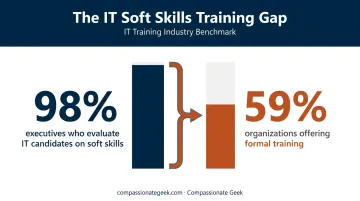
Soft skills training for IT professionals now means structured programs that teach communication and emotional intelligence, applied through customer-service scenarios specific to technical roles. In a CIO survey of 1,250 executives, 98% evaluated IT candidates on soft skills, and 66% rejected an otherwise-qualified candidate for lacking them.
This article breaks down the five trends reshaping IT customer service training in 2026, the forces driving them, how they're changing IT organizations, and what to watch for next.
Key Takeaways
- AI automation makes empathy and communication the top IT differentiator
- EQ training now factors into hiring and performance requirements
- Company-wide certification programs are replacing one-off skill badges
- Microlearning and on-demand formats are replacing full-day seminars
- Early adopters report stronger retention, satisfaction, and client trust
Key Trends Shaping Soft Skills Training for IT Professionals in 2026
Five trends stand out as IT leaders plan their 2026 training budgets. Each reflects a different pressure point, from AI capability to distributed, multilingual teams.
Trend 1: AI and Automation Are Elevating the Value of Human-Centric Skills
Generative AI now handles the work that used to fill a technician's day: ticket triage, basic scripting, and tier-1 troubleshooting. Support and service leaders report growing executive pressure to deploy AI, along with bigger automation budgets than a year ago.
Picture a service desk where a chatbot resolves a printer connection issue in ninety seconds, while a technician spends twenty minutes talking a panicked office manager through a ransomware incident. The chatbot doesn't need composure. The technician does.
As AI capability expands, what's left for people is the work requiring judgment, empathy, and nuanced communication. That's becoming a genuine competitive advantage:
- Shifts routine, rules-based tasks to AI agents
- Keeps complex, emotionally charged escalations with human staff
- Widens the gap between "average" and "indispensable" IT staff
Trend 2: Emotional Intelligence and Empathy Are Becoming Core IT Competencies
EQ training used to be an optional workshop. It's now showing up in hiring rubrics, service desk performance reviews, and MSP client-satisfaction targets.
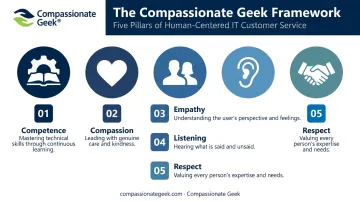
Don R. Crawley's Compassionate Geek framework offers a structured way to teach this. It breaks emotionally intelligent client interaction into five principles:
- Competence: staying current on systems and knowing your subject thoroughly
- Compassion: recognizing distress and responding to reduce it
- Empathy: understanding how the other person perceives their situation
- Listening: active listening, note-taking, and resisting the urge to interrupt
- Respect: treating every person with dignity, without sarcasm or dismissiveness
Quality-assurance research from HDI shows most technical support organizations now grade agents on tone, professionalism, and relationship-building, not just resolution speed. That shift means EQ now shows up directly in performance reviews and raises, not just customer feedback surveys.
Trend 3: Personalized, Microlearning-Based Delivery Is Replacing Generic Seminars
Day-long seminars are losing ground to bite-sized, on-demand video modules that fit into a technician's actual schedule. About two-thirds of talent-development professionals used microlearning in 2025, up 28 percentage points since 2017, according to ATD's research on practical microlearning strategies.
Compassionate Geek's own training portal reflects this shift. Instead of pulling an entire help desk offline for a full-day session, IT managers can assign a self-paced course, track a Group Management Console, and let staff work through modules between tickets.
That format matters more for distributed teams. On-demand access, available in English, French (Canadian), and Spanish (Mexican), lets global teams train on their own time zone, not a single trainer's calendar.
Trend 4: Formal Certification Programs for Customer-Centric IT Culture Are Rising
Individual certificates are giving way to something bigger: company-wide certification that proves a sustained service culture, not just one employee's completed course.
The Compassionate Geek Certified Company program, with Green and Silver levels, gives MSPs and IT organizations a way to signal that commitment to prospective clients. TeamLogic IT, for example, offers a co-branded version of the course to its franchise network, tying the certification directly to how it positions itself in a crowded MSP market.
Why it matters: certification creates external differentiation and internal accountability at the same time. It's harder to let a service culture slip when the whole organization, not just one technician, has something to maintain.
Trend 5: Hybrid and Remote IT Teams Demand Cross-Cultural Communication Training
Distributed IT teams are the norm now. Stack Overflow's 2025 Developer Survey of more than 49,000 respondents found 32.4% working fully remote, with the rest split across in-person and hybrid arrangements.
That distribution creates a real problem: written clarity and virtual communication norms matter more when you can't read body language on a call. Multilingual training platforms and virtual live-video sessions, delivered in multiple languages, address this by meeting dispersed teams where they work rather than forcing everyone into one time zone or one language.
What's Driving These IT Soft Skills Training Trends
Four forces are converging to push soft skills training up the priority list for 2026 budgets.
- Technology advances: Generative AI and automation now handle routine tasks, freeing staff time for higher-value, people-facing work
- Market demand: Improving customer experience ranks as IT leaders' second-highest priority, just behind AI research, according to Foundry's State of the CIO research
- Cost pressures: Escalated tickets and turnover carry real costs, pushing organizations toward emotional intelligence (EQ) and de-escalation training to avoid them
- Competitive dynamics: As core technical offerings become commoditized, MSPs and IT service providers differentiate on the service experience itself
None of these forces work in isolation. A service desk automating tier-1 tickets frees up time; that time only creates value if staff know how to use it on complex, emotionally charged interactions.
How These Trends Are Impacting IT Organizations
These trends are reshaping workflows, budgets, and hiring criteria across IT organizations, not just training calendars.
Operational Impact: EQ and communication checkpoints are getting built directly into ticketing and escalation workflows. Instead of measuring resolution time alone, some organizations now flag tickets for tone and require a soft-skills check before escalation. Onboarding programs increasingly blend technical certification with communication training from day one, rather than treating the two as separate tracks.
Business Impact: L&D budgets are shifting toward soft skills as a strategic line item, not an afterthought. MSPs are actively marketing certifications and service culture as client-facing differentiators in proposals and renewals.
According to HDI case studies, support organizations that make service certification mandatory report customer-satisfaction ratings above 95%.
Workforce Impact: Soft skills are carrying more weight in IT hiring and promotion decisions. Per the CIO-reported survey cited earlier, 98% of executives evaluate IT candidates on soft skills, yet only 59% offer formal training to help staff build them. That gap is exactly what structured programs, from reflection-based exercises to formal certification, are designed to close.
Future Signals for IT Soft Skills Training
These trends will keep evolving. Here's what IT leaders should watch over the next one to three years:
- AI-powered coaching tools will give real-time feedback on tone and empathy during calls or chats, letting technicians adjust mid-conversation rather than after a bad review.
- Sentiment analysis in service desk software is already here: tools like ServiceNow's Now Assist for ITSM can flag a requester's sentiment before a ticket escalates, giving staff a heads-up on emotionally charged conversations.
- Certification as a vendor-evaluation criterion may start appearing alongside traditional SLAs when clients evaluate MSP and IT service contracts. Programs like Compassionate Geek's own Certified Company certification already reflect this shift, giving organizations a documented way to prove their customer-service commitment.
None of these are guaranteed outcomes yet. They're directional signals worth tracking, not settled facts.
Conclusion
These five trends point in one direction: soft skills training is shifting from optional to foundational for IT professionals and organizations in 2026.
Organizations that adapt early to this shift, through structured EQ programs, communication training, and certification, gain a measurable edge over competitors still treating people skills as an afterthought. The Competence, Compassion, Empathy, Listening, and Respect framework gives them a concrete way to turn that foresight into lasting client relationships, rather than one more slide in a training deck nobody revisits.
Frequently Asked Questions
What are the most important soft skills for IT professionals in 2026?
Communication, emotional intelligence, adaptability, and empathy top the list. As AI absorbs routine technical work, these are the skills that determine service quality and client trust.
Why are soft skills becoming more important than technical skills in IT?
Soft skills compound technical skills rather than replace them. As AI automates routine tasks, human judgment and empathy become the primary differentiator in how service actually feels to the person receiving it.
How can organizations measure the ROI of IT soft skills training?
Track customer satisfaction scores, ticket escalation rates, and employee retention before and after training. Certification outcomes and published industry case studies offer useful benchmarks for comparison.
Can soft skills actually be taught, or are they innate traits?
They're learned behaviors, not fixed personality traits. Structured training, reflection exercises, and consistent feedback build empathy and communication skills the same way practice builds technical competence.
How is AI changing the demand for soft skills in IT roles?
AI now handles routine technical work like ticket triage and basic troubleshooting. That shifts an IT professional's value toward judgment and empathy for the complex human problems AI can't resolve alone.
What's the best way to start a soft skills training program for an IT team?
Start with a skills assessment, then move to structured on-demand or live-virtual courses your team can complete around their workload. Add a certification framework to sustain the culture change long-term.