Most "improvement" advice out there focuses on tools and service level agreements (SLAs), as if better software alone fixes the problem. It rarely does. The agent-user interaction, not the ticketing platform, is usually what determines whether someone walks away satisfied or annoyed.
This guide covers both sides of the equation: the operational fundamentals like metrics, automation, and staffing, plus the human skills and culture shifts that create improvement people actually notice.
Key Takeaways
- Poor IT support costs trust and time: Freshworks' 2025 benchmark of 187 million tickets found an average 21.96-hour resolution time worldwide.
- Technical skills close the ticket, but soft skills earn the trust that keeps users calling your team again.
- Self-service and automation can deflect over half of routine requests when implemented well.
- Service culture, more than any SLA, separates a help desk people tolerate from one they truly appreciate.
What Is an IT Help Desk and Why Improving It Matters
An IT help desk is the first point of contact when something breaks, a password locks, or software refuses to cooperate. It's narrower in scope than a "service desk," which typically handles broader IT service delivery, including changes, requests, and strategic planning. A help desk is tactical: it exists to restore function fast.
Core functions typically include:
- Logging and prioritizing tickets so nothing falls through the cracks
- Troubleshooting hardware, software, and connectivity issues
- Account and access management, including resets and provisioning
- Knowledge base upkeep for both agents and self-service users
- Reporting on volume, resolution times, and recurring problems
When any of these functions lag, the cost shows up in the numbers. According to Freshworks' 2025 analysis of 187 million IT tickets across more than 10,000 organizations, the global average sits at 21.96 hours to fully resolve a ticket and 9.36 hours just to get a first response.
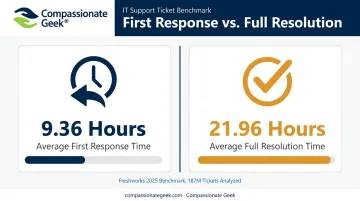
Multiply that delay across every employee waiting on a fix, and a sluggish help desk becomes a company-wide productivity tax.
Essential Skills Every IT Help Desk Agent Needs
Improving a help desk starts with people, not platforms. Hiring and training efforts need to balance two distinct skill categories: technical competence and interpersonal ability. Lean too hard into either one and you get a lopsided team.
Technical Skills That Keep the Help Desk Running
Every agent needs a working foundation in:
- Hardware and software troubleshooting, from basic device issues to application errors
- Networking fundamentals, including connectivity, VPNs, and common protocols
- Ticketing and ITSM tool proficiency so issues are logged and tracked consistently
- Security and access management, covering permissions, password policies, and identity verification
Certifications like CompTIA A+ and ITIL Foundation help validate that baseline. CompTIA A+ focuses on hands-on technical support skills, while ITIL Foundation covers broader service-management concepts like the service value chain and continual improvement. Together, these certifications give hiring managers a reliable technical benchmark to screen candidates against.
Soft Skills and Emotional Intelligence That Set Great Agents Apart
A technically correct fix can still leave a user angry if it's delivered poorly. Communication, active listening, empathy, and patience determine whether that fix actually lands as good service.
This isn't a minor hiring concern, either. HDI's 2025 State of Tech Support survey found that 55% of organizations struggle to find candidates with the right soft skills, compared to 39% citing gaps in hard skills. Nearly six in ten reported difficulty finding people with the right blend of both.
Compassionate Geek's training framework organizes this around five core principles:
- Competence – knowing your material well enough to explain it without arrogance
- Compassion – recognizing that a stressed or confused user deserves patience, not judgment
- Empathy – adjusting your language so the user feels capable, not condescended to
- Listening – letting people finish sentences and asking clarifying questions before jumping to solutions
- Respect – avoiding sarcasm and treating every user like a capable adult, even when they're wrong
Agents who combine deep technical ability with these five principles tend to resolve issues with less back-and-forth. They also build trust faster than colleagues who are technically sharp but interpersonally flat.
Proven Best Practices to Improve IT Help Desk Performance
Skills matter, but they need structure to scale. This section covers the operational backbone — the processes, tools, and team structures that let those skills scale.
Set Clear SLAs and Track the Right Metrics
Defining response and resolution times by ticket priority does two things at once. It creates accountability for agents and manages expectations for users who might otherwise assume every request is equally urgent.
Focus your KPI tracking on:
- First Contact Resolution (FCR) – the percentage of issues solved in a single interaction, without callbacks or escalation
- Average Response Time – how quickly a user hears back after submitting a request
- Customer Satisfaction Score (CSAT) – direct user feedback on the support experience
For context, Freshworks' 2025 dataset reports a global average of 97.83% CSAT and 74.14% FCR among internal IT teams, though older HDI benchmarks from 2010 put satisfaction closer to 91-93% depending on the sector. Use these as reference points, not hard targets, since methodology varies widely between studies.
Automate and Enable Self-Service
Once SLAs are tracked, the next opportunity is cutting ticket volume before it ever reaches an agent. Routine requests like password resets and account provisioning don't need a human touch every time. Automating them, alongside a searchable self-service knowledge base, frees agents to focus on complex problems that actually require judgment.
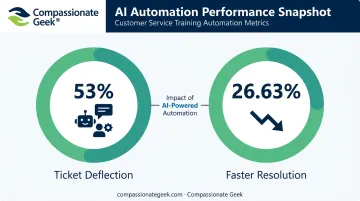
The payoff can be substantial. Freshworks' 2024 ITSM benchmark report, based on over 167 million tickets, found that generative-AI-powered self-service achieved 53% ticket deflection, with automated workflows cutting average resolution time by 26.63%.
Offering support across multiple channels, phone, chat, email, and a self-service portal, also matters. Users don't all communicate the same way, and forcing everyone through one channel just adds friction.
Build a Knowledge Management System
Self-service tools are only as reliable as the knowledge base behind them. A knowledge base that isn't updated is worse than useless. It creates false confidence and outdated fixes. A living system, refreshed regularly from real ticket data, keeps solutions accurate for both agents and self-service users, and it speeds up resolution for everyone involved.
Building a Compassionate, Customer-Centric Help Desk Culture
Tools and SLAs create efficiency. Culture creates loyalty. This is the part most improvement plans skip, and it's usually the difference between a help desk that's merely functional and one people genuinely trust.
A customer-centric culture starts at the top. Leadership needs to model empathy, active listening, and clear communication in their own interactions, not just preach it in a training deck. Agents notice when managers say one thing and do another.
Empowering agents with real autonomy also matters more than most teams realize:
- Give agents room to make judgment calls instead of rigid scripts
- Use coaching conversations to build skill, not just to monitor compliance
- Recognize good interactions publicly, not only technical wins
This kind of investment in people shows up in the data, too. HDI's Support Center Standard connects documented training and career-development planning with staff satisfaction and retention, treating employee and customer satisfaction as equally important outcomes worth tracking formally.
Some organizations formalize this commitment through structured programs. The Compassionate Geek Certified Company designation, for example, offers Green and Silver certification levels for organizations building a customer-service-first culture across their IT teams.
TeamLogic IT franchise teams have used this kind of training to strengthen client relationships, setting their service delivery apart from competitors offering similar technical capabilities.
How to Manage an IT Help Desk Team Effectively
Effective management depends on genuine rapport between leaders and agents. Agents perform better when leadership is approachable, checks in regularly, and maintains a visible, engaged presence.
A few practices make a measurable difference:
- Build cross-team collaboration with infrastructure, security, and other departments so knowledge doesn't stay siloed and users get consistent answers regardless of who they reach
- Use QA reviews as coaching, not punishment — review calls, tickets, and emails to identify growth opportunities the team can build on
- Pair technical training with soft-skills development on a recurring cadence so both skill sets advance together
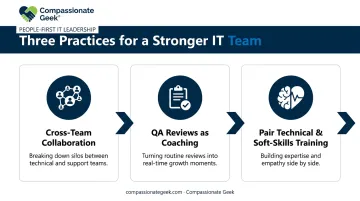
This blend of technical and interpersonal training reflects Compassionate Geek's five core principles: competence, compassion, empathy, listening, and respect.
MetricNet's research identifies analyst training hours as a key driver of both First Contact Resolution and customer satisfaction. Teams that treat training as an ongoing investment tend to see the benefit compound over time.
Measuring the Impact of Your Help Desk Improvements
You can't prove improvement without a starting point. Before rolling out changes, establish a baseline for:
- Resolution time
- CSAT scores
- Ticket deflection rate
- Repeat contact frequency
Once changes are in place, track both hard and soft signals.
Hard metrics include:
- Faster resolution times across ticket categories
- Fewer repeat tickets on the same issue
Soft signals matter just as much:
- Sentiment trends in feedback comments
- Fewer escalations to management
- Greater willingness among users to reach out proactively instead of avoiding the help desk
Review trends monthly or quarterly rather than reacting to single data points. One bad week doesn't mean your changes failed. A steady downward trend in CSAT over three months does.
Frequently Asked Questions
What skills are needed for IT help desk?
Agents need a blend of technical troubleshooting ability, covering hardware, software, and networking, alongside soft skills like communication, empathy, and active listening. Both categories matter equally for user satisfaction.
How do you manage an IT help desk?
Set clear SLAs, use data to guide staffing and process decisions, build genuine rapport with your team, and invest in ongoing training rather than one-time onboarding sessions.
What is the difference between a help desk and a service desk?
A help desk handles reactive, day-to-day user issues like password resets and troubleshooting. A service desk manages broader IT service delivery, including changes, strategic requests, and process governance.
How do you measure IT help desk performance?
Track First Contact Resolution, Average Response Time, and CSAT consistently over time. Trends matter more than any single data point, since one bad week doesn't reflect systemic problems.
What certifications are best for a career in IT help desk support?
CompTIA A+ validates core technical troubleshooting skills, while ITIL Foundation covers broader service-management concepts. HDI's Support Center Analyst credential digs into customer-contact and support-analyst competencies specifically.
How can soft skills training improve help desk KPIs like CSAT and FCR?
Agents trained in empathy and active listening tend to resolve issues with less back-and-forth clarification, which directly lifts First Contact Resolution. Users also report higher satisfaction when they feel heard, not just fixed. Compassionate Geek's courses build these exact skills through IT-specific scenarios rather than generic customer service training.