EI shows up in specific moments, not abstract leadership seminars. It's the technician who calms an angry user before escalating a simple password reset. It's the sysadmin who keeps a war room focused during a server outage instead of pointing fingers. This article breaks down why EI matters for IT pros in practical, measurable terms, not just theory.
Key Takeaways
- EI drives clearer communication, fewer repeat tickets, and stronger user trust
- High-EQ IT professionals report better job satisfaction and calmer incident response
- Missing EI shows up as defensive troubleshooting and rising escalation volume
- IT professionals can build self-awareness, empathy, and composure through deliberate practice
What Is Emotional Intelligence in IT Work?
Emotional intelligence is the ability to recognize and manage your own emotions while reading and responding well to other people's emotions. That's it. No mysticism required.
In IT, this plays out in specific, recurring scenarios:
- Help desk calls where a frustrated user needs to feel heard before they'll listen to a solution
- Ticket escalations where tone determines whether a conversation stays productive
- Client meetings where technical jargon needs translation into business impact
- Cross-team collaboration during outages where stress runs high and blame runs easy
- Performance reviews where feedback lands better when delivered with awareness
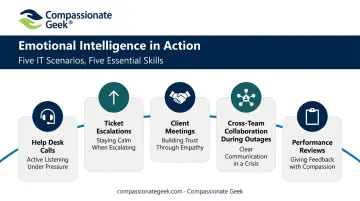
Across these scenarios, EI operates as a practical skill, not niceness for its own sake. It directly shapes how fast issues get resolved, how much users trust your team, and how far your career advances.
Key Advantages of Emotional Intelligence for IT Professionals
The advantages below aren't abstract soft-skill theory. They tie directly to metrics IT leaders and MSPs already track: CSAT, first-contact resolution, escalation rate, client retention, and staff turnover.
Clearer Communication and Fewer Misunderstandings
EI sharpens how technicians translate jargon and read frustration. Self-awareness and active listening let you catch confusion early, before a five-minute call turns into a three-touch escalation.
HDI's concept of "first conversation resolution" captures this well: a support issue often spans voice, email, and chat, and preserving context across those channels (rather than treating each contact as isolated) is what actually prevents repeat contacts. Technicians with strong EI naturally carry that context forward because they're paying attention to the full interaction, not just the ticket fields.
Why this matters operationally:
- Clearer conversations shorten support interactions and reduce repeat tickets for the same issue
- Catching frustration early prevents a routine ticket from becoming a complaint
- Fewer callbacks free up team capacity for new work
KPIs impacted: first-contact resolution rate, average handle time, repeat ticket volume, CSAT scores.
This advantage matters most during high-pressure outages, VIP support requests, and any interaction with non-technical end users who don't speak your vocabulary.
Stronger Trust and Longer Client Relationships
Empathy and respect turn a single support ticket into an ongoing relationship. That's especially critical for MSPs managing recurring client accounts, where trust determines contract renewals as much as uptime does.
Drayton Mayers, President of TeamLogic IT East Memphis, put it plainly after making Compassionate Geek's training mandatory for his entire team:
"I win new business because owners are frustrated with other IT companies who have proven to be undependable, can't prevent issues, are slow to resolve problems... and who have repeatedly proven that they don't have the right mix of compassionate geeks and technology to better their business."
That trust becomes a measurable competitive advantage, driving renewals and referrals that outlast any single support ticket.
Why this matters financially:
- Acquiring a new customer can cost five to 25 times more than retaining an existing one, depending on the industry
- Losing a client mid-contract forces a costly replacement sales cycle and disrupts recurring revenue
- Trust increases willingness to renew contracts and expand service scope
KPIs impacted: client retention rate, contract renewal rate, Net Promoter Score, upsell rate.
This proves most valuable for MSPs competing on service quality rather than price, especially during contract renewal season.
Better Composure and Conflict Resolution Under Pressure
Self-regulation is what keeps a technician calm during an outage instead of reacting defensively when a VP starts yelling on a bridge call. Emotionally regulated IT pros de-escalate tension, keep incident teams focused, and avoid layering interpersonal chaos on top of technical chaos.
Compassionate Geek's own course content walks through a version of this exact scenario: a user loses project files after a system crash. The training teaches technicians to silently notice rising irritation, take a breath, and respond with "I understand this is stressful, let's see what we can recover" instead of a defensive reaction. That pause is the entire skill.
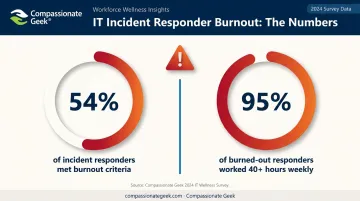
The stakes are real. In one 2024 study of 35 incident responders at a global IT company, 54% met the criteria for burnout, and nearly 95% of burned-out responders worked more than 40 hours weekly. Composure under pressure functions as burnout prevention, protecting both technicians and incident timelines.
KPIs impacted: mean time to resolution during incidents, employee turnover rate, internal escalation volume.
This capability counts most during major outages, security incidents, or any high-stakes moment with multiple stakeholders and a ticking clock.
What Happens When Emotional Intelligence Is Missing
Low EI doesn't announce itself. It shows up quietly, then compounds.
- Recurring miscommunication turns simple tickets into repeated escalations
- Defensive or dismissive responses to frustrated users erode trust fast
- Reactive firefighting replaces calm, structured incident resolution
- Rising client churn and higher recruitment costs follow burnout and turnover
- Weak delegation and mentoring emerge when low-EQ leaders struggle to read team morale
The turnover piece deserves attention. HDI's 2025 research found that 75% of support organizations reported notable turnover in the prior year, with most reporting a real operational impact. Losing experienced technicians because of preventable interpersonal friction is an expensive way to run a support desk.
How IT Professionals and Teams Can Build Emotional Intelligence
EI develops best through repeated practice in real interactions, not a single workshop that gets forgotten by Friday.
Start with self-awareness before anything else. You can't manage empathy or conflict effectively if you don't yet notice your own emotional triggers. A practical sequence looks like this:
- Track your emotional patterns — jot down daily interactions alongside how they made you feel
- Identify your activators — the specific situations or comments that reliably spike frustration
- Practice naming emotions in real time, not after the fact
- Check in with yourself throughout the day, not just during crises
- Take ownership of your reactions instead of blaming the user or the ticket
Once self-awareness is developing, empathy and conflict management become easier to layer on top.
Structured frameworks add consistency here. Compassionate Geek's five-principle model breaks the work into five pillars:
- Competence — technical skill that earns trust
- Compassion — caring about the person, not just the ticket
- Empathy — understanding their frustration
- Listening — hearing the full problem before reacting
- Respect — treating every user as capable
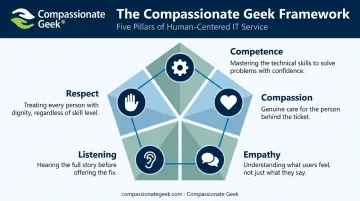
This structure builds these skills alongside technical training, rather than treating soft skills as an afterthought.
Whatever framework you use, review outcomes regularly. CSAT trends, retention numbers, and escalation data will tell you whether EI training is translating into real operational change, or just sitting in a slide deck.
Conclusion
Emotional intelligence changes how IT professionals experience their work. It provides:
- Control over tense interactions
- Clarity under pressure
- Steadier, trust-based client relationships
These gains compound over a career.
Better communication and calmer incident response don't just fix a single ticket. Over time, they shape promotions, client loyalty, and team culture.
Treat EI like a certification that needs periodic renewal: an ongoing practice, revisited throughout your career.
Frequently Asked Questions
What are the 5 C's of emotional intelligence?
There's no standardized "5 C's" model in the research. Daniel Goleman's framework instead lists five components: self-awareness, self-regulation, motivation, empathy, and social skill.
What is emotional intelligence in information technology?
In IT, EI means applying self-awareness, empathy, and composure to technical support scenarios. That includes reading user frustration, staying calm during outages, and clearly explaining issues to non-technical stakeholders.
Why does emotional intelligence matter more in IT than it used to?
As IT roles shift toward client-facing support, remote collaboration, and cross-functional projects, interpersonal skills increasingly determine career growth right alongside technical competence.
Can emotional intelligence actually be learned by technical people?
Yes. EI is a learnable skill set, not a fixed trait. Practical starting points include actively seeking feedback and deliberately practicing active listening in everyday interactions.
What does low emotional intelligence look like in an IT team?
Common signs include defensive troubleshooting, dismissing user concerns, blaming others during incidents, and rising friction between support staff and clients.
How can IT organizations start building emotional intelligence into their teams?
Start with structured soft-skills training paired with consistent feedback loops. Frameworks like Compassionate Geek's Competence-Compassion-Empathy-Listening-Respect model give teams a concrete way to begin.