
Introduction
A senior IT technician spends three hours diagnosing a failed server, replaces the right component, and restores full functionality. The client cancels the contract anyway.
Why? Because the technician never explained what was happening, dismissed the client's questions as "too basic," and left them feeling talked down to during the entire outage.
This scenario plays out constantly in IT support. Qualtrics estimates $3.7 trillion in global sales is at risk annually because of poor customer experiences, not faulty products.
IT organizations pour money into certifications and technical training. Far fewer invest in the interpersonal skills that actually determine whether a client renews their contract.
This article covers the essential soft skills your team needs, proven ways to build them, and the Compassionate Geek framework of five core principles for making the change stick.
Key Takeaways
- Poor communication, not technical failure, drives most client churn in IT support
- Active listening, empathy, and clear communication are the skills clients notice most
- One-off workshops fade fast; repeated coaching creates lasting behavior change
- Competence, Compassion, Empathy, Listening, and Respect form a repeatable team framework
- Tracking CSAT, NPS, and escalation rates before and after training reveals real ROI
Why Soft Skills Are the Missing Piece in IT and Customer Service Success
Technical skill and soft skill solve two completely different problems. Correctly diagnosing a server outage is a technical skill. Explaining that outage to a stressed, non-technical client, without jargon and without making them feel foolish, is a soft skill. Both matter. Only one gets consistent training budget.
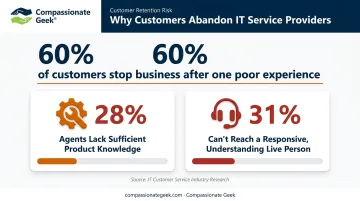
That imbalance shows up directly in customer behavior. Microsoft's five-country survey of 5,000 consumers found that 60% of customers stopped doing business with a brand after just one poor service experience. The reasons split in a telling way:
- 28% pointed to agents lacking the knowledge to resolve their issue
- 31% cited something simpler: they couldn't reach a live, responsive person who understood their frustration
Don Crawley, founder of Compassionate Geek, describes IT work as using technology to craft creative solutions to perplexing human problems. A perfectly executed fix means nothing to a client who felt ignored, rushed, or condescended to along the way.
This is the gap most MSPs and IT departments miss. They hire for CompTIA certifications and scripting ability, then wonder why client satisfaction scores stay flat. Technical competence gets a customer in the door. How your team communicates keeps them there.
The Essential Soft Skills Every Customer Service Team Needs
Before building a training plan, know what you're training for. According to SHRM's 2019 workplace skills gap report, 30% of organizations struggle to recruit candidates with adequate workplace soft skills, with communication and problem-solving among the biggest gaps. That scarcity makes internal development just as important as hiring criteria.
Here's what separates a good IT support interaction from a forgettable one:
- Active listening — Paraphrasing an issue back ("So your VPN drops every time you join a call, is that right?") before fixing it confirms you understood, not just heard words.
- Empathy — Naming the specific situation ("Losing access right before your deadline is frustrating") lands far better than a generic "I understand your frustration."
- Clear communication — Translating "the DNS cache needs flushing" into "we need to clear some stored network information on your end" makes technical fixes feel collaborative, not confusing.
- Patience — Answering the same question a third time, calmly and thoroughly, matters most with less tech-savvy users who need extra reassurance.
- Problem-solving — The same curiosity that drives troubleshooting a stack trace applies to figuring out why a client keeps escalating minor issues.
- Adaptability — A tone that works on a phone call can feel abrupt in a chat window; adjusting across channels is a skill, not an afterthought.
- Emotional intelligence — Managing your own stress during a high-pressure ticket while still reading the customer's emotional state takes practice.
- Respect and professionalism — Treating every customer with dignity, regardless of their technical literacy, is the Compassionate Geek principle of Respect in action.
Mastering four or five of these deeply beats a superficial pass at all eight.
How to Actually Improve Soft Skills Across Your Team: Proven Training Strategies
A single afternoon workshop rarely changes behavior. Skills fade within weeks without reinforcement. What actually works is repeated, structured practice built into the normal work rhythm.
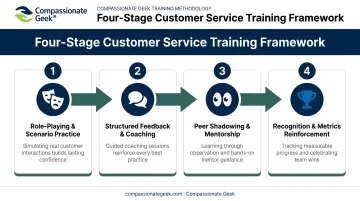
Role-Playing and Scenario-Based Practice
Rehearsing realistic scenarios builds muscle memory before agents face the real thing. Common situations worth practicing include:
- Irate customer demanding immediate escalation
- VIP client with unrealistic expectations
- Repeat complaint that wasn't resolved the first time
Teams that role-play these conversations in low-stakes settings respond with far more composure when a genuinely upset client calls in. Running these drills monthly keeps the skills sharp.
Structured Feedback and Coaching Loops
Regular one-on-one coaching using recorded calls or ticket transcripts turns abstract feedback into specific, actionable guidance. Frequency matters more than most managers assume. Employees who get frequent, meaningful feedback stay more engaged than those stuck with a single annual review. Weekly or biweekly check-ins beat a once-a-year performance conversation every time. Pairing these check-ins with Compassionate Geek's on-demand training portal gives managers concrete scenarios to reference instead of vague notes.
Peer Shadowing and Mentorship
Pairing junior staff with experienced reps to observe soft-skill application in real interactions accelerates learning faster than any slide deck. Flip the arrangement periodically, having seniors observe juniors, and the feedback loop catches bad habits early. Even brief weekly shadowing compounds over time.
Reinforcement Through Recognition and Metrics
Tie soft-skill behaviors to performance reviews and recognition programs so training sticks long after the kickoff session. Employees with ongoing development opportunities tend to stay longer than those left to figure it out alone. Recognition doesn't need to be elaborate. A shoutout for a well-handled escalation reinforces the behavior you want repeated.
The Compassionate Geek 5 Cs Framework: A Structured Path to Lasting Behavior Change
Generic skill lists rarely stick without something memorable to hang them on. Don Crawley built the Compassionate Geek framework around five core principles that IT teams and MSPs use worldwide:
- Competence: Technical mastery is the foundation, but it alone doesn't guarantee a satisfied client.
- Compassion: Caring about the person behind the ticket, not just closing it as fast as possible.
- Empathy: Understanding the customer's perspective and emotional state before jumping straight to a fix.
- Listening: Truly hearing what a customer says, and what they don't say, instead of pattern-matching to a handful of keywords.
- Respect: Treating every customer and colleague with dignity, no matter their technical knowledge or how many times they've asked the same question.
These five aren't isolated training modules; they reinforce each other. Competence without compassion feels cold, and empathy without genuine listening feels performative.
Organizations ready to formalize this can pursue Compassionate Geek Certified Company status, offered at two levels:
| Certification | Who's Required to Train | Additional Requirement |
|---|---|---|
| Green | All tech employees | Ongoing reinforcement of the 5 Cs (training, book clubs, discussion groups) |
| Silver | All employees, company-wide | Adds mandatory leadership training for all managers and supervisors |
Both levels require year-round reinforcement, not a one-time certificate. That distinction is deliberate: a framework only creates lasting change when it's practiced continuously, not filed away after the initial course.
Measuring the ROI of Soft Skills Training
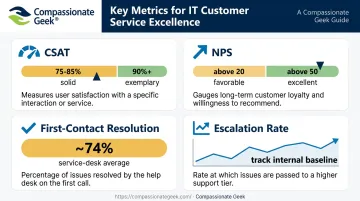
Soft skills training only earns its budget if you can show it worked. Track these metrics before and after any initiative:
| Metric | What It Measures | General Benchmark |
|---|---|---|
| CSAT | Satisfaction with a specific interaction | 75-85% is solid; above 90% is exemplary |
| NPS | Likelihood customers recommend your team | Above 20 is favorable; above 50 is excellent |
| First-Contact Resolution (FCR) | % of issues resolved on the first interaction | Service-desk averages hover around 74% |
| Escalation rate | % of tickets kicked up to another tier | No universal target; track your own trend |
Beyond the numbers, watch for qualitative shifts:
- Fewer repeat complaints about the same agent
- Better morale during team check-ins
- Clients mentioning specific staff by name in positive reviews
One franchise leader has seen these signals play out directly. Drayton Mayers, president of TeamLogic IT's East Memphis franchise, made Compassionate Geek training mandatory for his entire staff. He credits it with helping his MSP win new business by differentiating the team through compassionate service alongside technical skill, exactly the kind of qualitative signal worth tracking alongside your CSAT scores.
A good story helps, but consistent measurement confirms whether training actually changed behavior. Establish a baseline before training starts, then re-measure at a fixed interval, 90 days is a common benchmark, to see whether the change stuck rather than just checking a training box.
Replacing a disengaged employee typically costs half to two times their annual salary. That math alone makes retaining and developing existing staff the more economical bet in nearly every case.
Common Roadblocks to Building a Customer-Centric Culture
Even well-intentioned initiatives stall out. Watch for these three obstacles:
- Technical staff dismiss soft skills as "fluffy." Reframing IT work as solving human problems, not just fixing machines, helps engineers see the connection between their existing troubleshooting instincts and customer communication.
- Leadership treats training as a one-time onboarding checkbox. Without ongoing budget for coaching and reinforcement, skills fade within weeks of the initial session.
- Inconsistent follow-up after the kickoff. A single workshop without recurring practice, feedback, or recognition rarely produces lasting change.
Frequently Asked Questions
What are the 10 soft skills for customer service?
The most commonly cited are active listening, empathy, communication, patience, problem-solving, adaptability, emotional intelligence, respect, positive attitude, and teamwork. Mastering even a handful deeply matters more than covering all ten superficially.
What are 10 examples of soft skills?
Workplace-wide soft skills include time management, teamwork, conflict resolution, adaptability, and leadership. Customer-facing skills, like active listening and empathy, are covered in detail earlier in this article.
How long does it take to improve soft skills in a customer service team?
Visible behavior change typically takes several weeks of consistent practice and coaching. Reinforcement over time, through regular coaching check-ins, is what makes improvement stick.
Can soft skills be taught, or are they innate personality traits?
Some people have natural tendencies, but soft skills are learnable behaviors. Structured practice, feedback, and coaching build them the same way technical skills develop.
What's the difference between soft skills and technical skills in IT customer service?
Technical skills solve the problem. Soft skills determine whether the customer feels satisfied with how it was solved. Don Crawley's philosophy frames IT work as fundamentally about solving human problems through technology.
How can IT managers measure improvement in their team's soft skills?
Track CSAT, NPS, escalation rates, and first-contact resolution alongside structured coaching reviews. Establish a baseline first, then re-measure at a set interval like 90 days.