
If you jump straight to troubleshooting steps, you'll likely waste ten minutes on the wrong fix. The real skill isn't in the fix at all. It's in the questions that get you there.
Probing questions are the single most effective tool IT support agents have for diagnosing issues quickly while making customers feel genuinely heard. This guide breaks down the types of probing questions, gives you ready-to-use IT-specific examples, and covers the mistakes that turn a helpful conversation into an interrogation.
It's all framed around a philosophy Compassionate Geek founder Don Crawley has taught for years: IT work isn't really about technology. It's about using technology to solve human problems.
Key Takeaways
- Probing questions uncover root causes that vague complaints like "it's broken" never reveal.
- Four question types—exploratory, funneling, confirming, leading—serve different stages of a call.
- Open questions are a proven driver of first-contact resolution, per SQM Group.
- Neutral wording matters: swap "why" for "what" or "how" to sound less accusatory.
- Building this skill takes practice, not just a script—core to Compassionate Geek's training.
What Are Probing Questions and Why They Matter in IT Support
Probing questions are open-ended follow-up questions designed to dig past a customer's first statement and uncover the details, context, and root cause behind it. They're not the same as clarifying questions, though the two often get lumped together.
Clarifying questions confirm what you already heard, like asking, "So you're saying the error happens every time you open the app?"
Probing questions dig for new information, such as asking, "What were you doing on your computer right before the app crashed?" One verifies; the other expands.
Why This Matters More in IT Support
IT support carries three challenges that make probing questions non-negotiable:
- Technical language gaps — customers describe symptoms in plain language, not diagnostic terms
- No visual access — remote agents can't see the screen, the blinking light, or the error dialog
- Stress and frustration — outages happen at the worst times, and customers are rarely at their calmest
This connects directly to Compassionate Geek's five core principles: Competence, Compassion, Empathy, Listening, and Respect. Asking a sharp probing question requires enough technical competence to know what to ask, paired with the listening skill to actually hear the answer instead of waiting for your turn to talk. That combination pays off in measurable ways.
According to SQM Group, asking the right open questions to understand the reason for a call is a driving factor in first-contact resolution. The takeaway isn't a magic percentage. It's that agents who probe well resolve more issues without a callback.
4 Types of Probing Questions With Examples for Customer Service Agents
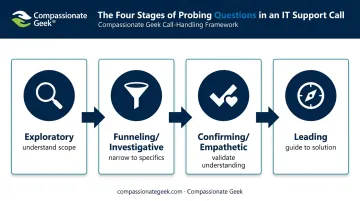
Probing questions generally fall into four categories, each suited to a different moment in the conversation. Start broad, then narrow.
Exploratory Probing Questions
Used at the very start of a call, before you diagnose anything specific. The goal is understanding scope, not jumping to solutions.
- "Can you walk me through what happened when the problem started?"
- "What are you currently doing when this occurs?"
- "When did you first notice something was off?"
- "What does a normal day look like for you on this system?"
- "Has anything changed recently on your end, like a new device or update?"
Funneling/Investigative Probing Questions
Once you understand the general issue, these questions narrow things down to the technical specifics you need for diagnosis.
- "What error message or code did you see on the screen?"
- "Is this happening on one device or all of them?"
- "Does it happen on Wi-Fi, Ethernet, or both?"
- "How many times has this occurred today versus this week?"
- "What application or program were you using at the time?"
Confirming/Empathetic Probing Questions
Use these before proposing a solution, and again after implementing a fix. They validate your understanding and show the customer they're being heard.
- "So if I understand correctly, the printer disconnects every time you send a large file. Is that right?"
- "How is this affecting your ability to work today?"
- "Does that resolve the issue on your end?"
- "Is there anything about this fix that still concerns you?"
Leading Probing Questions
These gently guide a customer toward a solution or additional service. Use them sparingly and transparently.
- "Would upgrading your RAM help avoid this slowdown going forward?"
- "Would you like me to set up automatic backups so this doesn't happen again?"
- "Should we schedule a follow-up to make sure the fix holds?"
Overuse can feel manipulative. Every leading question should serve the customer's actual interest, not a sales quota. Together, these four question types put the Compassionate Geek framework's core principle of Listening into practice, turning routine troubleshooting into a genuinely human conversation.
Probing Questions for Common IT Support Scenarios
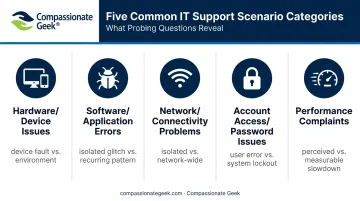
Most guides stop at generic examples. Here's a scenario-by-scenario breakdown you can actually use on your next call.
Hardware/Device Issues
These questions separate device faults from environmental factors like power or heat.
- "When did you last update your drivers?"
- "Does the issue happen when running on battery or plugged in?"
- "Have you noticed any unusual noise or heat from the device?"
Software or Application Errors
This narrows down a one-time glitch versus a recurring bug.
- "What were you doing right before the application crashed?"
- "Have you installed any new updates or plugins recently?"
- "Does the error happen every time you open the app, or only sometimes?"
Network/Connectivity Problems
This reveals whether the issue is isolated to one device or network-wide.
- "Are other devices on the same network affected?"
- "Is this happening on Wi-Fi, Ethernet, or both?"
- "Have you moved locations or changed routers recently?"
Account Access/Password Issues
This shows whether the lockout is user-caused, system-side, or security-related.
- "Have you recently changed your password or enabled MFA?"
- "Are you seeing a specific error when logging in?"
- "Did this start after a recent system update?"
Performance Complaints
This reveals whether hardware, software, or usage habits are behind the slowdown.
- "Is the slowdown constant or does it happen during specific tasks?"
- "How many applications do you typically have open at once?"
- "Has this machine's performance changed gradually or all at once?"
Best Practices for Asking Probing Questions Effectively
Getting the wording right matters less than getting the sequence and delivery right.
- Start broad, then funnel. Open with exploratory questions before jumping into technical specifics. Diagnosing too early often means diagnosing the wrong thing.
- Adapt to the answer, not the script. Active listening means your next question comes from what the customer just said, not a rigid checklist.
- Stay neutral, never accusatory. When asking what a customer already tried, frame it factually: "What steps have you taken so far?" instead of phrasing that implies they broke it.
These three habits do more for call quality than any list of clever questions. Compassionate Geek's training builds all three around its Listening and Respect principles, since a well-worded question delivered with an impatient tone still lands as an accusation.
Common Mistakes to Avoid When Probing Customers
Even experienced agents fall into these traps.
- Overusing "why" questions. "Why did you do that?" sounds like blame. Reframe as "What led you to try that approach?"
- Interrupting mid-answer. This damages rapport fast, and you'll miss the one detail that would've solved the problem.
- Firing off questions without acknowledgment. Asking five questions back-to-back with no "got it" or "that helps" makes customers feel interrogated instead of assisted.
The fix for all three is the same: slow down, acknowledge what you heard, then ask the next question. It costs you five seconds and saves the entire call.
Building This Skill With Compassionate Geek Training
Mastering probing questions isn't a matter of memorizing a script. It requires genuine listening and empathy, which is the foundation Don Crawley built Compassionate Geek on: "Our jobs in IT are not about technology, but about crafting creative technical solutions to perplexing human problems in the workplace."
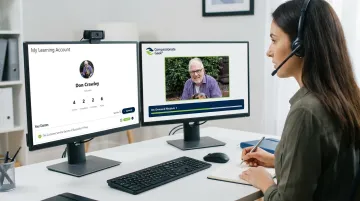
Compassionate Geek's self-paced online course walks IT teams through the five core principles that make effective questioning possible, including active listening techniques that go beyond a checklist. Teams can train through:
- On-demand courses — self-paced, available in English, French, and Spanish
- Virtual live-video training — instructor-led sessions for teams and MSPs
- Compassionate Geek Certified Company program — a formal way for organizations to signal their commitment to customer-focused, question-driven service
That commitment to structured training pays off in the field. Drayton Mayers, President of TeamLogic IT East Memphis, requires the course for every member of his staff. He credits it with helping his team win new clients away from competitors who move slower and listen less. That's the practical payoff of building this skill deliberately rather than picking it up by accident.
Frequently Asked Questions
What are examples of probing questions?
Examples include exploratory questions ("What were you doing when this started?"), funneling questions ("What error message appeared?"), and confirming questions ("So the issue happens every time you print, correct?").
What are some good customer service survey questions?
Post-interaction surveys should ask about resolution, communication clarity, and overall satisfaction. A useful example is "Was your issue fully resolved on the first contact?" alongside a general satisfaction rating.
What is the difference between probing questions and clarifying questions?
Clarifying questions confirm what's already been said, removing ambiguity. Probing questions dig for new details or context the customer hasn't yet shared. Both matter, but they serve different moments in a call.
How many probing questions should I ask during a support call?
There's no fixed number. Quality and timing matter more than quantity. Most effective calls use a handful of well-placed questions rather than a rapid-fire interrogation.
What's the difference between open-ended and closed probing questions?
Open-ended questions invite detailed, descriptive answers, useful early in a call. Closed questions get quick yes/no or specific answers, useful for confirming facts before you move to a fix.
How can I train my IT support team to ask better probing questions?
Role-play real scenarios and review actual call recordings for missed opportunities. Structured programs, like Compassionate Geek's courses, build these skills systematically instead of relying on trial and error.