Here's the retention problem hiding underneath that shift: employees who stop growing tend to leave, and employers who skip investing in growth pay for it in turnover. Back in 2018, 94% of employees said they'd stay at a company longer if it simply invested in their career development, per LinkedIn's Workplace Learning Report. That number hasn't lost relevance.
This article breaks down the professional development skills worth prioritizing right now, why each one matters, and practical ways to start building them, whether you're managing your own career or an entire team.
Key Takeaways
- Nearly 4 in 10 core job skills will shift by 2030, making continuous skill-building essential
- Communication remains the single most requested skill on job postings and resumes
- Soft skills like emotional intelligence and adaptability now rank alongside technical ability
- Investing in employee development directly improves retention and reduces costly turnover
- The strongest career strategies combine technical expertise with human-centered skills
What Are Professional Development Skills, Exactly?
Professional development skills are the transferable hard and soft skills that help someone grow in their career over time, distinct from personal hobbies or knowledge specific to a single employer. They travel with you between jobs, industries, and roles.
These skills fall into two buckets:
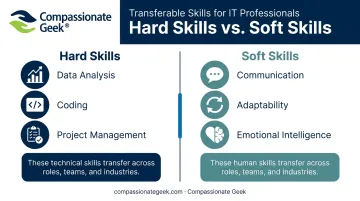
- Hard skills — technical, role-specific abilities like data analysis, coding, or project management
- Soft skills — interpersonal and self-management abilities like communication, adaptability, and emotional intelligence
Building these skills isn't optional anymore. The World Economic Forum projects that 59 out of every 100 workers globally will need retraining by 2030, and 85% of employers already plan to prioritize upskilling their teams. This is a current challenge, already shaping hiring and training decisions across industries.
We chose the skills below because they show up repeatedly across workforce research, employer surveys, and hiring data, regardless of industry.
Top Professional Development Skills to Build
These skills earned their spot on this list for one reason: they show up again and again in employer demand data, workforce trend reports, and real career outcomes. Here's the breakdown.
Communication Skills (Verbal, Written & Active Listening)
Communication covers presenting ideas clearly, writing concisely, and actually listening during difficult conversations. It's the foundation nearly every other skill on this list depends on.
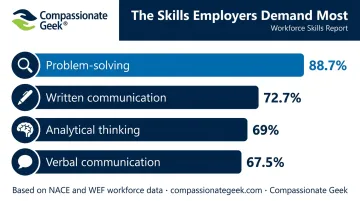
Employers aren't shy about wanting this. According to NACE's Job Outlook 2024, 72.7% of employers seek written communication skills on resumes, and 67.5% look for verbal communication. Employers rated communication importance at 99.5%, but proficiency among recent graduates came in at just 55.2%. That gap is worth closing.
| Why It Matters | Better collaboration, stronger client trust, and fewer costly misunderstandings across teams |
| How to Build It | Practice presentations, join writing workshops, and seek structured feedback on real work |
Emotional Intelligence & Empathy
Once you're communicating clearly, the next skill is reading what's beneath the words. Emotional intelligence includes self-awareness, reading others accurately, and managing your own reactions under pressure. As AI absorbs more routine tasks, this human skill becomes harder to automate and easier to value.
Research published by the American Psychological Association links empathy directly to leadership performance, with empathic managers receiving higher job performance ratings from their own bosses across a global sample of 6,731 managers in 38 countries.
| Why It Matters | Stronger leadership presence and better conflict management under pressure |
| How to Build It | Request 360-degree feedback, work with a coach, and practice active listening deliberately |
Critical Thinking & Problem-Solving
Self-awareness only goes so far without the ability to solve the problem in front of you. Critical thinking is about cutting through ambiguity to find the actual issue, using root-cause analysis and structured decision-making instead of just addressing symptoms.
Employers rank this at the top. Problem-solving is the number one attribute employers seek on graduate resumes, cited by 88.7% of respondents, per NACE. Separately, the World Economic Forum found analytical thinking remains the top-ranked core skill, with 69% of companies calling it essential in 2025.
| Why It Matters | Faster, better decisions and more room for genuine innovation |
| How to Build It | Work through real case studies, practice root-cause exercises, and use decision frameworks |
Adaptability & Resilience
Even the best problem-solving breaks down when circumstances keep shifting. Adaptability means navigating change, uncertainty, and shifting role expectations without losing momentum. That importance is rising fast as automation and AI reshape job requirements.
That 39% figure from earlier bears repeating here. When two-fifths of your skill set is expected to shift within five years, adaptability stops being a nice-to-have and becomes core infrastructure.
| Why It Matters | Greater business agility and less disruption when priorities or tools change |
| How to Build It | Try job rotations, take stretch assignments, and complete change management training |
Leadership & Influence
Adapting well as an individual is one thing; helping a team do the same is another. Leadership shows up in guiding teams, making sound decisions, and inspiring performance. Leadership isn't reserved for people with "manager" in their title. Individual contributors who influence outcomes without formal authority are practicing leadership too.
Only 20% of companies report having a strong leadership bench, according to DDI's Global Leadership Forecast 2025. Building this capability at every level, not just among managers, creates teams that adapt faster when someone leaves or priorities shift.
| Why It Matters | Better succession readiness and stronger day-to-day team performance |
| How to Build It | Seek mentorship, join cross-functional projects, and pursue leadership training early |
Time Management & Productivity
None of these skills matter much if the work never gets done. Time management centers on prioritization, realistic planning, and building a workload that's sustainable rather than constantly on fire. It connects directly to output quality.
Asana's research found knowledge workers spend 58% of their day on "work about work" instead of skilled, strategic tasks, with unnecessary meetings draining nearly 3 hours weekly. Poor time management doesn't stay contained. It compounds into missed deadlines and eventually burnout.
| Why It Matters | Higher output and meaningfully reduced burnout risk |
| How to Build It | Use time-blocking, priority matrices, and dedicated productivity tools |
Customer Service & Relationship-Building Skills
Every skill on this list converges here, especially in IT and technical roles, where solving the technical problem isn't enough if the human interaction leaves someone frustrated. Client communication, service recovery, and relationship management all fall under this umbrella.
Specialized IT customer service training, including the courses built by Compassionate Geek, teaches this through five core principles: Competence, Compassion, Empathy, Listening, and Respect. These principles show up in real support scenarios, like recognizing when a frustrated end-user needs patience before a fix, not just a solution.
| Why It Matters | Stronger client loyalty, fewer complaints, and a better reputation for MSP and IT teams |
| How to Build It | Practice role-playing difficult conversations and pursue structured service training, such as Compassionate Geek's IT-specific customer service courses |
How These Skills Were Selected
We built this list by cross-referencing three sources, not guesswork or trending LinkedIn posts:
- Workforce trend reports
- HR and L&D research
- Actual employer demand data
This approach avoids a common mistake many professionals make: chasing whatever skill is trending without checking whether it actually aligns with their role, industry, or an existing performance gap. That wastes time and rarely moves the needle.
That's why the strongest development strategies balance technical competence with human-centered soft skills. Treating them as separate priorities, rather than a combined strategy, is where most skill-building plans fall short.
Conclusion
No single skill guarantees career success. Durable growth comes from balancing technical expertise with interpersonal and self-management abilities, built deliberately over time.
Start by auditing your own skill gaps honestly. Build a personalized, time-bound development plan instead of relying on scattered one-off training events that don't stick.
This kind of intentional development doesn't have to happen alone.
For IT professionals, support teams, and MSPs looking to strengthen customer service, empathy, and communication skills, Compassionate Geek's training programs offer a structured next step. Created by Don R. Crawley, author of The Compassionate Geek, these courses turn these principles into daily practice.
Frequently Asked Questions
What is professional skill development?
It's the ongoing process of building transferable hard and soft skills that support long-term career growth. This differs from one-time training sessions or personal, non-work-related skills.
What are examples of professional development skills?
Common examples include communication, emotional intelligence, leadership, time management, critical thinking, and technical or digital skills relevant to your field.
What are the 5 P's of professional development?
Different frameworks reference varying "5 P's," but they generally center on Purpose, Passion, People, Practice, and Performance. This structure helps professionals organize a development plan around clear goals and consistent action.
How can I improve my professional development skills?
Combine structured courses, mentorship or coaching, self-assessment tools, and real-world application with regular feedback. Consistency matters more than intensity here.
Why is professional development important for career growth?
Skill growth ties directly to promotions, retention, and adaptability in a fast-changing job market. 91% of L&D professionals consider continuous learning essential for career success, per LinkedIn's 2025 Workplace Learning Report.
How often should professional development skills be assessed or updated?
Assess your skills at least annually, with quarterly check-ins whenever business priorities, tools, or your role shifts significantly.