

HDI's 2024 State of Technical Support survey found that 46% of support teams saw ticket volume rise last year, even as nearly half of all tickets were resolved remotely. Support has also gone hybrid, with many service desks now splitting time between office and remote work.
Professionalism often gets filed under "soft skills" — nice to have, hard to measure. But its real value shows up in resolution speed, escalation rates, and whether customers trust you enough to stick around. This article looks at why professionalism matters in practice: its advantages, the cost of skipping it, and how to build it consistently across a team.
TL;DR
- Professionalism means consistent, respectful, competent behavior in every interaction, not just when it's easy
- Builds trust, reduces conflict and escalations, and strengthens retention and referrals
- Skipping it leads to inconsistent service, rising costs, and support teams that can't scale
- Built through structured frameworks and ongoing training, not personality alone
What Is Professionalism in Customer Service
Professionalism in customer service means adopting a workplace-appropriate tone, behavior, and level of competence in every interaction, regardless of the channel or the customer's mood.
Professionalism applies across every communication channel, including:
- Phone calls
- Emails
- Chat windows
- Face-to-face support
It matters most in technical fields like IT support, where customers already feel vulnerable, confused, or embarrassed before they even reach out for help.
Professionalism is the mechanism that produces trust, resolution, and loyalty in every interaction. At Compassionate Geek, founder Don R. Crawley breaks that mechanism into five principles from his book, The Compassionate Geek:
- Competence: genuinely knowing the systems and solutions you support
- Compassion: recognizing when someone is stressed and choosing to respond without hostility
- Empathy: understanding how the situation looks from the customer's side, not just the technical side
- Listening: letting people finish speaking, asking clarifying questions, and taking notes
- Respect: treating everyone with dignity, even when they're not returning the favor
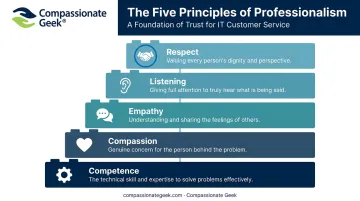
These five principles turn professionalism from a vague expectation into something a team can actually train for.
Key Advantages of Professionalism in Customer Service
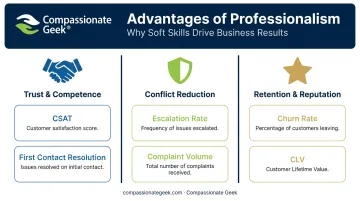
The advantages below focus on measurable, operational outcomes, not abstract soft-skill benefits. Each one ties to metrics support teams already track: trust scores, handle time, escalation rates, and revenue.
Builds Customer Trust and Perceived Competence
A calm, professional demeanor signals credibility before a problem is even solved. When a technician sounds sure of themselves, uses plain language instead of jargon, and stays composed even when the fix takes longer than expected, customers relax instead of bracing for bad news.
This shows up in small, consistent habits:
- Explaining what you're doing in plain language, not acronyms
- Keeping a steady, unhurried tone during a stressful outage
- Following up when you say you will, every time
Why it matters: customers who trust a rep's competence stay engaged instead of demanding a manager or shopping for a second opinion. That trust shortens the path to resolution because the customer stops second-guessing every step.
Trust is becoming more valuable, not less, as AI enters the picture. Salesforce's 2024 research found that 61% of consumers and business buyers say AI advances make a company's trustworthiness more important than before. As routine questions get handed to bots, the human interactions that remain carry more weight.
Compassionate Geek's training frames this as the Competence principle, the foundation the other four principles rest on. A technician can be endlessly patient and empathetic, but if they don't actually understand the system in front of them, that goodwill evaporates fast.
Composed body language and voice matter just as much on a call as in person. A two-minute update like "I'm checking the server logs now" keeps trust intact while real work happens in the background.
KPIs this affects: first-contact resolution rate, CSAT, trust/NPS scores, escalation rate.
This advantage shows up most in complex technical scenarios where customers have little visibility into the fix, such as IT helpdesk tickets involving unfamiliar systems. It's equally critical in high-stakes B2B relationships like MSP client accounts, where one shaky interaction can put a contract renewal in question.
Reduces Conflict and Enables Effective De-escalation
Professionalism sets the emotional tone of an interaction. When a customer is heated and the rep stays calm, the conversation tends to follow the calmer person, not the angrier one.
In practice, this looks like:
- Letting the customer finish venting before responding
- Asking clarifying questions instead of jumping straight to a fix
- Keeping your voice level even when the customer's isn't
Why it matters: a professional response catches minor frustration before it turns into a formal complaint, a one-star review, or a call to the manager.
Compassionate Geek's training uses role-play exercises for this reason: pairs act out a difficult support call, debrief on what escalated or de-escalated the situation, then run the scenario again with the fixes applied. Teams see, in real time, how one word choice changes the outcome.
Contact center work already runs hot, and complex issues are consistently among the hardest part of the job for agents. Burned-out agents don't de-escalate well. Poor de-escalation doesn't just cost the customer relationship: it wears down the person handling the call, which drives turnover and rehiring costs.
Flexibility matters too. The same customer might be pleasant on Monday and hostile on Friday after three failed fixes. Reps trained to read the room and adjust, rather than deploying a scripted response, defuse tension faster because the customer feels heard, not processed.
Losing composure, even briefly, tends to backfire. A sharp tone confirms the customer's fear that they're a burden, pushing them toward escalation rather than away from it.
KPIs this affects: average handle time, escalation and complaint rate, employee turnover, NPS.
This advantage matters most in high-pressure environments like call centers and IT helpdesks, and in any service recovery situation where the customer is already frustrated before the rep says hello.
Strengthens Retention, Reputation, and Growth
Trust and de-escalation matter interaction by interaction. Retention is what happens when those interactions add up over months and years. A customer treated consistently well, not just by your best rep, but by whoever picks up the phone, starts renewing contracts and referring friends without being asked.
Consistency is the key word. Reliability and promise-keeping applied uniformly across every rep and channel build a reputation that survives a single bad day. A five-star review culture doesn't come from one great interaction; it comes from hundreds of unremarkable, competently handled ones.
Why it matters: retaining an existing customer costs far less than acquiring a new one, and referrals from happy customers lower acquisition costs even further. TSIA's technology-sector benchmark found that companies making monthly or quarterly value-oriented contact with customers saw churn rates 6 percentage points lower than companies with no consistent contact strategy.
For an MSP or IT services firm, six points of churn is the difference between a stable book of business and a constant scramble to replace lost accounts.
Compassionate Geek's Certified Company program exists for this reason: it lets organizations signal, publicly, that professionalism isn't limited to a handful of standout employees but built into how the whole team operates.
Reputation compounds slowly, then all at once. A single bad review rarely sinks a business. A pattern of inconsistent service, great with one rep, dismissive with another, erodes trust faster than any individual mistake, because customers can't predict what they'll get next time.
KPIs this affects: customer lifetime value (CLV), churn and retention rate, referral rate, online review and reputation scores.
This advantage compounds fastest in recurring-revenue models like managed service providers, and in competitive markets where switching costs are low: if a customer can leave for a competitor with one phone call, professionalism is often the only thing keeping them from making it.
What Happens When Professionalism Is Missing or Ignored
Skip professionalism, and the consequences don't stay contained to one bad call. They spread through the whole operation.
- Inconsistent results: the same issue gets handled differently depending on which rep answers, so customers never know what to expect
- Higher error rates: rushed, rude, or jargon-heavy communication creates misunderstandings that turn into rework
- Reactive firefighting: unprofessional interactions escalate into formal complaints and negative reviews, forcing costly service recovery after the fact
- Rising costs over time: burnout and turnover among agents drive up recruiting and training expenses
- Difficulty scaling or delegating: without professionalism as a shared standard, service quality depends on which personalities are on shift, not on a repeatable process
That last point is the one leaders underestimate most. A support team of five can coast on a couple of naturally polished performers. A support team of fifty can't.
Growth exposes exactly how much of your service quality was ever actually a process versus how much was just a few good people carrying the load.
How to Get the Most Value from Professionalism
Professionalism pays off most when it's a team standard, not an individual trait. A single great technician can save one account. A team trained to the same standard protects all of them.
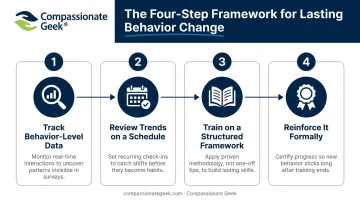
Getting there takes more than a one-time mention in an onboarding packet:
- Track behavior-level data. Overall CSAT can look fine while one rep drives most of your complaints. Break scores down by agent and interaction type to find where coaching is actually needed.
- Review trends on a schedule. Monthly review is common practice among IT service desks with formal quality monitoring, since waiting for a complaint to surface a problem is too late.
- Train on a structured framework rather than vague encouragement to "be nice." Compassionate Geek's five principles (Competence, Compassion, Empathy, Listening, and Respect) give teams specific, observable behaviors to practice instead of an abstract mood to aim for.
- Reinforce it formally. Organizations that want to signal, internally and to clients, that this standard is built into their culture can pursue Compassionate Geek Certified Company status rather than leaving professionalism to chance.
None of this replaces technical training. It sits alongside it. A team that's excellent at both the technology and the human side of the job is the one that keeps clients past the first renewal.
Conclusion
Professionalism works alongside technical skill, not as an afterthought to it. It gives every customer interaction control and consistency, whether the issue is a forgotten password or a server outage at 2 a.m.
The advantages compound over time. Trust shortens the path to resolution, and calm de-escalation keeps small frustrations from becoming formal complaints.
Consistent, respectful service turns one-time customers into long-term accounts and referral sources. For technical and IT service teams especially, that combination becomes a real competitive edge in markets where switching providers is only a phone call away.
Treat professionalism as an ongoing practice, not a lesson covered once during onboarding. Teams that revisit it through structured training, coaching, and frameworks like Compassionate Geek's five principles keep that standard alive long after the new-hire paperwork is filed away.
Frequently Asked Questions
What makes a customer service professional?
A customer service professional combines technical competence with communication skills, empathy, and consistent behavior across every interaction. Compassionate Geek frames this as five principles: Competence, Compassion, Empathy, Listening, and Respect.
Why is professionalism important in customer service?
Professionalism builds trust, reduces conflict, and drives long-term loyalty and reputation. It shortens the path to resolution and prevents small frustrations from turning into formal complaints or lost accounts.
What are the key qualities of professionalism in customer service?
Respect, competence, patience, clear communication, and reliability are the core traits. These show up as consistent tone, honest updates, and follow-through on promises, regardless of the channel used.
How is professionalism different from just being friendly?
Friendliness is a tone. Professionalism includes competence, consistency, and appropriate boundaries, even under pressure. A rep can be warm and still unprofessional if they're inconsistent or unprepared.
Can professionalism be trained, or is it a natural trait?
Some traits come more naturally to certain people, but professionalism is largely a learned skill. Structured frameworks and practice, like role-play exercises and repeated coaching, build it reliably across a team.
What happens when customer service reps lack professionalism?
Service becomes inconsistent, complaint rates rise, and reputation suffers. Over time, this drives higher churn and increases the cost of recruiting and training replacement staff.