Here's the pain point: frustrated users escalate faster the moment they sense indifference or jargon-heavy coldness from IT support, even when the technical fix is spot-on. The ticket gets resolved. The relationship doesn't.
This guide breaks down what tone of voice actually means in an IT support context, the four elements that build it, how to adjust it across phone, chat, and email, and how to build a team culture where compassionate communication becomes standard practice, not an afterthought.
Key Takeaways
- Tone carries real emotional weight in phone and ticket support, where visual cues disappear
- IT tone must balance technical authority with genuine human warmth
- Phone, chat, and email each demand their own tone adjustments to land correctly
- Trustworthy tone comes from training and deliberate practice, not instinct
- The five Compassionate Geek principles (Competence, Compassion, Empathy, Listening, Respect) give teams a shared framework
What Is Tone of Voice in Customer Service?
Tone of voice is the emotional coloring behind your words. It's built through word choice, delivery, pacing, and channel-specific cues like punctuation or vocal inflection. Two agents can say the exact same sentence and leave completely different impressions, purely because of how they say it.
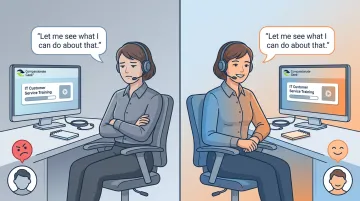
Tone and voice aren't the same thing. Voice is your consistent personality, the brand behind the words, while tone is how that personality flexes based on the situation.
| Aspect | Example |
|---|---|
| Voice | A help desk that's always direct, warm, and plain-spoken |
| Tone | That same help desk sounds urgent during an outage and reassuring during a routine password reset |
Where IT Support Complicates Things
Explaining a server outage to a stressed executive requires a very different tone than explaining the same issue to a fellow technician. The technical/non-technical communication gap means IT staff constantly need to translate complexity into language that reassures rather than confuses.
Why Tone of Voice Is Critical in IT Customer Service
Communication research offers a useful, if often misquoted, data point here. Psychologist Albert Mehrabian's classic experiments found that when someone's words and vocal tone send conflicting emotional signals, listeners lean heavily on tone and body language to decide what a person really means, not the literal words themselves.
Mehrabian's original research was narrow in scope, focused on feelings and attitudes. The underlying lesson still holds up in support settings: when a technician's words say "we'll fix it" but their tone says "I couldn't care less," users believe the tone.
That gap shows up constantly in IT support. Under pressure, technicians often default to a flat, transactional tone that reads as indifference, even when the fix is technically sound.
Compare these two responses to the same issue:
- Flat: "Server's back up. Should work now."
- Warm: "Good news—the server's back online. I know this outage held up your morning, so let me know right away if anything still looks off."
Same information. Very different customer experience.
The Business Case for Getting This Right
Support organizations increasingly treat communication as a core competency, not a soft extra. HDI's State of Quality Assurance research found that among technical support teams using QA scorecards, 94% evaluate communication skills, compared to 84% evaluating technical knowledge. Communication now ranks as the more heavily scrutinized skill, well ahead of technical knowledge.
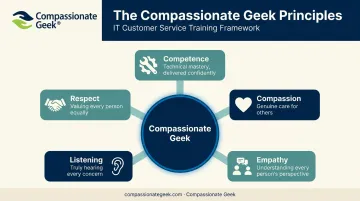
This connects directly to the Compassionate Geek philosophy: IT work centers on solving human problems, using technology only as the toolset. Five principles anchor that idea:
- Competence – staying sharp enough technically to resolve issues in a single contact
- Compassion – remembering the person on the other end is a human, not a ticket number
- Empathy – imagining what the customer feels and needs, not just what they typed
- Listening – paying full attention, taking notes, listening more than you speak
- Respect – treating every person with dignity, regardless of their technical skill level
For MSPs and internal IT teams, the payoff is concrete: fewer angry escalations and stronger client loyalty. It's also a real point of differentiation in a managed services market where everyone claims to be responsive.
The 4 Elements of Tone of Voice
Tone of voice comes from four measurable components: language, empathy, attitude, and context. Master these, and support interactions stop feeling robotic.
Language
Word choice alone signals care or indifference. "Ugh, that's really frustrating, let's get this sorted" lands completely differently than a cold, scripted line like "Please hold while I check your account status." IT staff should watch for unnecessary jargon in particular. Terms like "DNS propagation" or "packet loss" mean nothing to a panicked accountant who just wants their invoices back.
Empathy
Acknowledge frustration before diving into troubleshooting, especially in high-stakes situations such as lost data, a missed deadline, or unplanned downtime during a product launch. A simple "I understand how stressful this must be with your deadline today" buys goodwill before the technical work even starts.
Attitude
Genuine willingness to help comes through in tone, even in repetitive, scripted interactions like the tenth password reset of the day. This isn't cosmetic. Genesys's 2020 global survey of 5,000 consumers found only 52% felt they were treated with empathy when contacting support. That's essentially a coin flip—meaning attitude is often the deciding factor in whether a customer feels valued or processed.
Context
Reading the room changes the appropriate tone entirely: a payroll-blocking server crash calls for urgency and gravity, while a routine password reset calls for something lighter and reassuring. Using the same tone for both misreads the moment: it either overdramatizes a small fix or underplays a genuine crisis.
Tone of Voice Best Practices Across Support Channels
Tone doesn't transfer automatically between channels. What works on a call can fall flat in a chat window, and vice versa.
Phone & Voice Support
Pacing matters more than most technicians realize:
- Speaking too fast signals rushing or impatience
- Speaking too slow signals disinterest or condescension
- Steady, measured pacing conveys control and confidence
The "smile while you talk" technique isn't just folklore—facial expression physically changes vocal tone, even when the customer can't see your face. Try saying "I can definitely help with that" while frowning, then again while smiling; the difference is audible.
Pause to check for understanding, especially when walking a non-technical user through multi-step instructions. A quick "does that make sense so far?" prevents the frustration of finding out three steps later that they got lost at step one.
Chat, Email & Ticketing Systems
Punctuation carries tone in written channels the way inflection does on calls. "Ok." reads as curt. "Ok! Got it, I'll have this fixed shortly." reads as engaged.
A few written-channel rules worth following:
- Use emoji and abbreviations sparingly, and only when the relationship warrants it
- Never use ALL CAPS in status updates or ticket notes; it reads as shouting, even when unintended
- Translate technical explanations into plain language without sounding condescending or overly clinical
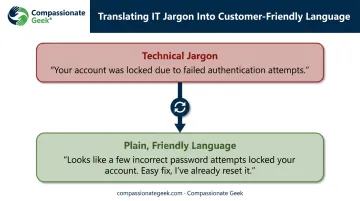
The unique IT challenge in writing is finding language that respects the user's intelligence while still explaining what actually happened. "Your account was locked due to failed authentication attempts" can become "Looks like a few incorrect password attempts locked your account. Easy fix, I've already reset it."
Building a Consistent Tone of Voice Culture on Your IT Team
Good tone isn't instinctive for most technicians. It comes from deliberate guidelines and practice.
Start simple:
- Build a "word bank" of approved empathetic phrases your team can lean on under pressure
- Create a "banned list" of jargon and dismissive language that consistently frustrates users
- Review a handful of real tickets or call recordings monthly and discuss tone, not just resolution speed
As referenced earlier, HDI's research shows technical support organizations now assess communication skills at a higher rate than technical knowledge on QA scorecards. Yet many IT teams still lack structured, repeatable training for tone, unlike the certification paths they've built for troubleshooting.
This is where formal training closes the gap. Compassionate Geek's self-paced online course, The Customer Service Secrets of Successful IT Pros, builds the five core principles (Competence, Compassion, Empathy, Listening, Respect) directly into everyday tone habits.
Teams of two or more get free access to a Group Management Console for tracking progress across the whole department.
Drayton Mayers, President of TeamLogic IT East Memphis, made the training mandatory for his entire staff and credited it with helping win new business. That's the practical payoff of formalizing tone: it stops being a personality quirk and becomes a repeatable skill your whole team shares.
Frequently Asked Questions
What are the 5 C's of customer experience?
Frameworks vary, but one commonly cited version (from Call Centre Helper) lists Care, Competence, Culture, Consistency, and Communication. These overlap heavily with tone-of-voice principles like empathy and clarity in IT support.
What are the 4 elements of tone?
Language, empathy, attitude, and context. Word choice signals care, and empathy acknowledges frustration. Attitude shows through even in scripted interactions, while context determines whether urgency or reassurance is called for.
Why is tone of voice especially important in IT and tech support?
IT support often happens over phone, chat, or email without visual cues, and frequently involves stressed, non-technical users. Tone becomes the primary signal customers use to judge whether they can trust you.
Can tone of voice actually be trained, or is it a natural talent?
It's trainable. Practice, role-play, written guidelines, and regular feedback build consistent tone the same way technical skills are built through repetition and coaching.
How does tone of voice differ between phone support and chat/email support?
Phone relies on pacing, pauses, and vocal inflection to convey warmth or urgency. Written channels rely on punctuation, word choice, and formatting, since there's no voice to carry emotional nuance.
How can IT teams tell if their tone of voice is actually working?
Track customer satisfaction scores, and review call recordings and ticket language for tone patterns. Ask directly for feedback on how interactions felt, not just whether the issue got resolved.