Introduction
IT support in 2026 looks different from even two years ago. AI handles routine tickets, hybrid teams span time zones, and clients expect faster answers with zero patience for confusion. Yet the technicians who thrive aren't just the ones who know the tech stack cold.
They're the ones who can calm a frustrated executive during an outage and explain a security patch without the jargon. Knowing when to hand a conversation off to a human colleague instead of a bot matters just as much.
In fact, 71% of technical support organizations say improving customer experience is now a top priority, according to HDI's 2025 State of Technical Support research.
This article breaks down the 10 customer service skills IT professionals and MSPs need heading into 2026, and how to build them systematically across a team.
Key Takeaways
- Listening and empathy matter as much as technical skill in AI-assisted support
- IT customer service blends people skills with technical competence and AI literacy
- Adaptability and AI collaboration are rising fast as automation takes over Level 1 work
- None of these skills are fixed traits — all ten can be trained, coached, and measured over time
Why Customer Service Skills Matter More in IT for 2026
Customer service in IT isn't the same job as customer service in retail. It means translating a server crash or a botched software update into language a stressed, non-technical person can understand, while staying calm enough to fix the problem at the same time.
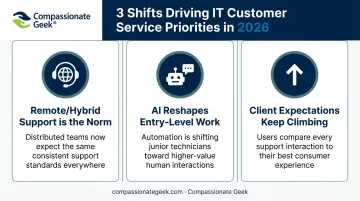
Three shifts are driving this into sharper focus for 2026:
- Remote and hybrid support is the norm now. HDI's 2024 State of Technical Support research found that a majority of support organizations now operate on a mix of in-office and remote arrangements — a model it describes as here to stay.
- AI is reshaping entry-level work. Automation increasingly handles basic call intake and issue triage, pushing human technicians toward more complex, higher-stakes interactions.
- Client expectations keep climbing. Faster resolutions, clearer updates, and less friction are now table stakes, not bonus features.
The next section breaks down the 10 skills that matter most for IT professionals and support teams navigating this shift.
The 10 Essential Customer Service Skills for 2026
These skills weren't picked at random. Each one is tied to measurable satisfaction and retention outcomes, shows up consistently across IT-specific industry research, and reflects where 2026 trends, particularly AI-assisted support, are pushing the profession.
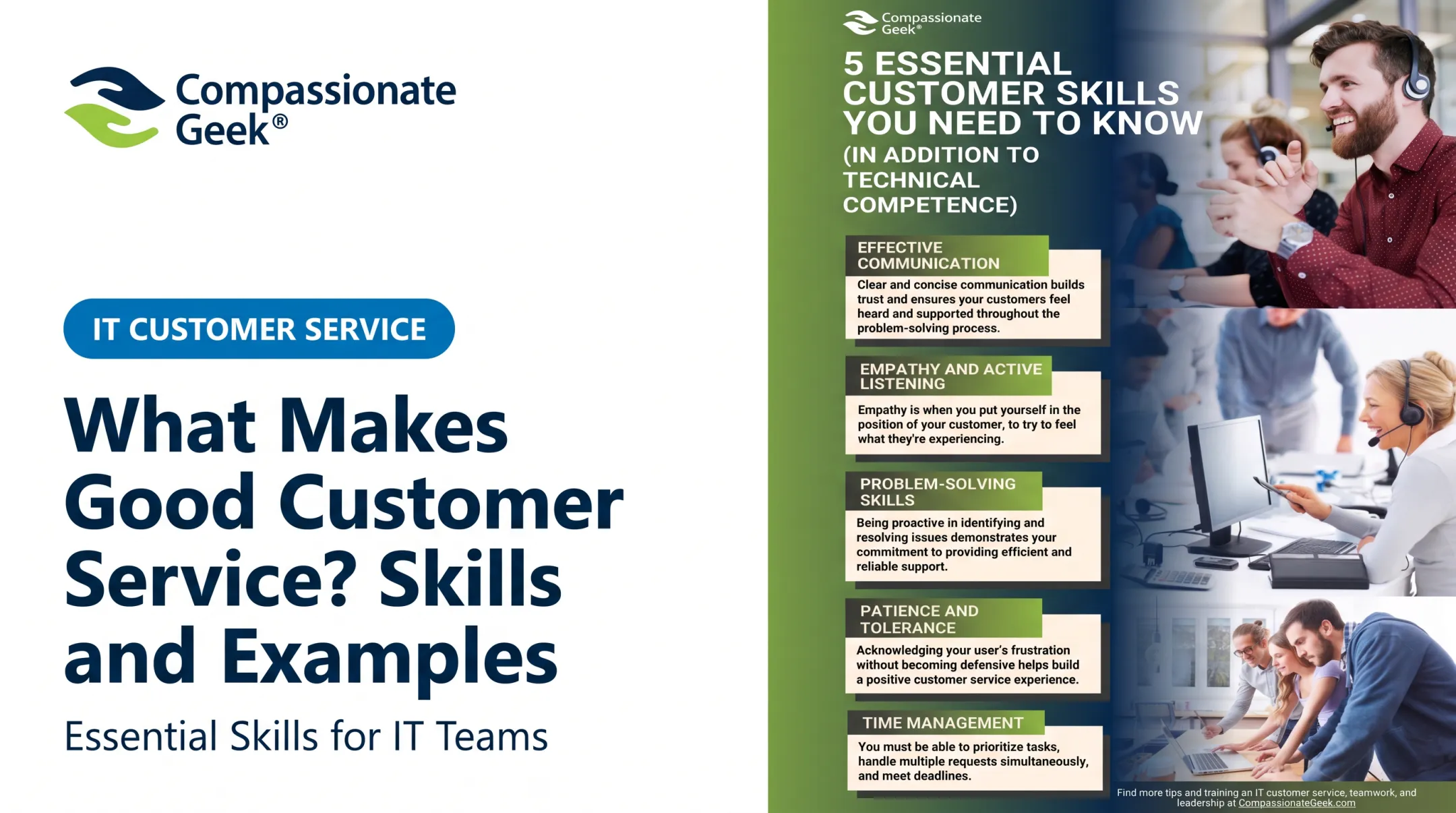
Skill 1: Active Listening
Active listening means hearing the actual problem, not just the first symptom a user describes. A user who says "my email is slow" might really be describing a failed sync, a full mailbox, or a network issue three layers deep.
HDI identifies paraphrasing and asking clarifying questions as core listening techniques for support analysts, and this matters more, not less, as AI takes over more of the initial call-handling process.
AI can transcribe and summarize a conversation, but it can't always catch the hesitation in someone's voice or the detail a user left out because they didn't think it mattered. That judgment call still belongs to the human on the line.
Skill 2: Empathy & Emotional Intelligence
Empathy is perspective-taking: imagining how it feels to be the user, not just processing their ticket. Compassionate Geek teaches this as a deliberate exercise: put yourself in their shoes before you respond.
Someone who just lost three hours of work to a crash isn't only frustrated about the technical problem. They're worried about a deadline. A simple line like "I understand how stressful losing that file must feel. Let's get you back up and running" acknowledges the emotion before jumping to the fix. That small shift changes the entire tone of the interaction.
Skill 3: Clear, Jargon-Free Communication
Technical accuracy means nothing if the person on the other end can't follow it. Explaining a DNS propagation delay to a marketing executive requires different language than explaining it to a fellow engineer.
This applies beyond spoken conversations, too:
- Tickets need clear, specific language so the next technician isn't guessing at what happened
- Documentation should assume zero prior technical knowledge unless stated otherwise
- Knowledge base articles work best with short steps and plain terms, not internal shorthand
A vague ticket or article creates just as much confusion as an unclear phone call.
Skill 4: Patience
Patience means walking a frustrated, non-technical user through the same three steps for the fourth time without a hint of irritation in your voice. It's harder than it sounds, especially during a busy shift with a growing ticket queue.
But patience pays off directly. Rushing a user off the phone often means they call back an hour later with the same unresolved problem, exactly the kind of repeat contact that drags down first-contact resolution rates and pushes issues into unnecessary escalation.
Skill 5: Deep Technical Competence
No amount of warmth compensates for not knowing your systems. Technical competence is the foundation everything else sits on. Compassionate Geek's own framework puts it first among its five core principles for exactly this reason: if you don't know your stuff, you can't carry your share of the load.
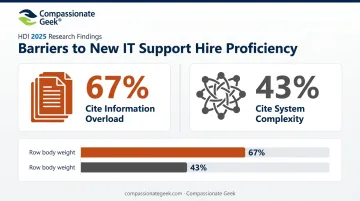
HDI's 2025 research found 67% of support organizations cite information overload and 43% cite system complexity as barriers to getting new hires proficient. This underscores the need to keep investing in technical training, especially as cloud platforms, security protocols, and AI tools keep shifting under everyone's feet.
Skill 6: Problem-Solving & Critical Thinking
Root-cause analysis under pressure separates a quick patch from a real fix. A technician who resolves the symptom but ignores the underlying cause creates a ticket that reopens next week, or next month.
HDI has warned that closing tickets quickly rather than thoroughly tends to produce repeat incidents and higher escalation rates. Documenting the actual solution, not just marking a ticket resolved, also turns one fixed problem into a resource the whole team can use next time a similar issue shows up.
Skill 7: Adaptability
A technician might field a chat request, jump on a phone call, and run a remote session all within the same hour, each requiring a different tone and pace. Adaptability also means reading the room: an executive who wants a two-line summary needs a different approach than a curious user who wants to understand what went wrong.
With tools, platforms, and hybrid work arrangements shifting constantly, rigid one-size-fits-all support styles simply don't hold up anymore.
Skill 8: AI & Digital Literacy
This is the newest skill on the list, and it's the fastest-growing. AI and automation now handle much of traditional Level 1 support, including intake and initial issue interpretation. That means technicians need to know how to work alongside AI chatbots and ticketing assistants, and knowing when to step in matters just as much.
HDI's 2025 research found 42% of support organizations expect AI to play a moderate or critical role in training future staff, a signal that AI literacy is becoming a baseline expectation, not a niche skill. Comfort with automation frees technicians to spend their time on the complex, high-empathy interactions no chatbot can handle.
Skill 9: Respect & Professionalism
Staying respectful during a security incident or extended outage, when stakeholders are anxious and sometimes short-tempered, is a professional discipline. Compassionate Geek's training puts it plainly: you don't need to feel respect for someone in the moment to act respectfully toward them.
For MSPs juggling multiple client accounts, this consistency matters enormously. One disrespectful interaction, even during a stressful incident, can undo months of relationship-building.
Skill 10: Follow-Through & Accountability
Closing the loop matters as much as fixing the problem. That means proactive status updates during a long ticket, and a final confirmation that the resolution actually worked from the user's side, not just from a dashboard.
HDI's Support Center Standard requires organizations to maintain clear procedures for communicating incident and request status on a regular basis. Reliable follow-through builds the kind of trust that keeps clients renewing contracts year after year.
How to Build These Skills Across Your IT Team
These aren't inborn traits. They're trainable and measurable, which means skill gaps are fixable, not permanent.
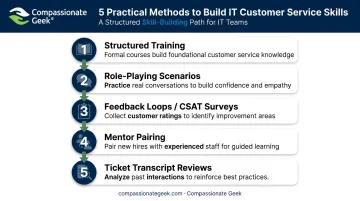
Practical ways to build them:
- Run structured training covering both interpersonal and technical skill areas, not just one or the other
- Use role-playing scenarios to practice handling frustrated users, unclear requests, and escalations before they happen for real
- Build feedback loops, such as post-interaction CSAT surveys, to spot patterns and coach specific behaviors
- Pair junior technicians with mentors who model strong communication alongside technical depth
- Review real ticket transcripts together as a team to identify what worked and what didn't
These informal practices work best when paired with structured training that reinforces them consistently. Compassionate Geek's online training programs are built around five core principles: competence, compassion, empathy, listening, and respect. The self-paced courses give IT teams and MSPs a structured way to formalize this kind of development, rather than relying on informal coaching alone.
Organizations that want to go further can pursue the Compassionate Geek Certified Company program, which requires ongoing reinforcement of these principles, not just a one-time training session.
How We Chose These Skills
These 10 skills weren't pulled from a generic customer service list and relabeled for IT. Selection followed three criteria:
- Proven impact on satisfaction and retention, based on industry research from HDI
- Relevance to IT-specific interactions, not general retail or hospitality service scenarios
- Alignment with 2026 trends, particularly AI-assisted support and hybrid work models
CompTIA's own 2026 list of soft skills for tech careers independently backs several of these same categories, including communication, active listening, teamwork, and adaptability.
A common mistake is treating this as an either/or choice: hiring for technical chops and hoping soft skills develop naturally, or hiring for personality and assuming technical training will catch up. Neither works alone. Service excellence requires both operating together, in the same person, on the same call.
Conclusion
Technical mastery gets a technician in the door. Human-centered skills like listening, empathy, and clear communication are what keep clients loyal, especially as AI reshapes what Level 1 support even looks like.
Given this shift, don't treat skill-building as a one-time workshop. Assess where your team's gaps actually are, then build a plan to close them systematically.
Compassionate Geek's training and certification programs offer a structured starting point for IT teams and MSPs. The goal: skill-building across the entire organization, not just among a few standout technicians.
Frequently Asked Questions
Is customer service a skill?
Yes. It's a learnable combination of soft and hard skills, including communication, empathy, and technical knowledge, that improves with deliberate practice and training.
What are the top customer service skills?
Active listening, empathy, clear communication, problem-solving, and patience consistently rank as the highest-impact skills for IT support. The full list of 10 above covers additional 2026-specific skills like AI literacy and adaptability.
How do you describe customer service skills?
They're the interpersonal and technical abilities that let someone help another person effectively, calmly, and knowledgeably, whether that's resolving a ticket, explaining a technical issue, or managing a frustrated stakeholder.
Can I list customer service as a skill on my resume?
Yes, but pair it with a measurable example. Instead of "strong customer service skills," try something like "resolved 90% of tickets on first contact" or "improved team CSAT scores over six months."
Why are customer service skills especially important for IT professionals in 2026?
AI now handles much of routine Level 1 support, pushing human technicians toward the complex, emotionally charged interactions automation can't manage. Hybrid work and rising client expectations make these skills non-negotiable.
How can IT teams improve their customer service skills?
Structured training, role-playing exercises, coaching feedback loops, and formal certification programs, like those offered through Compassionate Geek, give teams a repeatable way to build and measure these skills over time.