Introduction
Here's a reality most IT managers recognize immediately: the technician who solves the problem fastest isn't always the one users trust most. A ticket gets closed, the system is back online — and the user still walks away feeling dismissed, talked down to, or simply unheard.
Technical failure rarely destroys client trust. Poor interactions do.
According to HDI's survey of 115 technical-support industry leaders, 55% of organizations struggled to find candidates with adequate soft skills — compared to just 39% struggling with insufficient technical skills. The consequences show up in CSAT scores, repeat tickets, and client churn.
Customer service training skills for IT professionals aren't about transforming introverts into extroverts. They're learnable, trainable behaviors — empathy, active listening, clear communication, conflict resolution — that directly affect how users experience IT support, how teams are perceived, and how careers develop.
This article covers why IT-specific training differs from generic customer service programs, which skills matter most, and how teams and managers can build those skills in practice.
Key Takeaways
- IT professionals who pair technical expertise with customer service skills resolve issues more effectively and retain clients longer
- The most critical skills: active listening, empathy, clear communication, conflict resolution, and patience
- Generic training misses the IT context — jargon, outages, and technical complexity need specialized approaches
- Lasting improvement requires individual skill-building and organizational commitment from leadership
Why IT Professionals Need Specialized Customer Service Training
Many IT professionals entered the field because of a genuine passion for technology. The problem-solving, the systems, the architecture — that's what drew them in. Human interaction often came with the territory, not the job description.
Don Crawley, founder of Compassionate Geek, frames this tension precisely: "Our jobs in IT are not about technology. Our jobs are about crafting creative technical solutions to perplexing human problems in the workplace." For professionals evaluated almost entirely on technical output, that shift in perspective doesn't come automatically.
The Unique Pressure of IT Support Interactions
IT support sits at an uncomfortable intersection: users are often frustrated, stressed, or embarrassed about not understanding a technical problem. They're not calling because things are going well. They're calling because something broke — and that something is blocking their ability to do their job.
This dynamic is different from retail or hospitality. An IT professional must:
- Diagnose complex problems in real time while managing an emotionally escalated user
- Translate technical findings into language a non-technical person can act on
- Set honest expectations about timelines when no quick fix exists
- Remain composed when the user is anything but
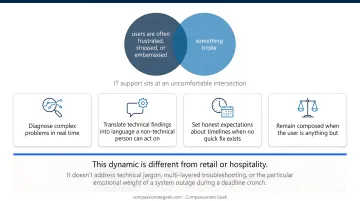
Standard customer service training — built for frontline retail or call center environments — doesn't account for any of this. It doesn't address technical jargon, multi-layered troubleshooting, or the particular emotional weight of a system outage during a deadline crunch.
Why Generic Training Falls Short
Most off-the-shelf customer service programs teach scripts designed for product returns and complaints about wait times. They're built for environments where the problem is visible, the solution is simple, and emotions run low. None of that holds in IT support.
When a user has lost three hours of unsaved work, or an entire team is locked out of a system mid-deadline, they need two things simultaneously: a technical solution and a steady presence. Generic training doesn't prepare anyone for that combination.
IT-specific training covers what generic programs skip entirely — how to explain a fix without condescending, how to manage expectations when the root cause isn't clear yet, and how to de-escalate a frustrated user without losing focus on the actual problem. These aren't soft additions to technical work. They're core to doing it well.
Core Customer Service Training Skills for IT Professionals
Empathy and Emotional Awareness
A system outage isn't just a technical event — it's a disruption to someone's ability to do their work. Maybe they're missing a deadline. Maybe they've already spent an hour trying to fix it themselves before calling. The frustration is real, and jumping straight to troubleshooting without acknowledging it signals that the IT professional sees a ticket, not a person.
Empathetic language is trainable. Compare these two responses to a user who's lost unsaved work:
Transactional: "What version of Office are you running?"
Empathetic: "I understand how disruptive this is — let's focus on getting this resolved for you right now."
The technical information still gets gathered. The difference is that the user feels heard before the technician begins diagnosing.
Active Listening
Active listening in IT support goes well beyond waiting for the user to stop speaking. It means paraphrasing what the user described, asking clarifying questions to identify root causes, and confirming understanding before proceeding.
Research on IT support ticket resolution found that approximately 57% of tickets contained requests for additional user input — and tickets requiring those follow-ups produced resolution times nearly twice as long. Getting the full picture the first time matters.
Practical training tip: Train IT staff to resist the urge to diagnose during a user's first sentence. Premature conclusions are one of the most common causes of repeat tickets. Taking notes during the interaction — a concrete, observable behavior — is one of the most effective active listening anchors.
Clear Communication and Jargon Translation
Ask an IT professional to explain a DNS error to a non-technical user, and the response usually reveals the problem instantly. Translating technical issues into plain language is a real skill — and one most IT training programs never explicitly teach.
A simple training exercise: Have IT staff explain a common technical fix as if they're describing it to a non-technical family member. This exercise exposes hidden jargon dependencies and builds the habit of user-centered language.
Compassionate Geek's training dedicates curriculum to plain-language communication — especially in email and chat, where jargon creates confusion with no immediate chance to clarify.
Conflict Resolution and Handling Frustrated Users
Users who are already stressed can become combative when resolution takes longer than expected. IT professionals need specific training in de-escalation — because staying calm under verbal pressure is a trainable skill, not an innate personality trait.
Key de-escalation behaviors to train:
- Validate the concern without accepting blame ("I understand this has been frustrating — here's what we're doing to address it")
- Stay factual rather than defensive when under pressure
- Communicate clear next steps: "I can't restore the file instantly, but I'll have an update for you within the hour"
- Know when to escalate to a senior team member rather than let an interaction deteriorate
The Compassionate Geek framework includes a six-step call-handling flowchart and specific modules on conflict resolution — including the nuanced challenge of delivering bad news (like "the file is unrecoverable") with honesty and care.
Patience and Composure
Patience gets tested when users repeat the same question three times, skip a step you've already explained, or call back about the same issue. Training should give IT professionals composure tools — not scripts that sound robotic, but acknowledgment phrases that preserve professionalism while the interaction resets.
Practical composure techniques to train:
- Use a brief reset phrase ("Let me make sure I have the full picture") to slow the pace without sounding dismissive
- Acknowledge repeat contacts without frustration ("I want to make sure this is fully resolved for you")
- Take a deliberate breath before responding to an escalating tone
- Focus on the next single step, not the full backlog of the interaction
The Five Principles Framework: A Customer-Centered Approach to IT Service
Compassionate Geek's training is built around five core principles that function as observable, trainable behaviors — not abstract values. Together, they form a framework that addresses both the technical and human dimensions of every IT interaction.
| Principle | Observable Behavior |
|---|---|
| Competence | Resolve issues on first contact; follow through on commitments |
| Compassion | Follow up after fixes; proactively communicate delays |
| Empathy | Acknowledge the emotional impact before troubleshooting begins |
| Listening | Take notes; paraphrase; confirm understanding before acting |
| Respect | Use positive language; treat every problem as worthy of attention |
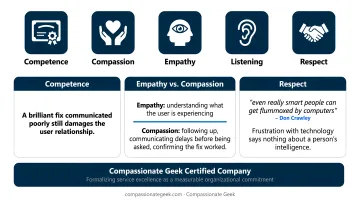
Three of these principles are worth unpacking beyond the table.
Competence extends past technical knowledge into service delivery. A brilliant fix that's communicated poorly still damages the user relationship. Credibility comes from results and how you treat people along the way.
The empathy/compassion distinction is deliberate. Empathy is understanding what the user is experiencing; compassion is what you do about it: following up after a fix, communicating a delay before the user has to ask, confirming the solution actually worked. In the Compassionate Geek framework, empathy recognizes the situation while compassion reduces the human cost of it.
Respect, in practice, means treating every problem as worthy of attention regardless of how trivial it looks technically. As Don Crawley points out, "even really smart people can get flummoxed by computers" — frustration with technology says nothing about a person's intelligence, and condescension destroys trust faster than a slow resolution time.
Organizations can formalize their commitment to these principles through the Compassionate Geek Certified Company program, which establishes service excellence as a measurable, organizational commitment rather than a periodic initiative.
How to Train IT Teams in Customer Service Skills
Role-Playing and Scenario-Based Practice
Customer service skills don't develop through lectures — they develop through practice and feedback. Role-play scenarios — where one person plays a frustrated user and another plays the IT professional — build muscle memory for empathetic communication and de-escalation.
Effective IT-specific scenarios include:
- A user who lost unsaved work and is visibly angry
- A VIP escalation where the user expects immediate priority treatment
- A repeat caller with the same unresolved issue
- A technically inexperienced user who can't follow basic troubleshooting steps
The goal is rehearsal under realistic pressure, with live feedback from peers or managers.
On-Demand Training for Shift-Based Teams
IT departments often can't pull entire teams offline for training. Self-paced, on-demand courses solve this — staff complete modules when coverage allows, without disrupting service continuity.
IT-specific courses are meaningfully more effective than generic alternatives because the scenarios, language, and challenges are ones IT professionals recognize from their actual workday. Compassionate Geek's online training program addresses exactly this need, with content grounded in real IT support contexts rather than retail or hospitality frameworks.
Coaching and Peer Feedback Loops
Managers can build an ongoing development loop by periodically reviewing actual support interactions — tickets, chat logs, or call recordings — with their teams. The goal isn't criticism; it's normalizing skill development as continuous rather than episodic.
Ask two questions during reviews: Where did customer service skills show up well? and Where was there an opportunity to apply them differently? This framing makes feedback developmental rather than evaluative.
Ongoing Training vs. One-Time Events
Customer service skills training should begin at onboarding and continue through regular refreshers. New hires need a foundation; experienced staff benefit from reinforcement when new tools, policies, or customer challenges emerge.
A survey of 1,001 U.S. employees and 500 HR managers found that 76% of employees were more likely to remain with an employer that offered continuous training.
For IT teams already facing retention pressure — HDI's 2025 survey found 75% of support organizations experienced notable turnover in the preceding year — ongoing training serves double duty: it develops skills and reduces attrition.
Measuring What Changes
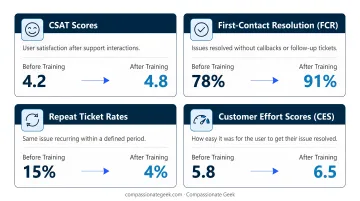
Track these metrics before and after training to quantify what's actually changing:
- CSAT scores — user satisfaction after support interactions
- First-contact resolution (FCR) — issues resolved without callbacks or follow-up tickets
- Repeat ticket rates — same issue recurring within a defined period
- Customer Effort Scores (CES) — how easy it was for the user to get their issue resolved
Building a Culture of Customer Service in IT Organizations
Individual skill development only goes so far. When leadership doesn't model the behaviors they're training for, the training doesn't stick.
When CIOs and IT managers visibly practice empathetic communication — staying calm under pressure, listening without interrupting, following up after difficult interactions — it signals that these behaviors are expected, not optional.
McKinsey's research across 1,240 global business leaders found that transformations were 5.3 times more likely to succeed when senior leaders modeled the requested behavioral changes. That finding applies directly to cultural shifts in IT customer service.
Leadership modeling creates the right environment — but it needs organizational structure behind it. Shared standards give teams something concrete to align around. Organizations that define what excellent IT customer service looks like typically do it through:
- Service principles that reflect the team's core values
- Behavioral frameworks outlining expected interactions
- Documented expectations shared across all IT staff
Without that shared definition, individual improvement rarely translates into consistent team performance.
The Compassionate Geek Certified Company program offers one path to formalizing that commitment: it creates shared organizational goals, gives staff a visible standard to work toward, and signals to customers that service quality is built into how the organization operates — visible in every ticket, call, and follow-up.
Frequently Asked Questions
What skills are taught in customer service training?
Core skills include empathy, active listening, communication, conflict resolution, patience, and product knowledge. IT-specific training also covers jargon translation, managing technically frustrated users, and setting honest expectations around resolution timelines — areas most general customer service programs rarely address.
Why do IT professionals specifically need customer service training?
IT professionals interact with users who are often stressed, non-technical, or experiencing real disruptions to their work. People skills are as critical as technical skills in these interactions, yet they're rarely taught in technical education programs or certification tracks.
What is the difference between soft skills and technical skills in IT customer service?
Technical skills are the ability to diagnose and resolve IT issues. Soft skills include communication, empathy, and active listening. A technically correct fix delivered with poor communication still produces a dissatisfied user. The most effective IT professionals build both skill sets deliberately.
How do you train IT staff in soft skills effectively?
Role-playing, scenario-based practice, peer feedback on real interactions, and on-demand IT-specific courses are the most effective methods. Soft skills develop through repetition and rehearsal, not passive reading. Practice matters more than instruction alone.
How does customer service training improve IT team performance?
Improved skills lead to measurable outcomes: higher CSAT scores, fewer repeat tickets, faster resolution through better initial diagnosis, and stronger long-term client relationships. For MSPs especially, service quality is often the primary differentiator between renewing and losing a contract.