
Here's the truth most help desks don't talk about: escalations rarely happen because of the technical problem itself. They happen because of poorly chosen words, robotic scripts, or a rep who gets defensive instead of curious. As Don Crawley, founder of Compassionate Geek, puts it, "Our jobs in IT are not about technology. Our jobs are about crafting creative technical solutions to perplexing human problems in the workplace."
This guide organizes 57 phone-tested phrases into five categories, so you always know what to say next.
Key Takeaways
- Deliberate word choices defuse most angry calls before a supervisor gets involved
- Organize phrases by call stage: acknowledgment, empathy, solution, then next steps
- Avoid arguing, flatly saying "no," or dismissing a customer's frustration as an overreaction
- Knowing when to escalate or end a call matters as much as what you say
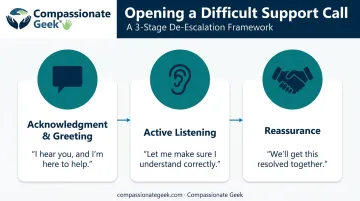
Phrases to Open the Call and Show You're Really Listening
The first moments of an angry call aren't for solving anything. They're for showing the customer you're actually paying attention. ICMI's research on defusing angry callers makes this clear: let the caller vent and take notes before you attempt to fix the issue. Jumping to solutions too early is one of the fastest ways to escalate a call.
Acknowledgment & Greeting Phrases
Use these before you've solved a single thing, just to let the customer know you're present and engaged:
- "Thank you for bringing this to my attention. I'm here to help."
- "I can tell this is really frustrating. Let's work through it together."
- "Tech Support, this is [Name]. How can I help you today?"
- "I hear you, and I want to get this sorted out."
- "I'm glad you called. Let's figure this out."
Active Listening Phrases
These verbal cues signal you're truly listening, not just waiting for your turn to talk. Interrupting an already-upset caller almost always escalates the anger, since it signals you'd rather talk than understand:
- "I see."
- "Let me make sure I've got this right, you're saying..."
- "Go on, I'm following you."
- "So what you're describing is..."
- "Can you walk me through what happened, step by step?"
Reassurance Phrases
Once you've listened, reassure the caller they've reached the right person:
- "You called the right place, and I'm not going anywhere until this is sorted."
- "Please tell me everything. I want the full picture."
- "I'm going to stay on this with you until we get an answer."
- "This is exactly the kind of issue I handle."
- "You don't need to repeat yourself. I've got the details."
Phrases to Empathize, Apologize, and Build Trust
Once the customer feels heard, it's time to validate their frustration and take ownership. The International Customer Management Institute (ICMI) recommends opening with phrases like "I agree" or "I understand" before moving into an apology, rather than treating empathy as an afterthought.
Empathy Statements
These validate the emotion without judging it:
- "I'd feel the same way if this happened to me."
- "That sounds incredibly frustrating, and I understand why you're upset."
- "I don't blame you for feeling that way."
- "Thank you for sharing that with me. I can understand how frustrating that is."
- "I know this is very frustrating, and I want to help."
Sincere Apology Phrases
Go beyond a generic "sorry" here. Specificity makes the apology land:
- "I sincerely apologize for the trouble this has caused you today."
- "You're right, and I want to fix this for you."
- "I'm sorry that happened. I know it's frustrating, and I'll get it taken care of."
- "I am so very sorry you've had to deal with this."
- "That shouldn't have happened, and I'm going to make it right."
Ownership & Trust-Building Phrases
These show you're personally invested in resolving the issue, not just reading from a script:
- "I'm going to personally see this through until it's resolved."
- "Let's work together to get this fixed."
- "I'm going to do everything in my power to help."
- "How can I make this better for you?"
- "I'm going to make sure we resolve this as fast as possible."
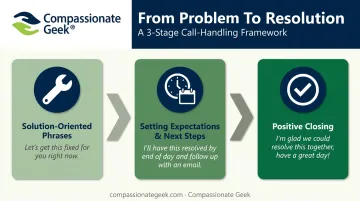
Phrases to Offer Solutions, Set Next Steps, and Close Strong
Once the customer feels acknowledged, pivot toward action. Specificity is everything here. Contact-center guidance from Call Centre Helper notes that vague expectations are a leading cause of repeat calls, so replace vague phrases like "I'll pass this along" with concrete specifics.
Solution-Oriented Phrases
These pivot the conversation toward fixing the problem:
- "Here's what I can do for you right now."
- "There are a couple of ways we can resolve this. Let's find the best fit."
- "I've found the cause. Here's what needs to happen next."
- "Let me walk you through your options."
- "I can take care of this for you immediately."
- "Here's the fastest path to getting this resolved."
Setting Expectations & Next Steps Phrases
Vague timelines create anxiety. Specific ones create patience:
- "I'll follow up with you by [time] with an update."
- "Here's exactly what happens next."
- "This process could take up to 90 minutes, and I'll check in at the 45-minute mark."
- "I am going to involve a colleague who specializes in this. They'll reach out within 30 minutes."
- "If this first step doesn't resolve it, I'll move to the next one, which takes about 20 minutes."
- "I'll send you a summary of everything we discussed today."
Positive Closing Phrases
End on a constructive note. Customers remember how a call ends almost as much as how it started:
- "Thank you for your patience while we worked through this."
- "Is there anything else I can help you with before we wrap up?"
- "I really appreciate you bringing this to me directly."
- "You'll hear from me by [time]. I've got it noted."
- "It was good talking with you, and I'm glad we got this sorted."
Phrases for Escalating, Transferring, or Ending a Difficult Call
Not every call resolves at the first level, and that's fine. What matters is how the handoff feels to the customer. According to ICMI's escalation guidance, organizations should draw a clear line between ordinary frustration and abusive behavior, with documented rules for when an agent may pause, escalate, or disconnect.
Looping in a supervisor without making the customer feel dismissed:
- "To make sure you get the best possible help, I'd like to bring in my supervisor."
- "My manager has more authority to resolve this quickly. Let me get them on the line."
- "I want you to have every resource available, so I'm escalating this now."
- "This deserves a second set of eyes. I'm bringing in my supervisor."
Transferring to another department or specialist:
- "I want to connect you with someone who specializes in exactly this issue."
- "I'll transfer you now, and I'm sending them the notes so you won't have to repeat yourself."
- "This is handled by our billing team. I'm connecting you now."
Calmly ending an abusive or threatening call:
- "I want to help, but I can't continue if this language continues."
- "I need us to keep this respectful so I can keep helping you."
- "I'm going to end this call now. Please call back when we can continue calmly."
Before ending any call, loop in a manager first when possible. It protects both the customer relationship and the rep.
How to Deliver These Phrases: Tone, Timing, and Training
Word choice only works if it's paired with the right delivery. Reading a script too fast, or too flat, undercuts even the best phrase on this list.
On timing: acknowledgment and empathy phrases always come first, never after an apology or solution. Jumping straight to "here's what I can do" before validating the customer's frustration reads as dismissive, even when the fix is right.
On tone: a 2025 study published in the Journal of Business Research analyzed 774 telecom call-center conversations. It found that vocal cues, like an affirmative tone and measured speech rate, added meaningful predictive value for customer satisfaction beyond the words themselves. In plain terms: how you sound matters as much as what you say.
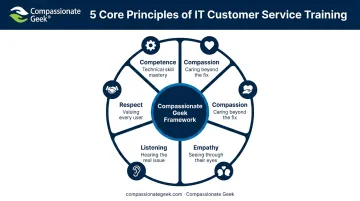
That's exactly why Compassionate Geek doesn't teach these 57 phrases as a script to memorize. They're a starting point for internalizing five core principles:
- Competence
- Compassion
- Empathy
- Listening
- Respect
Real change comes from structured practice, not word-for-word recitation. Compassionate Geek's on-demand IT customer service training and live-video sessions are built around that same idea, helping IT teams turn these principles into instinct rather than a rehearsed line.
Frequently Asked Questions
How should I respond to an angry customer over the phone?
Prioritize a calm tone and a sincere apology, then offer to help right away. Jumping straight into problem-solving before acknowledging the emotion tends to backfire.
What should you never say to an angry customer?
Avoid a flat "no," phrases like "calm down," and any language that blames the customer for the problem. These phrases signal dismissal and almost always intensify the tension.
How do you calm down an angry customer quickly?
Let the customer fully vent without interrupting, acknowledge their emotion first, then move toward a specific solution. Skipping the acknowledgment step usually backfires and extends the call.
When should you escalate or transfer an angry caller to a supervisor?
Escalate when you hit the edge of your authority or the customer requests a manager. Also escalate immediately if the caller becomes abusive — waiting too long can put your staff at unnecessary risk.
How can IT support teams practice these phrases so they sound natural instead of scripted?
Role-play mock calls, review recorded calls for coaching, and work through a structured course like Compassionate Geek's IT customer service training. Practice builds the instinct that memorization never quite delivers.
Is it ever okay to hang up on a customer?
Yes, but only as a last resort for abusive or threatening behavior. Loop in a manager first whenever possible, and always document what happened.