
Same problem. Wildly different experience.
That gap is exactly what first contact resolution rate measures. In IT support and MSP environments, agents have to juggle technical accuracy with clear, human communication — and FCR captures how well they're doing both at once.
This article breaks down what FCR actually means, how to calculate it, what a good benchmark looks like, why it matters more than most teams realize, where it can mislead you, and how to actually improve it.
Key Takeaways
- FCR measures full resolution on the first interaction, not just acknowledgment
- A 1% FCR increase can boost customer satisfaction by about 1% (SQM Group)
- Technical support lags retail benchmarks (60% vs. 75%), proving context beats a universal target
- Chasing FCR without guardrails can backfire through premature ticket closures
- Improving FCR requires technical training plus soft skills like active listening
What Is First Contact Resolution Rate?
First contact resolution (FCR) is the percentage of tickets, calls, chats, or emails resolved completely during the very first interaction: no callback, no escalation, no follow-up needed. It's sometimes called First Call Resolution or First Touch Resolution, and the terms apply across every support channel your team uses.
Here's a grounded example: a helpdesk agent gets a call about a locked account. They verify identity, reset the password, confirm the user can log back in, and end the call. No second contact required. That's FCR in action.
The key word is resolved, not acknowledged, not "ticket created," not "escalated to tier 2." For a contact to count toward FCR:
- The underlying issue must actually be fixed, not just patched
- The customer shouldn't need to reach out again about the same problem
- Live channels (calls, chats) require resolution before the interaction ends
- Email and web tickets typically follow a one-business-hour resolution window as the standard practice
FCR vs. Related Metrics
It's easy to confuse FCR with First Response Time (FRT), but they measure completely different things. FRT tracks how fast an agent replies to a customer. FCR tracks whether that reply actually solved the problem.
A team can have a blazing-fast FRT and a terrible FCR. Replying in 90 seconds with an answer that doesn't fix anything doesn't count for much.
There's also a stricter cousin worth knowing: One Contact Resolution (OCR). While FCR focuses on a single channel, OCR checks whether the customer used any other touchpoint (a follow-up email, a chat, a second call) before, during, or after the primary interaction. If they did, it doesn't count as OCR, even if FCR would still count it.
How to Calculate First Contact Resolution Rate
The standard formula is straightforward:
FCR = (Tickets/calls resolved on first interaction ÷ Total tickets/calls received) x 100
Here's a simple worked example. Say your helpdesk handled 400 tickets in a week, and 260 of those were fully closed on the first contact, with no repeat contact about the same issue:
260 ÷ 400 = 0.65, or 65% FCR
That leaves 140 tickets, or 35%, that required a second touch — worth digging into for patterns.
Two Ways to Measure It
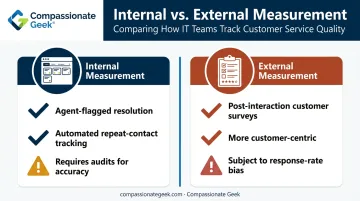
Internal measurement uses your CRM or ticketing system. Agents flag whether an interaction was resolved on first contact, or the system tracks repeat contacts automatically. This is common, but it depends on consistent agent behavior and periodic audits to stay accurate.
External measurement relies on post-interaction surveys, letting the customer decide whether their issue was actually resolved. It's more customer-centric but subject to response-rate bias since not everyone fills out a survey.
A few practical notes for getting the calculation right:
- Define a consistent repeat-contact window (commonly 1 to 30 days) for what counts as a follow-up on the same issue
- Exclude tickets that inherently require multiple touches by design, such as hardware replacements or bug fixes awaiting a patch release
Without these guardrails, your FCR number can swing wildly depending on how generously "resolved" gets interpreted.
What Is a Good First Contact Resolution Rate?
Industry data from SQM Group's 2024 benchmark study puts 70% to 79% in the "good" range, with 80% or higher considered world-class. That tier is rare — most contact centers don't get there.
But here's the catch for IT support specifically: benchmarks vary heavily by industry and issue complexity. SQM's same 2024 data shows technical support averaging around 60% FCR, compared to 75% for retail support.
Why the gap? Technical issues are just harder to diagnose in one shot:
- Multi-system troubleshooting often requires checking logs, replicating conditions, or coordinating with other teams
- Retail and transactional support tends to involve simpler, more scriptable requests
- A "good" FCR for a helpdesk resolving VPN and permissions issues looks different from a "good" FCR for a retail return line
The takeaway: don't chase a universal number. Benchmark against comparable IT support environments, and treat your own historical trend as the more meaningful signal.
Why First Contact Resolution Rate Matters
FCR connects directly to customer satisfaction, operating costs, and team morale.
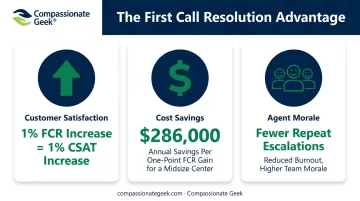
Customer satisfaction climbs with FCR. According to SQM Group's research, each 1% improvement in FCR corresponds to roughly a 1% improvement in customer satisfaction. That's a near one-to-one relationship, which is rare for any single metric.
The cost savings add up fast. SQM's benchmark model also links FCR gains to operating costs, estimating $286,000 in annual savings for a midsize center from just a one-point FCR improvement. Fewer repeat contacts mean less duplicated agent time diagnosing the same issue twice.
Agents feel it too. Resolving an issue completely, on the first try, gives agents a real sense of accomplishment. Compare that to fielding a third call from an already-frustrated customer whose problem still isn't fixed.
This is central to what Compassionate Geek teaches: IT work is about solving human problems, not just technical ones. An agent equipped to actually close the loop faces less stress and burns out slower than one stuck in a cycle of repeat escalations.
Challenges and Limitations of FCR
FCR is useful, but it's not foolproof. A high number doesn't automatically mean great service.
Self-service gaps can inflate the rate artificially. Weak knowledge base or FAQ content pushes simple questions to agents, who resolve them instantly and pad your FCR without reflecting true support quality.
In contrast, effective self-service actually removes the easy stuff, leaving agents with harder contacts. As Zendesk points out, this results in a lower, but more honest, FCR.
Pressure to hit targets can backfire. Agents chasing an FCR quota might close tickets prematurely, applying a quick fix rather than solving the root cause. The customer walks away thinking it's resolved, only to call back days later when the problem resurfaces.
That's why pairing FCR with complementary metrics matters:
- CSAT: did the customer actually feel satisfied with the outcome?
- Time to Resolution: how long did the fix take, beyond just contact count?
- Reopened-ticket rate: did the "resolved" ticket come back?
No single metric tells the whole story. FCR works best as part of a set.
How to Improve Your First Contact Resolution Rate
Improving FCR means equipping agents to solve problems correctly the first time, not pushing them to close tickets faster.
Blend Technical Training With Soft Skills
Misdiagnosis is one of the biggest drivers of repeat contacts, and it usually comes from one of two gaps: insufficient technical knowledge, or poor listening that leads to solving the wrong problem. Compassionate Geek's training addresses both, built around five core principles: Competence, Compassion, Empathy, Listening, and Respect.
A common practical strategy: teach agents to ask the right questions and dig deeper with the customer before proposing a fix. Then verify the fix actually works before closing the ticket or ending the call. Skipping that verification step is exactly how "resolved" tickets come back a week later.
Build Infrastructure That Supports First-Try Fixes
Training alone isn't enough. A few operational levers matter just as much:
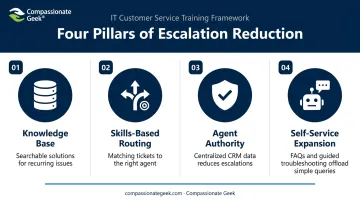
- Maintain a searchable knowledge base so agents can pull up solutions to recurring issues instead of researching mid-call
- Use skills-based ticket routing so issues land with the agent best equipped to solve them, not just whoever's next in queue
- Give agents authority and centralized CRM data, so they can resolve issues without unnecessary escalations to a supervisor
- Expand self-service options, such as FAQs, chatbots, and guided troubleshooting, to offload simple, repetitive queries and free agents to focus on complex first-contact resolutions
Invest in Ongoing Development
Sustainable FCR improvement requires ongoing reinforcement rather than a single training session. Organizations building a customer-focused culture can pursue structured programs like Compassionate Geek's Certified Company program, which recognizes teams that combine technical competence with genuinely human service.
Frequently Asked Questions
What is the definition of first contact resolution rate?
FCR is the percentage of support interactions (calls, chats, emails, or tickets) that get fully resolved during the first contact, with no follow-up needed from the customer.
How to calculate first contact resolution rate?
Divide the number of tickets resolved on first contact by total tickets received, then multiply by 100. Track it through CRM/ticketing flags or post-interaction customer surveys.
What is a good first contact resolution rate?
SQM Group benchmarks 70-79% as good and 80%+ as world-class, though technical support environments typically run lower (around 60%) than simpler transactional support.
What is the difference between first call resolution and first contact resolution?
The terms are largely interchangeable today. "First call" historically referred only to phone interactions, while "first contact" covers every channel: phone, chat, email, and web tickets.
How can IT teams improve their first contact resolution rate?
Combine technical and soft-skills training, maintain a strong knowledge base, use skills-based ticket routing, and expand self-service options so agents can focus on complex issues.
Does a high FCR always mean good customer service?
Not necessarily. A high FCR can mask weak self-service options or agents closing tickets prematurely, so it's best evaluated alongside CSAT and reopened-ticket rates.