
That's the gap this article is about: the space between fixing the problem and fixing the experience.
IT customer service skills aren't optional anymore. Remote work has scattered support interactions across chat, email, and screen shares, MSP competition has made service quality a genuine differentiator, and users expect both speed and understanding in the same conversation. A 2024 HDI survey of more than 100 support professionals found that 46% reported rising ticket volume year over year, with half of all tickets now resolved remotely.
This article breaks down the three core categories of IT customer service skills, why each one matters, and how tech pros can build them deliberately instead of hoping personality fills the gap.
Key Takeaways
- IT customer service skills span three categories: technical competence, emotional intelligence, and communication
- Technical fixes without empathy still leave customers unhappy
- Compassionate Geek's five-principle model (Competence, Compassion, Empathy, Listening, Respect) balances all three skill areas
- Skill priority depends on your role, team maturity, and customer base
- Structured training builds these skills at scale, more reliably than natural personality alone
What Are IT Customer Service Skills & Why They Matter
IT customer service skills combine technical troubleshooting ability with human-centered interpersonal skills. The goal is resolving the tech problem and making the person on the other end feel heard.
This differs from generic customer service in one important way: the "product" is usually invisible and frustrating. Nobody calls IT support to celebrate a working printer.
They call because something broke, and it's often blocking their ability to do their job. That frustration colors every interaction before a technician says a word.
Don Crawley, founder of Compassionate Geek, puts it directly: "Our jobs in IT are not about technology. Our jobs are about crafting creative technical solutions to perplexing human problems in the workplace."
What goes wrong without these skills:
- Generates repeat tickets from unclear explanations
- Triggers unnecessary escalations that could've been resolved on first contact
- Drops CSAT scores despite technically correct fixes
- Burns out support teams stuck fielding the same frustrated complaints
These patterns show up in industry data, too. TSIA's State of Support Services 2024 report found that support organizations face growing pressure to anchor service around full resolution, not just fast response. That shift reflects what customers actually care about: getting their problem solved without a second call.
The 3 Core Categories of IT Customer Service Skills to Master
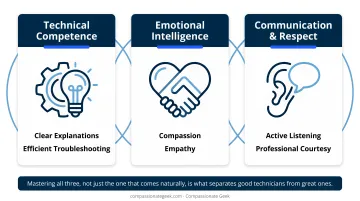
IT customer service skills aren't a single trait. They split into three interconnected categories, each covering a different part of the support interaction. Mastering all three, not just the one that comes naturally, is what separates good technicians from great ones.
Category 1: Technical Competence & Product Knowledge
This is the foundational hard-skill layer: deep, current knowledge of systems, software, hardware, and troubleshooting methodology. You build it through certifications, documentation, hands-on practice, and continuous learning.
Without it, empathy and communication have nothing real to work with. You can be the kindest technician in the building, but if you can't diagnose the actual issue, the customer's problem stays unsolved.
Best suited for:
- Escalation-tier support and complex, multi-system environments
- MSP technicians juggling varied client tech stacks
- Situations where speed and accuracy build immediate trust
Technical competence builds confidence fast and cuts resolution time. But it has real limits on its own.
A peer-reviewed study of 170 enterprise-system support encounters found that behavioral skills significantly moderated the effect of technical skill on customer satisfaction. In plain terms: technical proficiency alone wasn't enough. Satisfaction depended on how well that competence was paired with customer-facing behavior.
Category 2: Interpersonal & Emotional Intelligence Skills
This category covers the ability to recognize, manage, and respond to emotions, both the customer's and your own, during a stressful tech problem. It shows up as empathy statements, patience with non-technical users, and consistent respect regardless of someone's technical literacy.
Unlike technical competence, this category focuses on the human experience of the problem rather than the problem itself. It's the differentiator Compassionate Geek was built around.
Best suited for:
- Frustrated or non-technical end users
- High-stress situations like outages or security incidents
- Building long-term client relationships for MSPs
Compassionate Geek's Compassion, Empathy, and Respect principles work as a practical framework here:
- Compassion means recognizing that someone contacting IT is often stressed, confused, or embarrassed
- Empathy means seeing the situation through their eyes, not just your ticket queue
- Respect means never making a user feel small for not understanding technology
The trade-off: empathy without technical follow-through feels hollow. Kind words don't fix a broken VPN connection. This category has to pair with real resolution to build lasting trust.
Category 3: Communication & Problem-Solving Skills
This is the bridge between technical knowledge and emotional intelligence, translating jargon into plain language, actively listening to correctly diagnose issues, and structuring troubleshooting steps that adapt to the person you're helping.
In practice, this means:
- Paraphrasing what the customer said before jumping to a fix
- Breaking solutions into clear, sequential steps
- Adjusting explanations based on the listener's technical comfort
Best suited for:
- Remote support interactions and cross-departmental collaboration
- Situations where empowering the user to self-resolve saves everyone time
Strong communication reduces misunderstandings and speeds up first-contact resolution. The trade-off is that it takes deliberate practice. Simplifying without oversimplifying is a real skill, and it gets strained fast under time pressure and high ticket volume.
How to Develop and Prioritize These Skills
There's no single skill set that works for every IT pro. The right development path depends on your role, your team's maturity, and who you support.
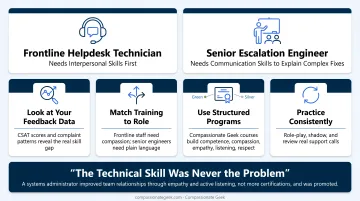
A frontline helpdesk technician fielding constant frustrated calls probably needs interpersonal skills first. A senior escalation engineer explaining a complex fix to a nervous stakeholder needs communication skills more urgently than another certification.
Factors worth considering before you pick a training priority:
- Look at your feedback data. CSAT scores, repeat-contact rates, and complaint patterns usually point directly to the skill gap driving them.
- Match training to role. Frontline staff often need compassion and patience training first; senior engineers often need help translating complexity into plain language.
- Use structured programs, not guesswork. Compassionate Geek's courses and its Certified Company program build competence alongside compassion, empathy, listening, and respect in a repeatable curriculum, rather than leaving it to chance.
- Practice consistently. Role-playing tough calls, shadowing experienced technicians, and reviewing real support interactions as a team turns theory into habit.
One story from The Compassionate Geek illustrates this well: a technically brilliant systems administrator struggled to build relationships with his team. After deliberately working on empathy and active listening, not additional certifications, his team dynamics improved and he was promoted. The technical skill was never the problem.
Common Mistakes That Undermine IT Customer Service Skills
Even well-intentioned teams sabotage their own service quality. Watch for these patterns:
- Skewed training budgets. Technical certifications get budget and calendar time, while soft skills training becomes an afterthought, if it gets any attention at all.
- Fixed-trait thinking. Empathy and patience aren't personality quirks; they can be coached, practiced, and reinforced just like any troubleshooting methodology.
- Skipping feedback loops. Ignoring CSAT surveys or complaint data means you're guessing at which skill gap is actually driving poor experiences.
- Treating training as a one-time event. A single workshop doesn't stick. Skills fade without ongoing coaching, book clubs, or refresher sessions built into team culture.
Each of these mistakes is fixable, and fixing them usually costs less than the repeat tickets and escalations they cause.
Conclusion
IT customer service skills stand as a core professional competency, on par with your technical ability to fix the actual problem.
Technical competence, emotional intelligence, and communication don't work in isolation; they reinforce each other. A brilliant fix delivered without empathy still leaves a frustrated customer, while empathy without technical follow-through leaves the problem unsolved. Communication is what carries both across the finish line.
Frameworks like Compassionate Geek's five principles: Competence, Compassion, Empathy, Listening, and Respect, give tech pros a practical way to build all three at once. Developing them deliberately improves customer outcomes and builds stronger, more resilient IT careers.
Frequently Asked Questions
What are skills needed for IT support?
IT support requires technical troubleshooting ability alongside interpersonal skills like clear communication, patience, empathy, and active listening. Neither category works well without the other.
What are the 7 skills of good customer service?
According to HubSpot's list of essential customer service skills, these include empathy, communication, patience, problem-solving, product knowledge, adaptability, and active listening. These apply directly to IT support, not just retail or hospitality contexts.
How can IT professionals improve their customer service skills?
Structured training, role-playing difficult scenarios, reviewing real support interactions, and pursuing certification programs all build these skills faster than relying on trial and error alone.
Why is empathy important in IT customer service?
Tech problems disrupt someone's ability to do their job, which creates real stress and frustration. Empathy builds trust with that person even when the actual fix takes longer than they'd like.
What is the difference between hard and soft skills in IT support?
Hard skills are technical and product knowledge, like troubleshooting a network issue. Soft skills are interpersonal and communication abilities, like active listening. Strong IT support requires both.
How do companies measure and certify IT customer service skills?
Organizations typically track CSAT surveys and QA scorecards, and some pursue formal recognition through programs like the Compassionate Geek Certified Company program.