That gap between "the problem is fixed" and "I felt helped" is where IT customer service lives. Many IT professionals are excellent troubleshooters but were never trained in communication, patience, or empathy. The result: frustrated end users, repeat tickets, and a reputation for IT being the department people avoid calling.
This article defines IT customer service, separates it from technical support, and breaks down the skills that turn a competent IT team into one people actually trust.
Key Takeaways
- IT customer service covers the full human experience of getting help, not just the technical fix
- Attitude and speed influence satisfaction far more than simply closing the ticket
- Customer service, customer support, and technical support are related but distinct layers
- Five core principles (competence, compassion, empathy, listening, and respect) drive lasting trust
- Structured soft-skills training closes gaps that on-the-job experience alone rarely fixes
What Is IT Customer Service?
IT customer service is the practice of supporting the people who rely on technology to do their jobs. It covers the technical problem and the human experience surrounding it: how the request was handled, how the person was treated, and how confident they feel that IT actually cares.
Don R. Crawley, founder of Compassionate Geek, frames it this way:
IT work is not about technology, but about crafting creative technical solutions to perplexing human problems.
That single idea reframes IT from a technical function into a people-first discipline. The server, the software, and the network are just the tools; the actual job is helping a stressed-out human get back to work.
Who Are IT's "Customers"?
IT's customers aren't always external. They fall into two groups:
- Internal customers: employees who rely on a company's help desk to reset passwords, fix devices, or troubleshoot software
- External customers: clients of a managed service provider (MSP) or IT vendor paying for support
The audience changes, but the same service principles apply to both. A help desk technician supporting a coworker in accounting needs the same patience and clarity as an MSP technician supporting a paying client.
Why Technical Skill Alone Isn't Enough
Resolving a ticket quickly means little if the user feels dismissed, rushed, or talked down to.
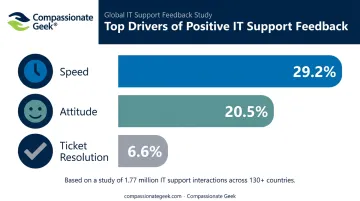
A large-scale employee experience study analyzing 1.77 million responses across more than 130 countries found that speed accounted for 29.2% of positive incident feedback and attitude accounted for 20.5%, while simply solving the ticket only drove 6.6% of positive feedback. In other words, how IT solves the problem matters almost as much as solving it at all.
This is why IT customer service is both proactive and reactive:
- Proactive: onboarding new hires, training users on tools, communicating planned outages ahead of time
- Reactive: fixing what's already broken
Pure technical support, by contrast, is almost entirely reactive. It waits for something to fail.
IT Customer Service vs. Customer Support vs. Technical Support
These three terms get used interchangeably, but they describe different scopes of interaction. Confusing them is a common reason companies under-invest in soft-skills training — they assume "support" and "service" mean the same thing, so they only train for the technical piece.
IT Customer Service: The Full Experience
This is the overarching, relationship-focused layer. It covers communication style, follow-up, tone, and how a user feels about interacting with IT overall, across every ticket, every call, every email.
IT Customer Support: Task-Oriented Problem Solving
Narrower and more reactive. This is resolving a defined issue (a password reset, a printer error, a software glitch) efficiently and accurately. It's transactional by design.
Technical Support: Specialized, Complex Troubleshooting
The most specialized tier. This handles server errors, network failures, security incidents, or escalated issues that require deep technical expertise, often beyond what a first-line help desk can resolve.
| Layer | Scope | Primary Focus | Example Scenario |
|---|---|---|---|
| IT Customer Service | Entire relationship | Communication, trust, experience | User leaves every interaction feeling heard, regardless of outcome |
| IT Customer Support | Single task | Speed and accuracy | Resetting a locked account in under five minutes |
| Technical Support | Complex/escalated issue | Deep technical expertise | Diagnosing a recurring network outage across multiple sites |
The Five Core Principles of Exceptional IT Customer Service
Compassionate Geek built its training around what it calls the Five Principles: Competence, Compassion, Empathy, Listening, and Respect. Together, they form the foundation separating average IT support from genuinely effective service.
Competence
Technical mastery is the baseline. Users trust IT more when a problem gets solved correctly the first time, without three follow-up calls.
This ties directly to First Contact Resolution (FCR), the percentage of issues resolved during a user's initial contact, without escalation. According to industry benchmarking from MetricNet, average net FCR sits around 74%, with top performers reaching into the 90s. Falling well below that range often signals skills gaps, not just process problems.
Compassion and Empathy
These sound similar but aren't the same thing:
- Compassion is caring about someone's situation and acting to reduce their distress, such as picking up a task for an overwhelmed teammate
- Empathy is understanding someone's frustration, even if you don't fully agree with their reaction
Both matter when a user is stressed about a deadline and a broken laptop. Compassion drives you to help faster; empathy helps you respond without getting defensive.
Active Listening
Truly hearing a user's issue, rather than assuming you already know it, prevents miscommunication and repeat tickets. A technician who interrupts halfway through a description and jumps to a familiar fix often ends up treating the wrong symptom. The user has to call back, frustrated, explaining the same problem twice.
Respect
Respecting a user's time, knowledge level, and frustration, no matter how basic the issue seems, builds long-term trust. Sighing at a "simple" password question or using jargon to sound smarter than the user only damages the relationship. Respect is what keeps interactions from turning defensive on either side.
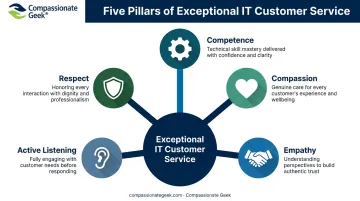
Compassionate Geek's training programs and Certified Company program are built specifically around these five principles, giving IT teams and MSPs a structured way to formalize this approach across an entire organization rather than leaving it to individual personality.
Common Channels for Delivering IT Customer Service
Users expect help wherever they already are. The most common channels include:
- Phone — best for urgent or complex issues needing real-time back-and-forth
- Email/ticketing systems — ideal for non-urgent requests with documentation trails
- Live chat — fast for quick questions without needing a call
- On-site visits — necessary for hardware issues or highly sensitive problems
- Remote desktop support — efficient for software fixes without physical presence
- Self-service knowledge bases — best for repetitive how-to questions
AI chatbots and automated workflows are increasingly handling routine requests like password resets and status checks. HDI research found 19% of support organizations were already using generative AI, with 41% planning deployment. But complex or emotionally charged issues still need a human.
Offering multiple channels improves accessibility. Consistency in tone and quality across all of them is what drives satisfaction.
Why Strong IT Customer Service Matters for Business
Every unresolved issue or poor interaction costs employees working time. A separate industry analysis found employees perceive an average of 3 hours and 18 minutes of lost productivity per IT incident. Multiply that across a workforce, and the hours add up fast.
There's a trust dimension too: in a survey of 1,000 IT workers, 93% said slow incident response can damage IT's internal reputation. Consistent, compassionate service builds the kind of trust that reduces shadow IT — where frustrated employees quietly find their own workarounds instead of calling for help.
For MSPs, this matters even more:
- Technical capabilities between providers often look similar on paper
- Clients notice urgency, empathy, and whether they feel valued
- Poor phone skills alone have gotten MSPs fired, even when the technical work was solid
For MSPs, superior IT customer service is frequently the actual reason clients stay or leave.
Best Practices to Strengthen Your IT Team's Customer Service Skills
Soft skills rarely develop naturally on the job. Combining technical training with structured communication, active listening, and conflict resolution training gets better, faster results than hoping people figure it out through experience.
Practical steps that make a difference:
- Run structured soft-skills training alongside technical certifications, not instead of them
- Use feedback loops — post-ticket surveys or CSAT scores — to catch where interactions break down, not just whether tickets got closed
- Invest in ongoing development. Compassionate Geek's on-demand IT customer service courses and Certified Company program give teams and MSPs a consistent way to build these skills at scale
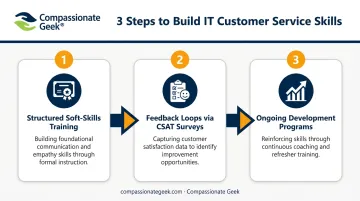
Those feedback loops reveal more than tickets closed. Resolution speed is only half the story — how people felt about the outcome matters just as much.
Frequently Asked Questions
What is 24/7 technical support?
It's round-the-clock availability of technical assistance, typically used for mission-critical systems that can't tolerate downtime. Even 24/7 support benefits from staff trained in compassionate communication, not just fast technical response.
How do I talk to customer service support?
Clearly describe the issue, its impact on your work, and any error messages you're seeing. Being specific and patient helps IT support diagnose and resolve the problem faster.
What is the difference between IT customer service and IT technical support?
IT customer service is the broader, relationship-focused experience covering communication and trust across every interaction. Technical support is the specialized, reactive resolution of complex technical issues like server or network failures.
What skills do IT customer service professionals need most?
A blend of technical competence with communication, empathy, active listening, and patience. Technical skill without people skills creates a career ceiling; people skills without technical knowledge erode credibility.
How is success in IT customer service typically measured?
Common metrics include First Contact Resolution (FCR), Customer Satisfaction Score (CSAT), and average resolution time. The best programs track all three together, not just one in isolation.
Why is empathy so important in IT customer service?
Users experiencing technical problems are often frustrated or anxious, especially when work is on the line. Empathetic communication reduces tension and builds trust, even when a fix takes longer than anyone wants.