Introduction
Help desk work looks nothing like it did five years ago. AI now triages tickets before a human ever sees them, chatbots handle routine password resets, and end users expect fixes faster than ever. Many technicians still assume strong technical chops are enough to stay ahead.
That assumption is starting to cost people their next promotion, if not their job.
Employers are hiring for a different mix now: technical fluency, yes, but also communication, judgment, and emotional intelligence. Someone who can fix a server but can't calm down a frustrated department head will hit a career ceiling fast.
This guide breaks down the specific technical, human, and AI-era skills help desk technicians need heading into 2026, along with how to build each one.
Key Takeaways
- Help desk skills now span three categories: technical, interpersonal, and business awareness
- AI and automation literacy is becoming a baseline expectation, not optional
- Industry analysts increasingly rank empathy and communication above raw technical skill
- Certifications like CompTIA A+ build technical credibility, while programs like Compassionate Geek build the soft skills to match
- Technicians who build soft skills alongside technical ones advance faster past entry-level roles
Overview of the Help Desk Technician Role Heading into 2026
The help desk technician is the first point of contact for anyone struggling with technology at work. That part hasn't changed. What has changed is the expectation: instead of just closing tickets, technicians are now expected to prevent problems and keep the business moving.
The job market reflects that shift. Computer support specialists earned a median salary of $60,340 in May 2024, according to the Bureau of Labor Statistics. Roughly 50,500 openings are expected annually through 2034, with most coming from people moving into new roles rather than pure growth.
That's a lot of turnover, and a lot of opportunity for technicians who stand out.
The sections below cover the full picture: the technical foundation, the new AI-era additions, and the human-centered abilities that increasingly separate technicians who get promoted from those who plateau.
Top Help Desk Technician Skills for 2026
These skills were chosen based on three factors chosen based on three factorsThree factors determined this list: how often employers ask for them, how resistant they are to automation, and how much they influence career growth beyond the help desk.
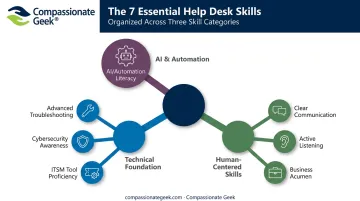
AI and Automation Literacy
AI-powered ticket triage, chatbots, and self-service portals aren't experimental anymore. They're becoming standard equipment. Technicians who understand how these tools work, and where they still fall short, will end up directing the AI instead of competing with it.
HDI's 2024 survey of technical support organizations found that 19% had already implemented generative AI, with another 41% planning deployment within the year.
| Skill Aspect | Details |
|---|---|
| What It Involves | Understanding how AI-enabled ticketing and diagnostic tools function, and recognizing where human judgment is still required |
| Why It Matters in 2026 | Support organizations are adopting generative AI quickly; technicians who can't work alongside it risk falling behind those who can |
| How to Build It | Take an introductory AI or automation course, and practice using the AI features already built into your ITSM platform |
Advanced Troubleshooting and Technical Diagnostics
Smarter tools don't remove the need for structured troubleshooting. If anything, they raise the bar. The easy tickets get automated away, leaving technicians with the harder, more ambiguous ones.
| Skill Aspect | Details |
|---|---|
| What It Involves | Diagnosing hardware, software, and network issues through a logical, repeatable process rather than guesswork |
| Why It Matters in 2026 | Faster root-cause identification protects end-user productivity and keeps the business running without interruption |
| How to Build It | Practice root cause analysis on real tickets, and pursue a foundational certification like CompTIA A+ |
Cybersecurity Awareness
Help desks sit on the front line of social engineering, and attackers know it. In 2024, the Department of Health and Human Services documented attackers impersonating employees to convince help desk staff to reset passwords and enroll new devices for multi-factor authentication.
| Skill Aspect | Details |
|---|---|
| What It Involves | Spotting phishing attempts, enforcing password hygiene, and understanding basic data protection practices |
| Why It Matters in 2026 | Help desk staff are often the first, and sometimes only, line of defense against social-engineering attacks |
| How to Build It | Complete cybersecurity awareness training and stay current on evolving attack patterns, especially identity-verification scams |
ITSM and Ticketing Tool Proficiency
Fluency in your organization's ticketing platform is essential now. Knowing how to navigate knowledge bases, automated triage queues, and reporting dashboards efficiently is what separates a fast resolution from a frustrating one.
| Skill Aspect | Details |
|---|---|
| What It Involves | Navigating ticketing systems, knowledge bases, and reporting dashboards without wasted clicks |
| Why It Matters in 2026 | Efficient tool use shortens handling time and supports better SLA compliance across the team |
| How to Build It | Get hands-on practice with your team's platform, and pursue ITIL Foundation training for broader context |
Clear Communication (Translating Tech to Non-Tech)
Ask any veteran technician what separates a good help desk from a great one, and jargon-free communication comes up almost every time. A frustrated user doesn't need a lecture on DNS propagation. They need to know when their email will work again.
| Skill Aspect | Details |
|---|---|
| What It Involves | Explaining solutions in plain language, verbally and in writing, without sounding condescending |
| Why It Matters in 2026 | Directly shapes end-user satisfaction and how the IT department is perceived across the business |
| How to Build It | Practice explaining fixes out loud during calls, and ask peers or supervisors for honest feedback |
Active Listening and Patience
Jumping to a solution before fully understanding the problem is one of the most common, and costly, mistakes on a help desk. It leads to repeat tickets, frustrated users, and wasted time on both sides.
| Skill Aspect | Details |
|---|---|
| What It Involves | Asking clarifying questions and repeating back what the user said to confirm understanding |
| Why It Matters in 2026 | Reduces misdiagnosis and repeat contacts, which directly improves first-call resolution rates |
| How to Build It | Practice paraphrasing on every call, and review recorded interactions to spot improvement areas |
Business Acumen and Organizational Awareness
Not every ticket carries the same weight. A jammed printer in an empty conference room isn't the same as a CRM outage during month-end close. Technicians who understand the business behind the ticket prioritize better.
| Skill Aspect | Details |
|---|---|
| What It Involves | Knowing key departments, workflows, and how specific IT issues affect revenue or productivity |
| Why It Matters in 2026 | Enables smarter prioritization beyond rigid scripts, aligning support work with actual business value |
| How to Build It | Shadow other departments occasionally, and ask context questions on every ticket you handle |
Why Compassion and Emotional Intelligence Are the #1 Differentiator in 2026
Most technical problems can be looked up. A broken trust relationship with a frustrated end user cannot. Technical knowledge is available to anyone with a search engine—making someone feel heard is not.
ITIL 4 ties service quality directly to the strength of the service relationship, not just resolution speed. In practice, a technician who listens well and communicates with patience prevents complaints before they start, rather than cleaning them up afterward.
Don R. Crawley, founder of Compassionate Geek, built an entire framework around this idea. His five core principles, Competence, Compassion, Empathy, Listening, and Respect, treat technical skill as the floor, not the ceiling. As Crawley puts it:
"Compassion doesn't mean you get a pass on your technical responsibilities... but that's just the start."
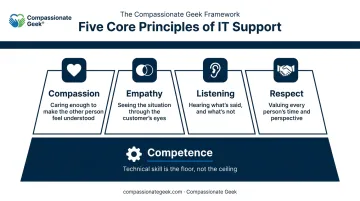
Crawley's material makes a sharper point too: teams rarely fail because someone lacked the right skillset. They fail because of how that skillset got communicated, or didn't. This points to a breakdown in communication and respect.
A compassion-first approach tends to pay off in specific, observable ways:
- Fewer escalations, because users feel heard on the first contact
- Lower repeat-ticket volume, since problems get correctly diagnosed the first time
- Stronger long-term trust in the IT function across the wider business
TeamLogic IT East Memphis put this into practice: the franchise made the training mandatory for its technicians and credits the combination of technical strength and compassionate service with helping it win new business.
How We Identified These Top Skills for 2026
We cross-referenced job posting trends, commentary from ITSM and IT career sources like HDI and PeopleCert, and current AI labor-market reports to identify skills with staying power, not just this year's buzzwords.
One pattern showed up repeatedly: technicians who over-invest in technical certifications while ignoring communication and emotional intelligence tend to stall at the entry level. Technical skill gets you in the door. Communication and judgment get you promoted past it.
We weighted these skills using three factors:
- Resistance to automation over the next several years
- Employer demand signals across current job postings
- Demonstrated impact on career mobility beyond the help desk
Conclusion
Thriving on the help desk in 2026 means blending three things: technical fluency, AI literacy, and human-centered service skills. None of these works particularly well alone anymore.
Take an honest look at your own skill gaps. Maybe you're technically sharp but stumble explaining fixes to non-technical users. Maybe you communicate well but haven't touched an AI-enabled ticketing tool yet. Either way, targeted training closes the gap faster than years of trial and error on the job.
That same principle holds at scale, too. If you're an IT manager building this out across a team, Compassionate Geek's training programs and certification are built specifically around compassion, empathy, and communication for IT professionals. They're not generic customer service scripts borrowed from retail or hospitality.
Frequently Asked Questions
How does a help desk improve customer service?
Help desks improve customer service by resolving issues quickly, communicating clearly throughout the process, and using empathy to reassure frustrated users. This combination builds trust and reduces repeat complaints.
What is the most important skill for a help desk technician to have in 2026?
Technical troubleshooting remains essential, but emotional intelligence and clear communication now drive career growth beyond entry-level roles.
Do help desk technicians need to know how to code?
Basic scripting knowledge can help with advanced troubleshooting and automation tasks, but it isn't mandatory for most entry-level help desk positions.
What certifications should I pursue to build help desk technician skills?
Compassionate Geek's IT customer service courses build the soft skills employers now expect, and pairing them with a foundational certification like CompTIA A+ or ITIL Foundation rounds out your technical credentials.
Is emotional intelligence really necessary for IT support roles?
Yes. It directly affects customer satisfaction, complaint reduction, and long-term trust in the IT function.
How can I quickly improve my help desk skills?
Review your own recorded calls, shadow high-performing peers, ask for regular feedback, and enroll in structured training to target specific gaps faster.