

This happens more often than most IT departments admit. Technicians get trained relentlessly on hard skills, certifications, and new platforms, while the mindset that actually drives satisfaction, loyalty, and career growth gets treated as an afterthought. Don Crawley, founder of Compassionate Geek, has spent years watching organizations excuse brilliant-but-abrasive technical staff simply because their skills were scarce. That excuse is running out of runway.
This post breaks down 10 practical tips for building a real customer service mindset, tips that matter whether you're a solo technician, part of an MSP team, or managing a help desk trying to reduce friction on both ends of the phone.
Key Takeaways
- Focus on the human need behind every request, not just closing the ticket
- Applies to external clients and coworkers alike, since employees are customers too
- Five core elements sustain it: competence, compassion, empathy, listening, and respect
- Building this mindset takes deliberate practice; good intentions alone won't do it
What Is a Customer-Focused Mindset?
A customer-focused mindset means consistently digging for the real need behind a request instead of stopping at the surface-level complaint. It's the difference between hearing "my email isn't working" and understanding that someone is about to miss a deadline because of it.
The contrast shows up clearly in daily behavior:
| Approach | What Happens |
|---|---|
| Transactional response | Fix the printer, close the ticket, move to the next queue item. |
| Mindset-driven response | Fix the printer, explain what caused it, tell the user what to watch for, and follow up to confirm it's holding. |
This gap matters more in IT than almost anywhere else. Technical jargon, time pressure, and stressed end users create distance fast. A technician focused only on the fix can leave a customer feeling processed rather than helped, even when the technical outcome is identical.
Why a Customer Service Mindset Matters for IT Professionals
IT work solves human problems through technology. The technology is the tool, not the point. Someone's ability to hit a deadline, feel confident using their tools, or trust the systems they depend on is the actual outcome.
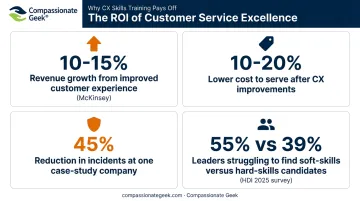
The business case backs this up. According to McKinsey's research on B2B customer experience transformations, companies saw 10-15% revenue growth and 10-20% lower cost to serve after improving CX, alongside stronger client-satisfaction scores.
One company in that research cut incidents by 45%, and the client renewed and expanded the contract specifically because of it.
The talent gap tells a similar story. In HDI's 2025 State of Tech Support survey, 55% of tech support leaders said finding candidates with adequate soft skills was harder than finding those with technical skills. Only 39% struggled with hard skills instead.
Empathy, communication, and collaboration now carry equal weight to troubleshooting ability.
For MSPs, the stakes are direct. Client retention often hinges on how support interactions feel, not just how fast tickets close. Technicians with strong interpersonal skills reduce internal friction, too, which matters just as much when the "customer" sits three desks away.
10 Tips for Developing a Customer Service Mindset
These tips aren't theoretical. They're behaviors technicians and support teams can start applying on their very next ticket.
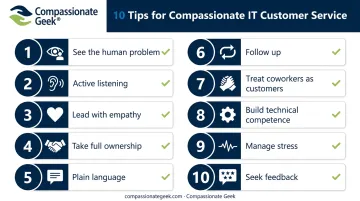
Tip 1: See Every Ticket as a Human Problem, Not Just a Technical One
Behind every request is someone experiencing frustration, urgency, or anxiety. Maybe their laptop crashed right before a client meeting. Your job is to solve for the person, not just the device. As Compassionate Geek's founding philosophy puts it: "You are not just solving technical problems, but human problems."
Tip 2: Practice Active Listening Before Jumping to Solutions
Pause. Let the user finish explaining before proposing a fix. Ask clarifying questions instead of assuming you already know the answer. This prevents misdiagnosis and, equally important, makes the customer feel heard rather than interrupted.
Tip 3: Lead With Empathy, Especially With Frustrated Users
Acknowledge the frustration out loud before troubleshooting begins. A simple line like "I understand why that's frustrating, let's work through this together" de-escalates tension fast. Skip this step and even a perfect technical fix can feel cold.
Tip 4: Take Full Ownership of the Issue
Avoid the "not my department" reflex. Following an issue through to resolution, even when it crosses team boundaries, builds trust and cuts down on repeat contacts. One Compassionate Geek case study involved a plugin issue that vendor support left unresolved for weeks, until a technician refused to let it go and tracked down the hidden setting personally.
Tip 5: Communicate in Plain Language, Not Jargon
Translate technical explanations into terms anyone can follow. Compare "your mailbox is corrupted due to a synchronization issue" to "there's a problem syncing your email, I'm going to fix it so your messages show up correctly." Same fix, completely different customer experience.
Tip 6: Follow Up to Confirm the Issue Is Truly Resolved
A quick check-in call or message shows commitment and catches problems before they turn into complaints. Don't assume a closed ticket means a solved problem.
Tip 7: Treat Internal Colleagues as Customers Too
IT doesn't just serve external clients; when departments across the company get the same diligence as paying customers, it strengthens culture and reduces friction. Poor internal communication makes coworkers hesitant to call IT the next time something breaks.
Tip 8: Keep Building Deep Technical Competence
Compassion without competence is empty reassurance. As the Compassionate Geek framework puts it: "No empathy or communication skills can compensate for lack of knowledge to solve technical problems." Ongoing skill development is what earns lasting trust.
Tip 9: Manage Your Own Stress and Emotional Reactions
High-pressure incidents test self-regulation. A large-scale analysis of over 78,000 workers found that emotional intelligence has a strong negative relationship with job stress, alongside positive links to job satisfaction and performance. Managing your own frustration keeps it from bleeding into customer interactions.
Tip 10: Seek Feedback and Keep Improving
Actively request feedback through surveys or post-ticket ratings, then act on what you hear. It signals that customer input genuinely shapes better service, not just a box to check.
The Five Core Principles Behind a Lasting Customer Service Mindset
Compassionate Geek's five-principle framework ties every tip above together:
- Competence: Technical skill builds the credibility customers need to trust your solutions. No amount of warmth substitutes for actually knowing your stuff.
- Compassion: Genuinely caring about the customer's experience, not just closing the ticket.
- Empathy: Putting yourself in the customer's shoes to understand what they're truly experiencing. This is what separates a technician who fixes problems from one who helps people.
- Listening: Giving full attention to what customers and colleagues are actually saying, not just waiting for your turn to speak.
- Respect: Treating every interaction, internal or external, with dignity.
Don Crawley's book The Compassionate Geek popularized this framework for IT professionals navigating both technical and human challenges. He often points back to a chief engineer he once worked alongside, brilliant with equipment, but so difficult that colleagues avoided him whenever possible.
Management excused it as "just how technical people are." That excuse doesn't hold up anymore, especially as technical knowledge itself becomes more commoditized.
Organizations can formalize this culture through the Compassionate Geek Certified Company program, which recognizes teams demonstrably committed to these five principles.
Building a Customer Service Mindset Culture Across Your Team
Individual effort only goes so far. Leadership has to model the mindset and reinforce it through hiring, training, and recognition, not just talk about it in a meeting once a year.
Practical ways to build it organization-wide:
- Role-play real scenarios. Teams internalize behaviors faster through practice than through reading alone. Rehearsing a frustrated-user scenario builds muscle memory for the real thing.
- Reinforce it in hiring. Screen for interpersonal skills alongside technical qualifications, not as an afterthought.
- Invest in structured training. Formal courses make the mindset consistent and measurable across an entire department or MSP, rather than dependent on individual personality.
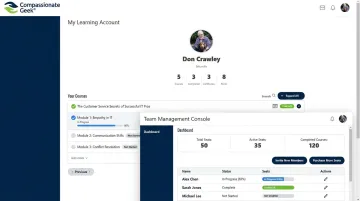
For example, Compassionate Geek's self-paced IT customer service course runs $299 per seat, with volume discounts available for teams of 500 or more. Organizations that purchase two or more seats also get a free Group Management Console to track progress across the team.
Frequently Asked Questions
What are the 7 principles of customer service?
No single authoritative list exists, but most frameworks emphasize competence, empathy, communication, ownership, patience, respect, and responsiveness. Compassionate Geek condenses these into five core principles specifically for IT teams.
What is a customer-focused mindset?
It's the habit of consistently prioritizing a customer's underlying needs and experience over simply completing a task or following a script. The goal is the outcome the customer actually needed, not just the box you checked.
How is a customer service mindset different for IT professionals?
IT pros must balance technical problem-solving with emotional support, since users often reach out stressed, confused, or under deadline pressure. The technical fix and the human reassurance both matter.
Can a customer service mindset be taught, or is it innate?
Some people lean naturally toward empathy, but specific behaviors—active listening, plain-language communication, follow-up habits—can be taught through training and repeated practice.
How do you measure a customer service mindset in employees?
Look at customer satisfaction scores, first-contact resolution rates, repeat or reopened ticket rates, and behavioral observations during interactions. No single metric proves mindset on its own; they need to move together.
What's the difference between a customer service mindset and a customer experience mindset?
A customer service mindset focuses on how individual interactions get handled. A customer experience mindset considers the entire journey across every touchpoint, of which service interactions are just one part.