Many technicians are brilliant with systems and hopeless with the person sitting in front of the broken system. A 2022 Freshworks survey found that 34% of employees cited extended IT response times as a top workplace technology complaint. One rough interaction can define how an entire department, or an entire MSP, gets perceived.
This guide covers the core principles behind great IT customer service, the daily habits that put them into practice, and a framework for handling clients when things get tense.
Key Takeaways
- Technical skill alone won't satisfy frustrated users; empathy and active listening close the gap
- Plain-language communication cuts down on rework and repeat tickets
- De-escalating angry clients works best with a repeatable framework, not gut instinct
- Customer-first culture needs training and metrics, not just good intentions from individuals
Why Customer Service Skills Matter More in IT Than Ever
For most employees, IT support is the only direct, human interaction they have with "technology" as a concept. When that interaction goes badly, it doesn't just color their opinion of the help desk. It colors their opinion of the whole organization.
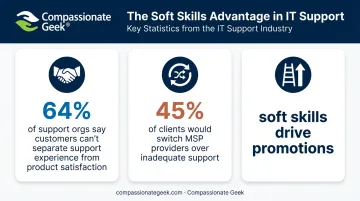
HDI's research backs this up: 64% of customer technical-support organizations say it's genuinely difficult for their customers to separate satisfaction with the support experience from satisfaction with the product or service itself. In other words, your delivery becomes the product.
The Stakes Are Higher for MSPs
For managed service providers, that perception problem is also a revenue problem. Clients typically assume competence going in. What determines whether they renew is how it feels to work with your team.
A 2025 Barracuda survey of 2,000 security decision-makers found that 45% would switch MSP providers if their current one couldn't clearly demonstrate the skills and support needed around the clock. That's nearly half your client base at risk, driven by confidence in support quality, not just technical output.
The Career Argument
Technicians who pair technical depth with soft skills tend to move up faster. It makes sense: managers promote people who make clients (and coworkers) feel handled well, not just people who close tickets fast. IT work is fundamentally about solving human problems, so a technician's people skills often carry more weight in promotion decisions than their ticket-closing speed.
The 5 Core Principles of Exceptional IT Customer Service
Compassionate Geek's founder, Don R. Crawley, built his entire training philosophy around five principles: Competence, Compassion, Empathy, Listening, and Respect. This isn't arbitrary. HDI's 2025 State of Tech Support research found that 55% of organizations struggled to find candidates with adequate soft skills, compared to just 39% citing gaps in hard skills — proof that interpersonal ability, not technical knowledge, is the harder hire.
Competence
Customers expect you to know their systems. But a technically correct answer delivered poorly still fails. Telling a stressed office manager "it's a DNS TTL caching issue on the client side" is accurate and useless at the same time. Without communication, competence is just correctness nobody can use.
Compassion
Compassion means caring about the person's experience, not just the ticket's status. A technician who takes an extra two minutes to walk a nervous, non-technical employee through what happened, rather than rushing to the next ticket, builds trust that outlasts the fix itself.
Empathy
Empathy is different from compassion. It's imagining what the customer is actually losing. A business owner facing a two-hour outage isn't annoyed about a server. They're watching revenue disappear. Saying "I understand this is costing you sales right now" reflects that reality back to them instead of treating the outage as an abstract technical event.
Listening
Active listening means restating the problem before jumping to a fix. Skipping this step is how technicians misdiagnose issues and waste troubleshooting cycles on the wrong problem. A simple "So what I'm hearing is X, is that right?" catches misunderstandings before they cost anyone time.
Respect
Respect means valuing the customer's time, intelligence, and sense of urgency, regardless of how "simple" the issue looks to you. What feels routine to a technician can feel like a crisis to the person experiencing it.
Essential Customer Service Tips for IT Professionals
The five principles above are the foundation. These are the daily habits that put them into action during real support interactions.
Communicate Clearly and Confirm Understanding
Skip "DNS propagation is still in progress." Try: "The fix is live, but it can take up to 24 hours to reach every device. You'll notice it work gradually." Same information, zero confusion.
Then confirm understanding before closing the ticket. Ask the customer to summarize the resolution or next steps in their own words. This simple habit catches miscommunication before it becomes a repeat ticket.
Set Realistic Expectations and Own What You Don't Know
Vague promises erode trust fast. Compare these two:
- ❌ "I'll get to it soon."
- ✅ "I'll have an update for you by 3 PM today."
Specific commitments, kept consistently, are what build a reputation, especially in dispatch and ticket-queue environments where customers can't see what's happening behind the scenes.
It's equally fine to say "I don't know," as long as you offer a plan. Guessing or stalling damages trust more than admitting a gap. "I'm not certain yet, but I'll research this and get back to you by end of day" builds more credibility than a confident-sounding wrong answer.
Document and Follow Up After Resolution
A short follow-up call or email after a fix, especially for recurring issues, shows the customer they weren't just a number. Good documentation also means they never have to explain the same problem twice.
How to Handle Tough Clients in the IT Industry
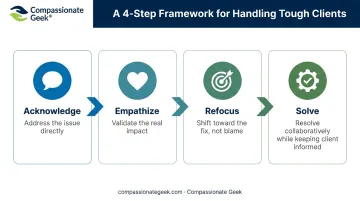
Even great technicians face angry clients. A repeatable framework beats improvisation every time. Here's the four-step approach:
- Acknowledge the issue directly instead of minimizing it or rushing past it
- Empathize with the real impact, such as lost productivity or a missed deadline
- Refocus the conversation on the fix, not the blame
- Solve collaboratively, keeping the client informed at each step
A Real Scenario: The Second Outage in One Month
Here's how this framework plays out when a client reports the same problem twice.
Poor response: "It's not our fault, your network setup is outdated." This deflects blame and instantly escalates frustration.
Better response: "I hear you. A second outage this month is unacceptable, and I know it's disrupted your team's work again. Let's get you back online, then I'll walk you through exactly what's causing this pattern and how we're fixing it for good."
That response works because it validates the client's frustration before moving toward a fix.
Separate the Frustration From the Person
Staying calm starts with a mindset shift. A client yelling about downtime is frustrated with the situation, not attacking the technician personally. Reacting defensively turns a solvable problem into a personal conflict. Staying emotionally regulated is what keeps the conversation productive.
Know When to Escalate
Some conversations still need extra support. If a client is too heated to move forward productively, loop in a supervisor or senior technician, framing it as getting them more resources, not passing them off. "I want to bring in our senior engineer so we can resolve this faster" feels like support, not dismissal.
Follow Up After the Conflict
Resolving the issue doesn't end the work. Once resolved, a brief follow-up confirms the client feels heard, not just serviced. This step is often skipped, and it's the one that rebuilds trust fastest.
Building a Customer-Centric Culture in Your IT Team or Organization
Individual effort only goes so far. Without training, coaching, and shared standards, good customer service depends entirely on which technician happens to answer the phone.
This is where structured programs matter. Compassionate Geek's on-demand courses and certification path, including the Compassionate Geek Certified Company program, help teams formalize a customer-first culture instead of leaving it to chance. The program has two tiers:
| Requirement | Green Certification | Silver Certification |
|---|---|---|
| Who completes training | All tech employees | All company employees |
| Leadership training required | No | Yes: Compassionate Leadership for IT Managers and Supervisors |
| Ongoing reinforcement (book clubs, video lectures, discussion groups) | Required | Required |
Certification formalizes the culture, but it doesn't prove the culture is actually working day to day.
Track What Actually Matters
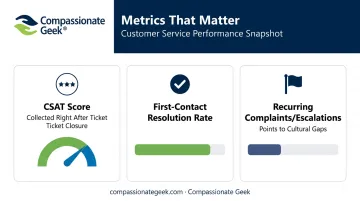
Ticket closure time alone doesn't tell you whether clients feel valued. Pair operational metrics with customer-facing ones:
- CSAT scores collected right after ticket closure
- First-contact resolution rate
- Recurring complaints or escalations, which often point to cultural gaps rather than technical ones
Teams that pair soft-skills training with technical work typically see CSAT scores climb within a few review cycles. The human side of IT is measurable, not just a nice sentiment.
Frequently Asked Questions
What are the top 3 skills for customer service?
Empathy, active listening, and clear communication consistently rank as the most critical skills — often above raw technical knowledge. These three form the backbone of Compassionate Geek's five-principle framework.
How to handle tough clients in IT industry?
Use a four-step approach: acknowledge the issue, empathize with its impact, refocus on the solution, and solve it collaboratively. Staying calm and separating the situation from a personal attack keeps the interaction productive.
What makes customer service in IT different from other industries?
IT professionals must translate technical concepts for non-technical users while often managing high-stress, business-critical situations like outages. Few other support roles combine that level of technical complexity with financial urgency.
How can I improve my customer service skills as an IT professional?
Practice active listening and plain-language communication deliberately, not just when things go wrong. Structured training, like Compassionate Geek's courses, helps turn these habits into consistent behavior.
What is the Compassionate Geek approach to IT customer service?
It's built on five principles: Competence, Compassion, Empathy, Listening, and Respect. The philosophy centers on solving human problems through technology, not just fixing systems.
How do you measure customer service success in IT support?
Track CSAT after ticket closure, first-contact resolution rate, and recurring complaint trends. Following up directly with clients after major interactions adds qualitative insight numbers alone can't capture.