
Introduction
A technician spends two hours untangling a network outage, restores service perfectly, then sends a one-line email: "Fixed. Router config was wrong." The user, who'd been locked out of payroll all morning, replies to their manager complaining about "another unhelpful IT interaction."
The fix was flawless. The communication wasn't.
This scenario plays out daily across help desks and IT departments. Technical competence gets you in the door, but it doesn't guarantee trust, buy-in, or a good review.
Employers have noticed. In Skillsoft's 2023 IT workforce survey of over 5,700 professionals, about 1 in 5 IT decision-makers ranked power skills like communication or leadership as the single most important attribute when evaluating job candidates — often above technical credentials alone.
This post breaks down what IT communication skills actually are, why they matter, the 10 skills that separate great IT pros from merely competent ones, the barriers getting in your way, and practical steps to close the gap.
Key Takeaways
- IT communication blends verbal, written, visual, and nonverbal channels with emotional intelligence and translation skills
- Strong communicators reduce rework, speed up project approval, and build lasting stakeholder trust
- Active listening, plain-language explanation, and empathy rank as top IT communication priorities
- IT communication skills develop through deliberate practice, feedback, and structured training
What Are IT Communication Skills?
IT communication skills are the ability to exchange technical and non-technical information clearly, accurately, and empathetically with colleagues, end users, and business stakeholders. That's a broader job than it sounds.
General workplace communication assumes both people share similar context. IT communication rarely gets that luxury. You might explain the same server issue to a fellow sysadmin, a marketing director, and a panicked employee who just lost three hours of work. Same underlying problem, three completely different conversations.
The skill is translating complexity into clarity without dumbing anything down or condescending to the listener.
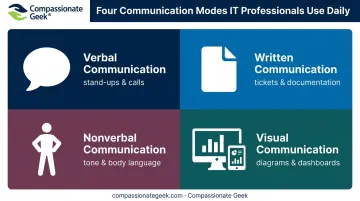
Types of Communication IT Professionals Use Daily
IT pros cycle through multiple communication modes, often within a single hour:
- Verbal communication: Stand-ups, troubleshooting calls, and client conversations where tone and pacing matter as much as content
- Written communication: Tickets, documentation, emails, and knowledge base articles that need to be accurate months later, not just understood in the moment
- Nonverbal communication: Body language and tone in video calls or in-person visits; crossed arms or a flat voice can undo an otherwise solid explanation
- Visual communication: Diagrams, screen-shares, and dashboards that let non-technical stakeholders "see" a problem instead of just hearing about it
Each mode requires different instincts. A written knowledge base article can be dense and precise. A support call with a frustrated user needs warmth first, precision second.
Why Communication Skills Matter for IT Professionals
Communication directly affects whether technical work gets funded, adopted, or trusted in the first place.
Getting projects approved depends on translation skill. Leadership doesn't fund "migrating to a containerized microservices architecture." They fund "reducing downtime and cutting infrastructure costs by 20%." IT staff who can make that translation secure budget and buy-in far more consistently than those who can't.
Poor communication also carries a measurable cost. A Harris Poll study conducted for Grammarly, surveying 251 business leaders and 1,001 knowledge workers at U.S. companies, found:
- 7.47 hours per week lost to poor communication per employee, roughly 19% of a 40-hour week
- $12,506 per employee annually in estimated productivity costs
- 39% of business leaders reported missed deadlines or extended project timelines
- 29% of knowledge workers struggled to understand their next steps or responsibilities
In IT specifically, this shows up as ticket escalations that didn't need to happen, rework from misunderstood requirements, and end users who stop trusting the help desk to actually help.
The 10 Most Important IT Communication Skills
These 10 skills split roughly into two categories: technical-translation ability and human/emotional skill. Both matter equally. A technician who's brilliant at simplifying jargon but tone-deaf toward a stressed user will still lose trust.
Active Listening
Fully focusing on the speaker, paraphrasing back what you heard, and asking clarifying questions before jumping to a fix. Skip this step and you risk solving the wrong problem entirely, a leading cause of avoidable rework.
Plain-Language Explanation
Translating "the DNS resolution is failing intermittently" into "your computer is having trouble finding the website: here's what's happening." The U.S. Bureau of Labor Statistics specifically notes that computer support specialists must explain solutions in terms a nontechnical person can understand.
Written Communication and Documentation
Clear, concise tickets and knowledge base articles aren't just professional courtesy: they're what the next technician relies on six months from now when the same issue resurfaces.
Nonverbal Communication and Body Language
Posture, eye contact, and facial expressions shape trust in face-to-face and video interactions. A distracted glance at a second monitor during a video call reads as disinterest, even if you're actually multitasking to help faster.
Emotional Intelligence
Self-awareness, self-regulation, and empathy let you read a user's frustration and adjust your approach before things escalate. Research on software teams found that practitioners who managed their own emotional responses maintained better team productivity during high-pressure changes.
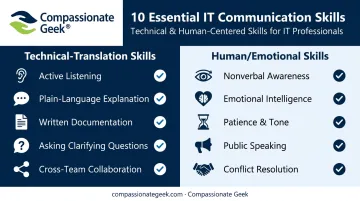
Patience and Tone Management
Staying calm and choosing supportive wording de-escalates tense calls. "I hear how frustrating this is, let's fix it together" lands very differently than "It's not that complicated."
Public Speaking and Presentation Skills
IT professionals increasingly present findings and recommendations to leadership and non-technical groups. This is no longer optional for anyone hoping to move beyond a purely technical track.
Conflict Resolution
Disagreements over priorities, timelines, or blame are inevitable on any team. Addressing them calmly and directly, instead of letting resentment build, preserves working relationships long-term.
Asking Clarifying Questions
"When you say it's slow, do you mean loading pages or opening files?" Targeted questions prevent assumptions that waste everyone's time.
Cross-Team and Stakeholder Collaboration
Talking fluently with finance, operations, and marketing helps align technology decisions with what the business actually needs, not just what's technically elegant.
Common Barriers to Effective IT Communication
Even skilled communicators run into structural obstacles. Three show up most often:
Technical jargon. Unexplained terminology alienates stakeholders and slows decisions. When a non-technical executive doesn't understand "the API rate limit," they can't approve the fix for it. They just stall.
Remote and hybrid work. Lost nonverbal cues and video lag increase miscommunication risk. Buffer's 2023 survey of 3,000 remote workers found 30% said collaboration was harder remotely than in-office. Owl Labs' 2024 research found 70% of hybrid meeting participants struggled to see or hear everyone clearly.
Heavy workloads. Under ticket-volume pressure, communication best practices are often the first thing cut. HDI's service desk analysis warns that optimizing purely for speed encourages analysts to close tickets fast rather than thoroughly. That pattern produces more repeat incidents and lower satisfaction, not less work overall.
How to Strengthen Your IT Communication Skills
Communication skills aren't fixed traits. They're built the same way technical skills are: through repetition, feedback, and structure.
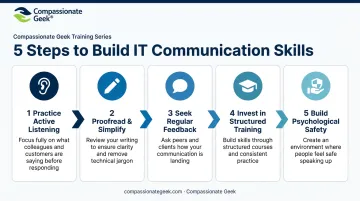
- Practice active listening deliberately. On every call or ticket, paraphrase back what the user said before responding. It confirms understanding and slows you down just enough to avoid assumptions.
- Proofread and simplify before sending. Read every ticket update and email once more, specifically hunting for jargon you can cut or replace.
- Seek regular feedback. Ask managers, peers, and even end users how clear and approachable your communication felt, not just whether the fix worked.
- Invest in structured training. Ad-hoc improvement only goes so far. Don R. Crawley built Compassionate Geek around five principles: Competence, Compassion, Empathy, Listening, and Respect. TeamLogic IT made the course mandatory network-wide, and owner Drayton Mayers credits it with winning business over weaker-service competitors.
- Build a culture of psychological safety. Team members need to feel safe asking "wait, what does that mean?" without looking incompetent. That openness prevents small misunderstandings from becoming expensive ones.
Group training options exist specifically because rolling this out to an entire team, not just one motivated technician, is what actually shifts an organization's service reputation.
Frequently Asked Questions
What are communication skills in IT?
IT communication skills are the ability to convey technical information clearly across verbal, written, nonverbal, and visual channels. They combine technical translation with emotional intelligence to reach audiences with varying technical literacy.
What are the 10 most important communication skills?
Active listening, plain-language explanation, written documentation, nonverbal awareness, emotional intelligence, patience, public speaking, conflict resolution, clarifying questions, and cross-team collaboration. See the detailed breakdown above for how each applies specifically to IT work.
How can IT professionals communicate better with non-technical people?
Avoid jargon, use everyday analogies instead of technical terms, and confirm understanding by asking the listener to summarize what they heard. Slowing down to check comprehension prevents far more rework than it costs in time.
Why is communication important for a career in IT?
Robert Half research found 74% of CIOs consider communication a top requirement for leading digital transformation, ahead of technical knowledge at 52%. Strong communicators get promoted faster and land more client-facing, leadership-track opportunities.
How does emotional intelligence relate to IT communication?
Emotional intelligence lets IT staff read a user's frustration or confusion and adjust tone and pacing accordingly. This self-awareness directly improves collaboration and outcomes during high-pressure situations, especially when users are frustrated or under deadline pressure.
How should IT staff handle communication with frustrated or angry users?
Stay calm, listen actively without interrupting, and acknowledge the user's frustration before moving into a technical explanation. Leading with empathy, even briefly, defuses tension faster than jumping straight to the fix.