A technician can restore a server in ten minutes flat and still leave a user feeling dismissed, rushed, or talked down to. That gap between technical competence and customer experience is where most service desk reputations are won or lost. Yet when leaders decide to fix it, the default move is often just "send everyone to a training."
That approach rarely works on its own. Results vary wildly depending on curriculum design, delivery format, and whether soft skills get taught with the same rigor as technical troubleshooting. This article covers whether formal training is the right move right now, what you need in place before you start, a step-by-step build process, the core skills that actually move the needle, and the mistakes that quietly sink well-funded programs.
Key Takeaways
- Great training pairs technical skills with communication and empathy practice.
- Skills stick through ongoing, spaced reinforcement, not a single onboarding session.
- The best programs start with real ticket data, not guesswork.
- Active listening and respect boost resolution speed and loyalty.
- Certification validates skills but should support hands-on coaching, not replace it.
How to Train Help Desk Staff for Better IT Customer Service
Building a training program that actually changes behavior takes more than a curriculum. It takes a process. Here's a four-step framework that works whether you're training two agents or two hundred.
Step 1: Assess Current Skill Gaps
Skip the guesswork. Pull hard data first:
- First contact resolution (FCR): industry benchmarks suggest a healthy FCR target sits between 70% and 80%, so anything well below that signals a training opportunity.
- Escalation and reopen rates — recurring escalations on the same issue type often point to a knowledge gap, not a system problem.
- CSAT and NPS scores — segment these by agent and ticket category to spot patterns.
Once you have the numbers, build a simple skills matrix. Rate each agent 1 to 3 on technical competence and 1 to 3 on customer-service competence. This two-axis view usually reveals something surprising: your strongest technical agent often isn't your strongest performer on satisfaction scores.
Don't stop at the numbers, though. Survey end users directly about tone, patience, and clarity. Ticket metrics tell you what happened. User feedback tells you how it felt.
Step 2: Design a Curriculum That Covers Both Technical and Human Skills
Structure your curriculum as two parallel tracks running side by side, not sequentially:
- Technical track: systems, tools, troubleshooting workflows specific to your environment.
- Human skills track: communication, empathy, conflict resolution, active listening.
A structured framework helps here rather than building from scratch. Compassionate Geek's five principles (Competence, Compassion, Empathy, Listening, and Respect) give trainers a consistent vocabulary for the human side of the job, so it doesn't get treated as an afterthought squeezed in after the "real" technical content.
Make the practice realistic. Use actual ticket transcripts and role-play scenarios featuring frustrated, confused, or anxious users instead of generic customer service theory.
A line like "Nothing ever works on this laptop!" needs a modeled response ready to go, something like: "It sounds like this has been going on for a while. Tell me what happened today." That's the kind of scripted practice that transfers to real calls.
Step 3: Deliver Training in Short, Practical Sessions
Long classroom sessions feel thorough but don't stick. Microlearning (short, focused 10 to 15 minute sessions) tends to hold attention better and fits around ticket queues instead of fighting them.
A blended delivery model works best:
- Live or virtual instructor-led sessions for complex or nuanced topics
- On-demand, self-paced content for flexibility across shifts and time zones
- Peer mentoring or "train-the-trainer" shadowing, pairing new agents with agents strong in a specific skill area
This mix matters because retention research on web-based versus classroom instruction shows online formats perform about 6% better for declarative knowledge, meaning facts, procedures, and terminology stick slightly better when delivered digitally, while live coaching still wins for behavior change and tone.
Step 4: Reinforce, Coach, and Measure Results
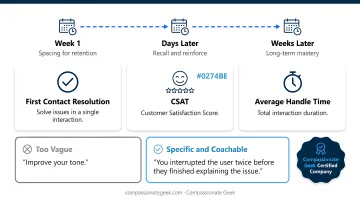
Training that ends after week one fades fast. Schedule spaced refreshers days and weeks later, because spacing out practice sessions measurably improves long-term retention compared to cramming everything into one sitting.
Tie every coaching session to a small, specific set of metrics:
- First contact resolution
- CSAT
- Average handle time
Use quality assurance reviews of real tickets and calls to give feedback tied directly to skills taught, not vague notes like "be nicer." Specific beats general every time: "You interrupted the user twice before they finished explaining the issue" is coachable. "Improve your tone" isn't.
Consider layering in a recognized certification, such as the Compassionate Geek Certified Company program, to formalize that customer-service standards are being met organization-wide. Certification works best as validation of skills already coached in, not a substitute for the coaching itself.
When Should You Invest in Formal Help Desk Training?
Training shouldn't run on autopilot or a fixed annual calendar. It should be triggered by specific signals.
Good reasons to invest right now:
- Onboarding a wave of new hires
- Rolling out new systems, tools, or ticketing platforms
- CSAT scores trending downward over consecutive quarters
- Escalation or reopen rates climbing without an obvious technical cause
- Scaling the team quickly and diluting institutional knowledge
When formal training is the wrong move:
- During a live outage or active crisis, when agents need to focus on resolving the issue
- When the real problem is missing or outdated documentation, not agent skill
- When leadership wants training as a symbolic gesture rather than a fix for a specific performance gap
That second point trips up a lot of organizations. If agents keep giving inconsistent answers because the knowledge base is three versions out of date, more training won't fix that. Fix the documentation first, then train.
What You Need Before Training Your Help Desk Team
Jumping straight into a curriculum without the right groundwork wastes time and budget. Two things need to be in place first.
Team and Leadership Readiness
Training competes directly with queue pressure. Without management buy-in protecting that time, sessions get skipped the moment ticket volume spikes.
- Secure explicit leadership commitment to protect training hours
- Designate a clear owner — a manager, senior agent, or external training partner — responsible for driving the program forward
- Communicate the training schedule early so agents can plan around ticket coverage instead of skipping sessions
Data and Content Inputs
Generic theory doesn't transfer well to specific work. Before building anything, gather:
- Ticket data covering the metrics outlined in Step 1
- An up-to-date knowledge base agents can reference during training
- Role cards or runbooks defining the scope of each position
This groundwork keeps training grounded in real work rather than abstract best practices. Once these pieces are in place, a licensed course or structured curriculum saves trainers from building content from scratch. Options include an individual course, a group seat license, or an on-demand portal.
Key Skills That Determine Training Success: The 5 Pillars of IT Customer Service
Not every training program produces the same results, even with similar time and budget invested. The difference usually comes down to which skills actually get reinforced. Technical checklists alone rarely move satisfaction scores.
This five-pillar framework, developed by Compassionate Geek and detailed in Don R. Crawley's book The Compassionate Geek, is used by organizations including TeamLogic IT to structure their curricula. Companies can formalize the approach further through the Compassionate Geek Certified Company program.
| Pillar | Why It Matters | Impact on Service |
|---|---|---|
| Competence | Technical accuracy builds trust and credibility | Fewer escalations and reopened tickets |
| Compassion | Users are often frustrated or embarrassed, not just filing a ticket | Defuses tension, lowers conflict |
| Empathy | Understanding context and urgency behind a request | Better first-response tone, perceived quality |
| Listening | Active listening prevents miscommunication | Higher first contact resolution |
| Respect | Every user deserves patience and dignity regardless of tech literacy | Builds loyalty, cuts formal complaints |
The correlation between these human factors and hard metrics isn't theoretical. CSAT scores consistently track with first contact resolution rates. Agents who listen carefully enough to solve problems on the first try also tend to score higher on satisfaction. Both outcomes stem from the same underlying skill: genuinely understanding what the user needs the first time they ask.
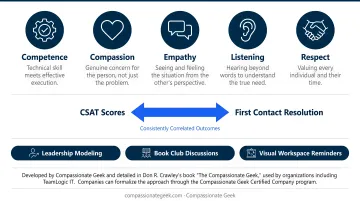
Companies formalizing this approach typically reinforce it through several channels:
- Leadership modeling that demonstrates the five pillars in daily interactions
- Book club discussions built around The Compassionate Geek
- Visual reminders posted directly in workspaces, including Compassionate Geek's free customer service posters built around these five principles
Common Mistakes When Training Help Desk Staff
Even well-funded programs stumble in predictable ways. Watch for these four:
- Treating training as a one-time event. Tools, policies, and ticket trends change constantly, so a single onboarding session can't keep pace. Training needs an ongoing cadence.
- Focusing exclusively on technical certification. Most customer complaints trace back to communication and tone, not broken systems. Ignoring soft skills leaves the biggest gap unaddressed.
- Skipping measurement entirely. Training without tracking FCR, CSAT, or reopen rate leaves you unable to prove impact or catch what isn't working.
- Overloading new hires in week one. Cramming every system, tool, and policy into the first days creates overwhelm, not confidence. Spread it out.
Frequently Asked Questions
How do you train help desk staff in technical skills and customer service?
Run parallel tracks — technical tool and system training alongside communication and empathy skills. Reinforce both with real ticket scenarios, role-play, and coaching tied to KPI data.
What qualifications are required for IT help desk staff?
Most roles expect an associate's or bachelor's degree, or equivalent experience, plus certifications like CompTIA A+. Soft skills now carry roughly equal weight during hiring and training.
How long should help desk training take?
Onboarding typically runs one to two weeks, covering scope and shadowing. After that, ongoing microlearning and refreshers should continue on a monthly or quarterly cadence.
What certifications are best for IT help desk agents?
Technical options include CompTIA A+ and HDI-CSR. For customer-service-specific credentialing, the Compassionate Geek Certified Company program helps organizations formalize service standards.
How do you measure the success of help desk training?
Track first contact resolution, escalation rate, reopen rate, and CSAT or NPS at the category level before and after training. This isolates real impact from normal fluctuation.
Can small IT teams train help desk staff without a dedicated trainer or budget?
Yes. Peer or train-the-trainer models, a simple skills matrix, and short ticket debriefs substitute well for formal programs. Affordable, licensed on-demand courses can scale training without a large budget.