Introduction
It's 4:47 PM. Sarah's laptop just froze, and her presentation is due to the board at 5:00. She calls IT, hands shaking, voice tight with panic.
How the technician on the other end responds in the next thirty seconds matters just as much as whether they fix the laptop.
Most IT professionals train for years on networks, systems, and software. Almost none of that training covers how to handle a stressed, confused, or frustrated human being.
That gap has real consequences: a 2022 study by Lakeside Software found that 40% of workplace technology issues go unreported to IT — meaning employees would rather struggle silently than call support.
This guide breaks down what makes IT customer service different from every other kind of support, the five principles behind exceptional service, and the daily habits your team can start using this week.
Key Takeaways
- Technical fixes aren't enough — users judge support by how they're treated.
- Five principles drive great IT service: Competence, Compassion, Empathy, Listening, and Respect
- Plain-language communication and honest timelines build trust faster than technical accuracy.
- Proactive updates and closed-loop follow-ups prevent repeat tickets and rebuild confidence.
- Tracking first-contact resolution, resolution time, and CSAT turns managers into coaches, not critics.
Why IT Customer Service Is Fundamentally Different
Retail customers browse. Restaurant guests relax. But when someone calls IT, they're usually already anxious. Their tech failure is blocking them from doing their actual job, whether that's closing a sale, hitting a deadline, or just getting through the day.
That anxiety changes everything about the interaction. A slow response doesn't just feel inconvenient. It feels like being ignored while their work grinds to a halt.
Beyond that frustration, IT staff also face a dual-skill challenge that few other support roles carry:
- Diagnose a technical problem that might involve dozens of interconnected systems
- Translate that diagnosis into language a non-technical person can understand, trust, and act on
Getting the first part right without the second often leaves users just as frustrated as before the call. This isn't a soft add-on to the job. IT workers themselves recognize the stakes: in a Vanson Bourne survey of 1,000 IT professionals, 93% said slow incident response can damage IT's internal reputation.
Don R. Crawley, founder of Compassionate Geek, built his entire training philosophy around this reality. As he puts it, IT professions "are not just about technology. They are about using technology to find creative solutions to complex human problems at work." Every principle covered below traces back to that idea.
The 5 Core Principles of Exceptional IT Customer Service
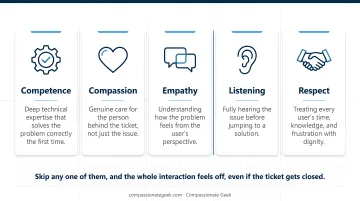
Compassionate Geek's framework identifies five pillars that separate forgettable IT support from support that builds lasting trust: Competence, Compassion, Empathy, Listening, and Respect. Skip any one of them, and the whole interaction feels off, even if the ticket gets closed.
Competence
Technical skill is the entry fee, not the differentiator. Users can't verify whether a technician understands the underlying architecture, but they can absolutely tell when a fix works, sticks, and doesn't require three follow-up calls.
Resolving problems on the first contact is one of the strongest available signals of competence. Service desks that consistently resolve issues on the first contact build trust quickly; desks that bounce users between escalations lose it just as fast. Weak technical follow-through erodes trust faster than almost anything else on this list.
Compassion
Getting the fix right is only half the job. Compassion means recognizing that what looks minor to a technician can feel like a genuine crisis to the person calling. A locked account an hour before payroll runs isn't "just a password reset" to the person locked out of it.
Compare these two openers:
- Dismissive: "It's probably just your password again."
- Compassionate: "That sounds stressful with payroll coming up. Let's get you back in right away."
Same fix. Completely different emotional experience for the user.
Empathy
Compassion acknowledges what someone is going through. Empathy goes a step further and actually connects with how they feel before jumping to a solution.
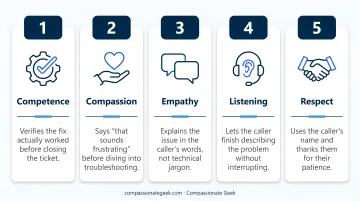
Compassionate Geek's training teaches technicians to validate the user's frustration before troubleshooting begins, using a simple line: "I understand why that's frustrating. Let's work through this together." That single sentence does two jobs at once. It addresses the emotional moment and signals partnership, so the user isn't left feeling alone with the problem.
Listening
Empathy only lands if the user believes you're actually paying attention. Active listening in IT support looks different from casual conversation. It requires deliberate restraint. Key techniques include:
- Letting the user finish describing the problem completely before jumping to a diagnosis
- Waiting for a natural pause before asking clarifying questions
- Summarizing what you heard and asking the user to confirm you got it right
- Listening without judgment, rather than mentally drafting a rebuttal
- Asking questions instead of making assumptions out loud
That third point, summarizing back what the user said, serves two purposes. It confirms understanding and makes the user feel genuinely heard, often before the technical work even starts.
Respect
Listening well sets up the final principle. Respect means never making someone feel foolish for not understanding technology they weren't trained to understand. Condescension shows up fast, even in well-intentioned phrasing.
- Condescending: "You just needed to restart it. That usually fixes everything."
- Respectful: "Thanks for your patience. Here's what we fixed and why it should stick."
The second version explains the outcome without implying the user should have known better.
Best Practices for Day-to-Day IT Support Interactions
These five principles only matter if they show up consistently in daily habits. Here's what that looks like on an actual help desk.
Communicate in Plain, Jargon-Free Language
Technical accuracy means nothing if the user can't act on it. Compare:
- Jargon-heavy: "Your DNS records haven't fully propagated yet, so you're hitting a stale cache."
- Plain language: "Your email changes are still updating across the internet. It should be working within a couple of hours."
Same information, but only one version leaves the user with something useful.
Set Realistic Expectations and Follow Through
Vague reassurances like "it'll be fixed soon" create more anxiety than a specific, honest timeline. Tell users what to expect and when, then update the ticket proactively instead of waiting for them to chase you.
A quick "still working on this, expect an update by 3 PM" message costs seconds and prevents a frustrated follow-up call an hour later.
Take Ownership and Aim for First-Contact Resolution
Bouncing users between tiers forces them to re-explain the same problem repeatedly, which is exhausting and erodes confidence in the whole department. Whenever possible:
- Own the ticket from intake through resolution
- Share context through unified tools so a second technician doesn't start from zero
- Escalate the problem, not the burden of re-explaining it
Be Proactive, Not Just Reactive
The best support interaction is the one that never has to happen. Monitoring systems that flag issues before users notice, advance outage notices, and self-service knowledge base articles all prevent tickets from being opened in the first place.
Many issues never surface through normal support channels, which is exactly why this proactive layer matters. Catching problems early closes that gap before it becomes a trust issue.
Close the Loop on Every Ticket
A short follow-up message, checking that the fix is still holding a day or two later, signals that the technician cared about the outcome, not just the ticket count. It's a small habit that separates transactional support from genuinely relational support.
Building a Customer-Centric Culture Across the IT Team
Individual good habits fade without reinforcement. A customer-centric culture needs training, coaching, and visible leadership modeling, because teams tend to mirror how their managers handle pressure and frustration.
Formal, structured programs help make this stick at scale, and Compassionate Geek's Certified Company program offers a way to formalize that commitment company-wide.
Tracking the right metrics also matters, as long as they're used to coach rather than criticize. Freshservice's 2024 benchmark report, drawn from more than 167 million tickets across 9,442 organizations, found industry averages of 73.9% first-contact resolution, 24.15 business hours average resolution time, and 97.4% ticket CSAT. Use figures like these as a baseline for coaching conversations:
- Is a technician's low FCR a training gap or a process bottleneck?
- Are resolution times slower because of complexity, or missing escalation paths?
- Does low CSAT correlate with specific ticket types worth investigating?
These numbers work best as a starting point for coaching, so dig into what's driving them before drawing conclusions.
Common IT Customer Service Mistakes to Avoid
Even well-meaning technicians fall into predictable traps. Watch for these three:
- Treating end users as an interruption. Some technicians view tickets as distractions from "real" technical work, but helping the end user is the job. Every ticket represents someone whose work is currently blocked.
- Over-explaining technical minutiae. Walking a stressed user through every diagnostic step rarely helps them. Focus on what they need to know to move forward, not everything the technician did to get there.
- Over-promising to calm someone down. Telling an upset user "it'll be fixed in ten minutes" feels good in the moment. When that deadline slips, and it often does, trust takes a bigger hit than an honest, longer timeline would have.
Frequently Asked Questions
What is IT customer service and why does it matter for IT teams?
IT customer service is the human side of technical support: how issues get communicated and handled, not just resolved. It directly shapes whether users trust IT, adopt new tools, and report problems instead of working around them.
What skills do IT professionals need to deliver excellent customer service?
Beyond technical competence, IT professionals need clear communication, active listening, empathy, and patience under pressure. These skills determine whether a technically correct fix actually feels helpful to the user.
What are the 5 principles of great IT customer service?
Competence, Compassion, Empathy, Listening, and Respect form the core framework behind consistently strong IT support. Each principle addresses a different part of the user experience, from technical trust to emotional validation.
How can IT teams balance fast technical fixes with genuine customer service?
Acknowledging a user's frustration takes just a few seconds and doesn't slow down troubleshooting. Lead with a validating phrase, then move efficiently into diagnosis and resolution.
How do you measure customer service performance in an IT support team?
Core IT-specific metrics include first-contact resolution rate, average resolution time, and ticket CSAT (customer satisfaction) scores. Track these over time and use them to identify coaching opportunities rather than to penalize individual technicians.
How can IT managers improve their team's customer service skills?
Ongoing soft-skills training, role-play coaching, and structured certification programs, such as Compassionate Geek's Certified Company program, help build habits that stick beyond a single workshop. Leadership modeling reinforces whatever gets trained.