Introduction
A client's server crashes at 4 p.m., hours before a major deadline. Their voice is tight, their patience is gone, and they need help now.
The technician on the line has two instinctive options: sympathize or empathize. Most reps don't even realize these are two different tools.
That distinction isn't academic. Contact-center satisfaction scores run 35% higher when customers perceive genuine agent empathy, according to SQM Group's research on agent empathy.
Get the response wrong, and a stressful ticket turns into an escalation. Nail it, and you build the kind of trust that keeps clients around for years.
This article breaks down what separates sympathy from empathy psychologically, when IT professionals should reach for each one, and how Compassionate Geek's five core service principles put the distinction into practice.
TL;DR
- Sympathy views feelings from the outside; empathy feels them from within
- Empathy walks a mile in someone's moccasins; sympathy just feels sorry for their feet
- Empathy builds deeper trust and loyalty; sympathy helps maintain healthy emotional boundaries
- Pairing empathy with technical competence resolves issues faster than sympathy alone
- Compassionate Geek teaches empathy as one of five traits that define great technicians
Sympathy vs Empathy: Quick Comparison
| Factor | Sympathy | Empathy |
|---|---|---|
| Core Focus | Acknowledging hardship, feeling concern from a distance | Actively imagining and sharing what the other person feels |
| Perspective | Your own lens and reaction | The other person's lens |
| Emotional Depth | Surface-level acknowledgment | Deep, immersive connection |
| Typical Response | "I'm sorry that happened." | "I understand how frustrating this must be — let's work through it together." |
| Risk if Overused | Can feel like pity or judgment | Can lead to empathy fatigue or burnout |
Neither response is wrong — a quick "I'm sorry that happened" can be exactly right for a minor hiccup, while a frustrated customer facing a major outage needs the deeper connection empathy provides.
Understanding Sympathy and Empathy
What is Sympathy?
Sympathy is feeling concern or sorrow for someone's situation without necessarily sharing or deeply understanding what they're experiencing. It's best understood as a heightened awareness of someone else's plight, viewed as a problem to acknowledge rather than an emotion to absorb.
In IT customer service, sympathy lets you recognize a customer's frustration over a broken VPN or a failed backup without needing to personally relate to their exact stress. That keeps interactions efficient, which matters when you're closing a routine ticket, not counseling a client through a crisis.
Sympathy works best for brief, transactional touchpoints:
- Ticket closure notes
- Formal apology emails after an outage
- First interactions with unfamiliar clients
Use Cases of Sympathy
Sympathy typically shows up early in a support workflow, as the initial acknowledgment before troubleshooting begins. Picture a technician sending a short note after a multi-hour outage: "I'm sorry this disrupted your team's day. Here's what we did to fix it." No shared personal experience required, just a respectful, human touch.
Brief acknowledgment matters more than people assume. A study of written apologies involving 755 participants found that acknowledging responsibility was the single most important component of an effective apology, ranking above requests for forgiveness or lengthy explanation (Ohio State University, 2016). A short, sincere sympathetic statement, delivered with ownership, does real work, even without deep emotional engagement.
What is Empathy?
Empathy is the ability to feel and understand another person's emotions from their point of view, actively imagining their experience rather than observing it from outside. This is why empathy sits at the center of Compassionate Geek's philosophy: IT work is about solving human problems, not just technical ones.
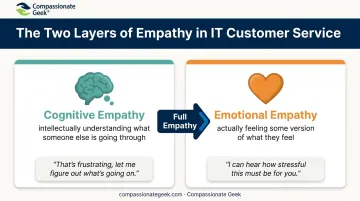
Psychologists split empathy into two layers:
- Cognitive empathy: intellectually understanding what someone else is going through
- Emotional empathy: actually feeling some version of what they feel
Compassionate Geek's training frames this in practical terms for technicians who can't always relate to the specific situation:
"Even when you can't relate to what happened with the other person, try to relate to their emotion... Remember how you felt at the time and know that your customer is feeling that way now."
You don't need to have crashed the same server. You just need to remember what frustration feels like.
Use Cases of Empathy
Empathy earns its keep in the moments sympathy can't touch:
- Escalated or angry tickets where the customer feels unheard
- Long-term MSP relationships where trust compounds over time
- High-stakes business disruptions: a healthcare IT outage delaying patient records, or a financial services system down during trading hours
These are situations where stress and trust both run high, and a generic "sorry about that" won't land.
The data backs this up. Researchers analyzing 289 stressful call-center interactions at a financial-services company found that simple affective statements like "I'm sorry" were less effective than attentive and cognitive empathic responses. Agents who demonstrated genuine understanding of the customer's specific situation earned better outcomes (Clark, Murfett, Rogers & Ang, 2013).
Combined with SQM Group's 35% CSAT gap for perceived empathy, the pattern is consistent: customers can tell the difference, and it changes how they rate the interaction.
Sympathy vs Empathy: Which Should IT Professionals Use?
The right choice depends on a few factors:
- Severity of the situation: a minor password reset doesn't need the same emotional investment as a business-halting outage
- Relationship depth: a one-off caller versus a five-year MSP client
- Time constraints: a queue of 40 tickets versus one urgent escalation
- What the customer actually needs: to feel understood, or simply acknowledged so they can move on
General rule: use sympathy for brief, low-stakes, or unfamiliar-client interactions where efficiency matters. Reserve empathy for escalated, high-stakes, or long-term relationship-building conversations.
There's a real cost to defaulting to empathy every time, though. Psychologist Paul Bloom has argued that fully absorbing someone else's distress can be exhausting and even counterproductive, leading helpers to avoid difficult situations rather than engage with them.
Bloom draws a useful distinction:
- Empathy means feeling another person's emotions as your own
- Compassion means caring about their wellbeing without absorbing the emotion itself
For technicians fielding escalation after escalation, leaning on compassion can be more sustainable than emotionally absorbing every angry call.
This is why Compassionate Geek treats empathy as one part of a five-principle framework: competence, compassion, empathy, active listening, and respect. Paired with technical competence and active listening, empathy becomes a functional tool for de-escalating tense situations and resolving them correctly the first time, rather than just an emotional drain.
Real-World Example: Empathy in Action During an IT Crisis
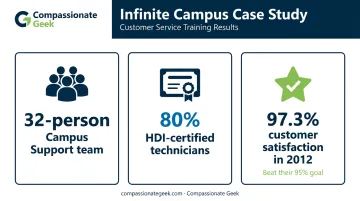
Infinite Campus, a company supporting school-district technology, ran a 32-person Campus Support team handling technical troubleshooting and guidance for districts nationwide. Leadership identified a gap: their team was strong technically but needed structured soft-skills development to match.
The team adopted formal soft-skills training through HDI, choosing a program built by trainers who understood technical support environments rather than generic customer service coaching. Roughly 80% of the team became HDI-certified.
The result: Infinite Campus reported 97.3% customer satisfaction for 2012, beating their own 95% goal (HDI Case Study: Infinite Campus).
The case doesn't isolate empathy training as the single cause. But it makes a broader point: teams that invest in emotional communication skills alongside technical ones consistently land above their satisfaction targets.
Technical fixes solve the problem, but empathy determines whether the customer feels valued afterward. A server that's back online at 2 a.m. still leaves a bad taste if the customer felt dismissed getting there.
If your team recognizes this gap, Compassionate Geek's IT customer service training builds these exact skills — competence, compassion, empathy, listening, and respect — into a practical curriculum for technicians and MSPs. Organizations that build a customer-focused culture around this framework can also pursue Compassionate Geek's Certified Company recognition, signaling that commitment to clients and partners.
Conclusion
Neither sympathy nor empathy is universally better. Sympathy keeps brief, low-stakes interactions efficient and respectful. Empathy builds the deeper trust needed for escalated tickets, high-stakes outages, and long-term client relationships. The real skill is recognizing, ticket by ticket, which approach the moment calls for, rather than locking into one permanently.
For IT teams, that judgment call translates directly into business outcomes: fewer complaints, stronger client retention, and smoother communication across the team. Technicians who know when to sympathize and when to empathize, and who pair that judgment with real technical competence, are the ones clients keep calling back.
Frequently Asked Questions
What is a real-life example of sympathy vs empathy?
A sympathetic response to a server outage might be "I'm sorry that happened." An empathetic response acknowledges the specific stress: "I can hear how urgent this is with your deadline today, so let's get you taken care of."
What are some examples of sympathy?
Sending condolences, saying "I feel for you," or expressing concern in a closing ticket note are all sympathetic responses. They acknowledge hardship without requiring deep personal understanding of the situation.
What are some examples of empathy?
Active listening, asking validating questions, and imagining yourself in the customer's exact situation before responding all demonstrate empathy. It goes beyond acknowledgment into genuine perspective-taking.
Is saying "I'm sorry" empathy or sympathy?
"I'm sorry" is typically sympathy: a brief acknowledgment from your own perspective. It becomes empathy only when followed by specific understanding of what the person is actually going through.
Which is more important in customer service, sympathy or empathy?
Both have value, but empathy tends to build stronger trust and loyalty, particularly in escalated or high-stakes support situations. Sympathy still matters for quick, low-stakes interactions.
Can you have both sympathy and empathy at the same time?
Yes. Most people lean toward one depending on their own experience with the situation, but a single interaction can include both: a sympathetic opening followed by an empathetic conversation.