What separates companies that keep customers from ones that lose them isn't whether conflict happens. It's how the team handles it. 43% of customers say they're at least somewhat likely to switch brands after just one negative customer-service interaction, according to a Qualtrics and ServiceNow study of over 1,000 US adults.
This article breaks down 12 practical conflict resolution strategies, explains how to pick the right one for each situation, and covers how to turn these skills into a lasting team habit — not a one-time training session.
Key Takeaways
- Conflict in customer service is unavoidable, but structured techniques make it manageable.
- Active listening, empathy, and a calm tone form the foundation of successful resolutions.
- Loyal customers often deserve accommodation, while abusive behavior deserves firm boundaries.
- Following up after a resolution matters just as much as the resolution itself.
- Team-wide training turns individual tactics into a consistent service culture.
What Is Conflict Resolution in Customer Service?
Conflict resolution in customer service refers to the specific techniques reps use to de-escalate tension and reach an outcome that satisfies the customer without violating company policy. It's a narrower skill than general customer service: it kicks in specifically when there's disagreement, frustration, or anger to work through.
This applies across every channel: phone calls, live chat, email threads, social media replies, and face-to-face interactions. A billing dispute over email requires the same core skills as an angry phone call, even though the tactics look different.
Why It Matters for Retention, Reputation, and Team Morale
Unresolved conflict drives customers away fast. But the reverse is also true: 78% of customers say they'll forgive a company's mistake if the service is excellent. That finding comes from Salesforce's State of the Connected Customer report, which surveyed over 15,000 consumers and business buyers worldwide.
Good conflict resolution also protects your team, not just your customer base. Repeated exposure to rude or abusive customer behavior is strongly linked to agent burnout, lower job satisfaction, and higher turnover intentions. That means better handling of conflict isn't just a retention play; it's a staffing cost saver too.
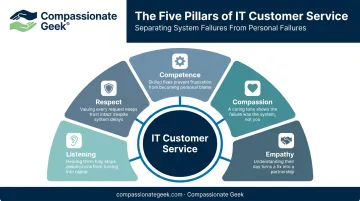
For IT support specifically, frustration is often aimed at the technology, not the technician. That distinction matters. Compassionate Geek's five-principle framework (Competence, Compassion, Empathy, Listening, and Respect) was built around this exact scenario, helping reps separate "the system failed" from "you failed me" so the interaction doesn't turn personal.
12 Conflict Resolution Strategies for Customer Service
These strategies build on each other, moving from immediate de-escalation to long-term trust-building. Some situations call for just one or two; heated conflicts often require several combined.
1. Let the Customer Fully Vent First
Interrupting an upset customer early almost always backfires: it signals you're not listening, which escalates the frustration further. Let them talk without interjecting, even if you already know the fix. Use that time to identify the real root issue, which is often different from the first complaint they voice.
2. Practice Active and Reflective Listening
Paraphrasing confirms you actually heard the problem. Try:
- "What I hear you saying is..."
- Brief verbal affirmations like "I see" or "That makes sense"
- Repeating back specific details (order numbers, dates, error messages)
This proves the customer is being heard, not just processed.
3. Stay Calm and Control Your Tone
Emotional tone spreads between people during a conversation, a phenomenon researchers call emotional contagion. A steady, measured voice tends to bring the temperature down; a defensive or clipped tone tends to raise it. Keep your pacing slow and your pitch even, especially in the first 30 seconds of a heated call.
4. Show Genuine Empathy, Not Just Sympathy
Empathy means putting yourself in the customer's place, not just acknowledging their problem exists. A scripted "I understand your frustration" often lands flat. A specific statement, such as "I can see how frustrating that must be, especially with a deadline coming up. Let's get this fixed," reads as authentic because it names the actual stakes.
5. Move Heated Conversations to a Private Channel
Public disputes (an open office, a visible chat thread, a social media comment section) intensify embarrassment and defensiveness on both sides. When things get heated in public, offer to move it: a private call, a DM, or a dedicated support ticket. It gives both parties room to de-escalate without an audience.
6. Apologize Sincerely When It's Warranted
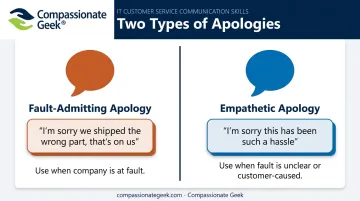
There's a difference between the two apology types:
- Fault-admitting apology: "I'm sorry we shipped the wrong part, that's on us."
- Empathetic apology: "I'm sorry this has been such a hassle for you," without admitting company error.
Use the first when your company is clearly at fault. Use the second when fault is unclear or lies with the customer, so you're not creating liability you don't need to.
7. Use Tactical Empathy to Label Emotions
Naming an emotion out loud tends to invite agreement rather than pushback. "It sounds like you're feeling let down by this" gives the customer space to say "yes, exactly" instead of continuing to escalate to prove their point. This labeling technique works especially well when a customer feels dismissed.
8. Find and State Common Ground
Shift the tone from adversarial to collaborative with statements like:
- "We both want this resolved as quickly as possible."
- "I can see you've been a loyal customer for years, and that matters here."
- "Let's figure out the fastest path to a fix together."
- "Your patience through this really does help us get it right."
Common ground reminds the customer you're on the same side, not opposing ones.
9. Offer Clear, Actionable Solutions or Choices
Three approaches work depending on the situation:
- Ask what resolution they want: appropriate when the fix is flexible and customer input builds buy-in.
- Offer two to three concrete options: appropriate when policy allows some flexibility but not full discretion.
- State the resolution directly: appropriate when policy is fixed and ambiguity would only cause more frustration.
10. Know When and How to Escalate
Setting a respectful boundary with an abusive customer protects your own wellbeing and your team's. If a customer crosses into abuse, it's reasonable to end the call and loop in a supervisor. When you escalate, brief the next person privately first; nobody wants to repeat their whole story from scratch to a stranger.
11. Set Clear Expectations and Timelines
Vague promises like "we'll look into it soon" tend to reignite the same conflict later, once the customer realizes "soon" meant nothing concrete. Give a specific timeframe and next step: "You'll get an update by Thursday at 3 PM" beats "we'll follow up" every time.
12. Follow Up to Confirm Resolution and Rebuild Trust
The interaction isn't over once the ticket closes. Follow-up tactics that reinforce loyalty include:
- A quick satisfaction survey
- A personal callback to confirm the fix held
- A small goodwill gesture for a serious inconvenience
- A brief note documenting what was resolved, for future reference
Skipping this step leaves customers uncertain whether anything was actually resolved.
How to Choose the Right Strategy for Each Situation
Not every strategy fits every conflict. Weigh these factors before picking your approach:
- Emotional intensity — a mildly annoyed customer needs less than a furious one.
- Fault — clear company error calls for a different tone than ambiguous or customer-caused issues.
- Urgency — a production outage needs faster action than a minor billing question.
- Channel — a phone call allows tone and pacing tools that chat and email don't.
The Thomas-Kilmann Conflict Mode Instrument identifies five approaches to conflict: competing, collaborating, compromising, avoiding, and accommodating, sorted by how assertive versus cooperative each response is, according to the official TKI framework.
Customer service leans heavily on collaborating and accommodating, though compromising shows up often in policy-flexible situations. Use this framework as a starting point for deciding how firm or flexible to be.
As a rule of thumb: accommodate loyal customers and ambiguous-fault situations. Set firmer boundaries for abusive or policy-violating behavior.
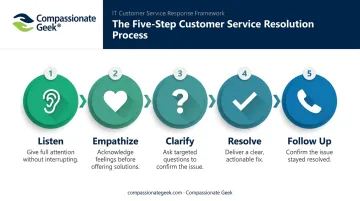
A simple mental checklist helps under pressure: listen, empathize, clarify, resolve, follow up. Running through those five steps automatically reduces the guesswork mid-conversation.
Common Mistakes That Undermine Conflict Resolution
- Matching the customer's energy: reacting defensively instead of staying neutral escalates instead of resolving.
- Over-promising to end the call fast: a promise you can't keep erodes trust worse than the original problem did.
- Skipping the follow-up: leaves the customer guessing whether the issue actually got fixed.
Building a Conflict-Resolution-Ready Support Team
Individual skill only goes so far. Without a shared framework, two agents on the same team can handle an identical complaint two completely different ways — and customers notice the inconsistency.
A documented conflict resolution process reduces that variability. Role-playing real scenarios during onboarding builds agent confidence before agents face a live, frustrated customer for the first time. Common scenarios worth rehearsing include:
- Billing disputes and unexpected charges
- Product or service failures
- Miscommunication between departments
This is where formal training earns its keep. Compassionate Geek built its self-paced IT Customer Service Training course specifically for IT support teams, where frustration is often aimed at the technology rather than the person on the call.
The course, along with the Compassionate Geek Certified Company program, formalizes five core principles into a measurable, repeatable service culture rather than a one-off workshop:
- Competence
- Compassion
- Empathy
- Listening
- Respect
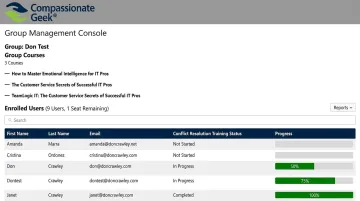
Beyond the course itself, teams purchasing group seats gain added visibility. The included Group Management Console lets managers track each agent's progress through training modules, ensuring consistency across the team rather than leaving it to chance.
Conclusion
Conflict in customer service isn't going away. Every channel, every industry, every team eventually deals with a frustrated customer. What changes the outcome is whether the response is structured or improvised.
These 12 strategies work best as a full service philosophy: listening first, empathizing genuinely, and following through with clear timelines and real follow-up. They aren't isolated tricks to pull out only when things get tense.
Investing in structured training, such as the IT-focused courses from Compassionate Geek, pays off in ways that compound. Expect fewer customers switching brands, less burnout on the front line, and a reputation that survives the occasional bad day.
Frequently Asked Questions
How do you resolve conflict in customer service?
Listen without interrupting, acknowledge the customer's feelings with genuine empathy, clarify the actual issue, offer a clear resolution, and follow up afterward. Skipping any step tends to leave the conflict half-resolved.
What are the 5 main conflict resolution strategies?
The Thomas-Kilmann model identifies competing, collaborating, compromising, avoiding, and accommodating as the five core styles. Customer service situations typically call for collaborating or accommodating over the other three.
What is the 10-5-3 rule in customer service?
It's a hospitality-derived engagement guideline: acknowledge a customer with eye contact at 10 feet, offer a verbal greeting at 5 feet, and engage in meaningful conversation at 3 feet.
Why is conflict resolution important in customer service?
It directly affects retention, brand reputation, and agent morale. Customers who feel dismissed are far more likely to switch to a competitor, and unresolved conflict wears down support teams over time.
What skills do customer service reps need for conflict resolution?
Active listening, empathy, emotional regulation, clear communication, and problem-solving form the core skill set, closely aligned with Compassionate Geek's five principles of Competence, Compassion, Empathy, Listening, and Respect.
How should you handle an angry customer who won't calm down?
Stay calm, use tactical empathy and emotion labeling, and set a respectful boundary if the behavior turns abusive. If it doesn't improve, escalate to a supervisor rather than absorbing the abuse indefinitely.