Introduction
Picture a 2026 support queue where AI has already handled the password resets, the status checks, and the "where's my order" questions. What's left for your human agents? The callers who are angry, anxious, or afraid they've lost critical data.
That's the reality reshaping de-escalation training — the structured practice of teaching reps to calmly defuse heightened customer emotions before they boil over. As automation absorbs routine tickets, the conversations reaching human agents are only getting harder.
Research shows the shift is already underway. According to McKinsey's analysis of contact centers across more than 30 organizations, even as AI expands, 50% to 60% of interactions remain transactional, while the rest demand real human judgment.
This article breaks down the five trends redefining de-escalation training in 2026, what's fueling them, how they're changing the industry, and where things head next.
Key Takeaways
- AI sentiment tools now coach agents flagging frustration in real time
- Simulation-based training is shortening new-hire ramp-up time
- Compassionate Geek's Green/Silver certification validates service culture
- QA scorecards blend sentiment data with CSAT to make coaching continuous
- Hybrid AI-human routing gives agents a higher share of tough calls
Key Trends Shaping Customer Service De-Escalation Training in 2026
Trend 1: AI-Powered Real-Time De-Escalation Coaching
Real-time agent-assist tools listen to live calls and chats, track tone and sentiment, and surface suggested phrasing the moment a conversation starts heading south. Instead of a supervisor eavesdropping on one call at a time, the software watches every interaction, every agent, every shift.
McKinsey's 2024 survey of more than 340 customer-care executives found 21% were already using AI tools to train or support staff — a number that's climbing fast as labor shortages make constant human supervision impossible.
Why this matters:
- Agents get in-the-moment coaching instead of feedback days later, since supervisors can't personally monitor hundreds of daily calls the way software can
- New agents lean on prompts while they build confidence
Every agent, not just the top performers, now gets a coach whispering in their ear when it counts. That support augments an agent's judgment rather than replacing it.
Trend 2: Immersive Simulation-Based Training Replaces Scripted Role-Play
Scripted role-play has a problem: real customers don't follow scripts. That's why organizations are shifting to AI-driven simulations where reps practice against unpredictable, emotionally volatile personas before they ever face a live customer.
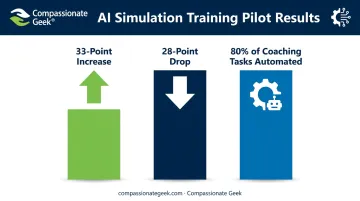
A McKinsey-documented pilot at a technical help desk built simulations from real call intents. The results were striking:
- A 33-percentage-point increase in positive interaction outcomes
- A 28-point drop in simulation interruptions (agents freezing or fumbling)
- Roughly 80% of coaching-onboarding tasks automated
Conventional new hires typically need four to six months to reach peak proficiency, according to McKinsey's analysis of contact-center training. Simulation training compresses that timeline substantially.
The payoff isn't just speed. Practicing tough conversations in a low-stakes sandbox builds the emotional muscle memory agents need before a real, upset customer is on the line.
Trend 3: De-Escalation Certification Becomes a Business Differentiator
Technical competence used to be the differentiator for IT service providers. Now it's assumed. What clients can't assume is that a team will handle a meltdown gracefully.
That's driving a shift from one-off workshops toward formal, credentialed programs. Compassionate Geek's own Certified Company program, launched in 2019, offers Green and Silver certification levels that validate an organization's commitment to compassionate, customer-focused service. The program is built around five core principles: competence, compassion, empathy, listening, and respect.
Employers increasingly want proof, not promises, that soft-skills training happened and stuck. For MSPs and IT departments competing on trust rather than just uptime, a certification badge becomes a tangible answer to "why should we choose you?"
Trend 4: Data-Driven, Continuous Coaching Loops
Annual reviews are too slow for a skill like de-escalation. QA scorecards now blend AI sentiment analysis, call recordings, and CSAT/first-call-resolution data into ongoing, granular feedback loops.
Deutsche Telekom's personalized coaching engine, built with McKinsey/QuantumBlack and used by 8,000 field and call-center agents, shows what this looks like at scale:
- Net Promoter Score climbed 14 points
- First-time resolution improved 10% year-over-year
- Call transfers dropped 2%
The engine took a six-week diagnostic and a four-month build to launch, according to McKinsey's case study on Deutsche Telekom. That's a meaningful investment, but it turns empathy and tone into tracked KPIs instead of vague performance-review language.
Trend 5: Hybrid Human-AI Escalation Models
As AI takes over routine, low-emotion tickets, human agents are increasingly reserved for the messy, complex, emotionally charged cases. The same McKinsey research cited earlier found that 50% to 60% of interactions remain simple enough for automation, leaving humans to handle the harder residual workload.
This changes what de-escalation training needs to cover. Agents aren't practicing for an average day anymore; they're training for a day that's front-loaded with frustration.
- Escalation paths route emotionally flagged conversations to humans earlier
- Training shifts from broad coverage to deep, high-stakes scenario work
- Fewer, more highly skilled agents handle a denser mix of difficult calls
Fewer easy wins during a shift means every de-escalation skill an agent has needs to be sharper.
What's Driving These De-Escalation Training Trends
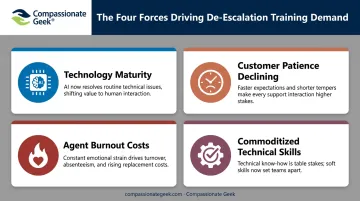
These shifts aren't happening in a vacuum. Four pressures are pushing them forward at once.
- Technology has caught up with the need. Generative AI and sentiment analytics have made real-time coaching and realistic simulation technically feasible at scale, something that wasn't practical five years ago.
- Customer patience is thinner than ever. Forrester's 2024 CX Index, based on more than 98,000 US customers across 223 brands, found customer experience quality at an all-time low after three straight years of decline. PwC's 2025 survey backs this up: 29% of consumers say they've stopped buying from a brand entirely because of poor experience.
- Burnout is a business cost. Difficult, emotionally draining calls contribute directly to agent turnover, a cost most contact centers can't absorb given current staffing pressures.
- Commoditized technical skill needs a new differentiator. When every provider claims strong troubleshooting, compassionate, de-escalation-ready service becomes the thing clients actually remember and refer.
How These Trends Are Impacting the Customer Service Industry
These trends are reshaping how support teams operate, invest, and hire, with effects showing up across three distinct areas.
Operational Impact
- AI-assist prompts and simulation modules are getting built directly into onboarding, not bolted on afterward
- Escalation workflows now loop humans in earlier when sentiment tools flag rising frustration
- Coaching has moved from a scheduled event to a running background process
Business Impact
Training budgets are moving away from one-time workshops. CIPD's 2023 survey of 1,108 organizations found 27% increased investment in learning technology, versus just 11% that cut back — a clear signal that continuous, tech-enabled soft-skills training is winning budget over one-and-done sessions.
Formal proof of culture matters here too. Programs like Compassionate Geek's Certified Company designation give organizations something concrete to point to in client proposals, beyond claiming good service.
Workforce Impact
Job postings for IT support and help desk roles increasingly list "emotional intelligence" and "de-escalation" right alongside technical certifications. That's a real shift from just a few years ago, when soft skills barely made it into the job description at all.
This same emphasis on human skills shows up in retention, too. Reduced burnout tends to follow structured coaching investment, since agents who feel equipped to handle hard calls report less exhaustion than those left to improvise under pressure.
Future Signals to Watch in De-Escalation Training
De-escalation training won't stand still. Here's what's worth watching over the next one to three years:
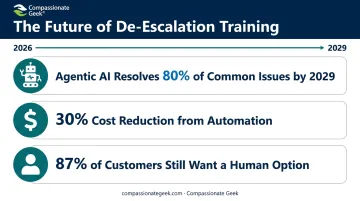
- Agentic AI handling more on its own. Gartner predicts agentic AI will autonomously resolve 80% of common customer-service issues by 2029, cutting costs by about 30%. Yet 87% of customers still want a human option, so training for tougher conversations matters more than ever.
- Earlier warning signals. Voice-stress and biometric sentiment analysis are being explored as a way to catch rising tension before a customer's tone noticeably shifts, though solid outcome data on this is still thin.
- Personalized, adaptive learning paths. Expect more multilingual, AI-driven microlearning that adjusts in real time to an individual agent's specific coaching gaps instead of delivering the same module to everyone.
Conclusion
AI-assisted coaching, immersive simulation, formal certification, continuous data-driven feedback, and hybrid escalation models are collectively raising the bar for de-escalation training in 2026. None of these trends work in isolation. They reinforce each other.
Given that synergy, organizations investing early gain a measurable edge in customer retention, agent retention, and brand reputation. The ones that treat de-escalation as a checkbox exercise will feel the gap widen.
Compassionate Geek's on-demand IT customer service training and Certified Company program give IT teams and MSPs a practical starting point for building this capability. There's no need to wait for a crisis to force the issue.
Frequently Asked Questions
What are the steps of de-escalation in customer service?
Stay calm, listen without interrupting, and validate the customer's feelings before problem-solving. Apologize for their experience, offer clear solutions or choices, and know when to loop in a supervisor.
What are the four C's of de-escalation?
There's no single industry-standard version of this framework, but it's commonly described as Calm, Connect, Communicate, and Collaborate. Each stage moves the conversation from managing emotion toward jointly finding a solution.
How long does de-escalation training typically take to show measurable results?
Most organizations notice CSAT or handling-time improvements within a few weeks of consistent coaching. The bigger factor is ongoing reinforcement, not the initial training session itself.
Can AI fully replace human agents in de-escalation situations?
No. AI handles low-emotion, routine issues well, but complex, high-emotion escalations still need human empathy and judgment. That's exactly why hybrid human-AI models are becoming standard.
What industries benefit most from de-escalation training in 2026?
IT and MSP support, healthcare, financial services, retail, and government all face frequent, high-stakes customer interactions. De-escalation skills matter across every one of these sectors, but IT and MSP teams face an added layer: solving a technical problem while managing the conflict at the same time.
How is de-escalation training different for IT support teams specifically?
IT professionals must troubleshoot a technical problem while managing a customer who's often already frustrated before the call even starts. Training has to blend technical clarity with compassion, since a customer who feels dismissed will remember that more than the fix itself.